

Hello All,
I hope you won't mind the question in English.
I am removing the plasterboard from the inside of our external walls. The external walls are made from 140 mm x 60 mm horizontal planks.
The insulation that was there was old and ineffective.
I was planning to install PIR insulation but I'm not sure what thickness to go with. One person said to me that around 60 mm would be enough.
I'd like to make the house much better in winter.
Would anyone have any thoughts on PIR thickness to use with that construction of external wall?
Thanks in advance
I hope you won't mind the question in English.
I am removing the plasterboard from the inside of our external walls. The external walls are made from 140 mm x 60 mm horizontal planks.
The insulation that was there was old and ineffective.
I was planning to install PIR insulation but I'm not sure what thickness to go with. One person said to me that around 60 mm would be enough.
I'd like to make the house much better in winter.
Would anyone have any thoughts on PIR thickness to use with that construction of external wall?
Thanks in advance
60 mm insulation of any kind will not give you a "Swedish house grade" insulation.I actually saw this, which looks promising:
https://www.recticelinsulation.com/sv/deck-vq
It claims 0,008 W/mK which would be extremely good. It is meant for roofing, but could probably be used in walls as well. It cannot be cut or drilled into though as it relies on vacuum. Having this board on the big surfaces and something else where you cannot use it could be a way forward if it can be used in walls at all.
PIR boards seem to have about 0,022 W/mK, which is good but 60 mm of that will not be sufficient if you want to save energy. Normal insulation has 0.038 W/mK and you often use 240 mm of that. The same grade of insulation would be achieved with 140 mm PIR.
Not about PIR, but general guidlines:
https://www.byggahus.se/isolera-med-ratt-tjocklek-och-metod
https://www.recticelinsulation.com/sv/deck-vq
It claims 0,008 W/mK which would be extremely good. It is meant for roofing, but could probably be used in walls as well. It cannot be cut or drilled into though as it relies on vacuum. Having this board on the big surfaces and something else where you cannot use it could be a way forward if it can be used in walls at all.
PIR boards seem to have about 0,022 W/mK, which is good but 60 mm of that will not be sufficient if you want to save energy. Normal insulation has 0.038 W/mK and you often use 240 mm of that. The same grade of insulation would be achieved with 140 mm PIR.
Not about PIR, but general guidlines:
https://www.byggahus.se/isolera-med-ratt-tjocklek-och-metod
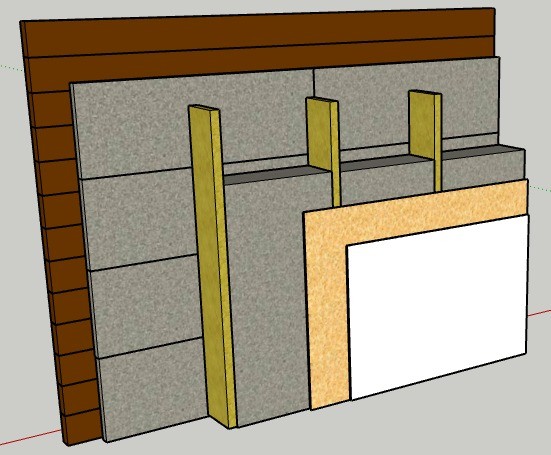
Thanks for your reply! you got me thinking more about overall thermal requirements. I also decided to do a cost analysis per square meter vs wall thickness. I hope I have found a better solution now which is MUCH cheaper than using PIR and overall the wall thickness isnt really impacted. I am thinking it will also help with the thremal bridge problem - I have attached a sketchup image I made. External wall, Stenull 45mm, Stenull 220mm, plywood 12mm and gips 13mm. I tried my best to calculate the thermal value (using something from kingspan) it came out at 7.32 overall at a cost of 325 kr per square meter compared with 851 kr per kvm for PIR with a U value of 6.11.F fb35523 skrev:60 mm insulation of any kind will not give you a "Swedish house grade" insulation.I actually saw this, which looks promising:
[länk]
It claims 0,008 W/mK which would be extremely good. It is meant for roofing, but could probably be used in walls as well. It cannot be cut or drilled into though as it relies on vacuum. Having this board on the big surfaces and something else where you cannot use it could be a way forward if it can be used in walls at all.
PIR boards seem to have about 0,022 W/mK, which is good but 60 mm of that will not be sufficient if you want to save energy. Normal insulation has 0.038 W/mK and you often use 240 mm of that. The same grade of insulation would be achieved with 140 mm PIR.
Not about PIR, but general guidlines:
[länk]
Does this make sense or am I missing the point?
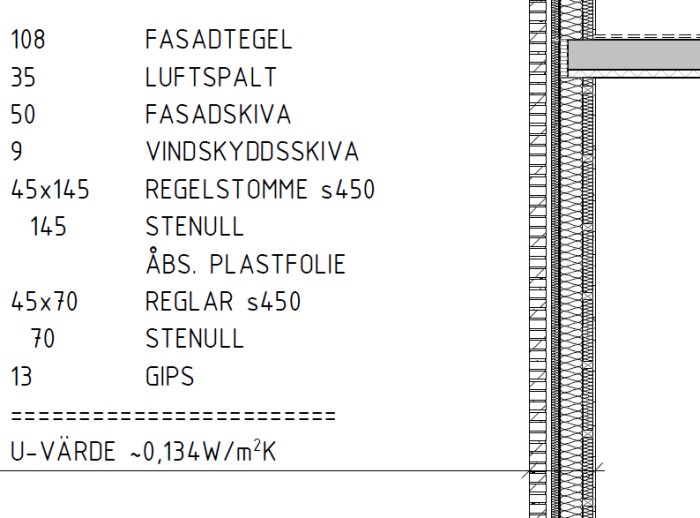
I would do it like this:
External wall, Windproofing?, Stenull 220mm,PLASTFOLIE, Stenull 45mm, plywood 12mm and gips 13mm.
That way you can have your electrics in the 45 mm without breaking the moisture barrier.
Somewhat like this:
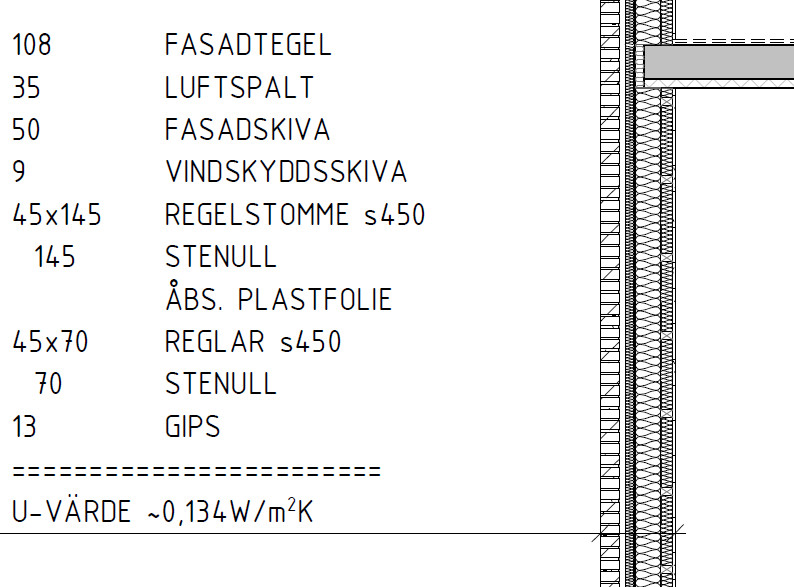
External wall, Windproofing?, Stenull 220mm,PLASTFOLIE, Stenull 45mm, plywood 12mm and gips 13mm.
That way you can have your electrics in the 45 mm without breaking the moisture barrier.
Somewhat like this:
Inloggade ser högupplösta bilder
Logga in
Skapa konto
Gratis och tar endast 30 sekunder

Please refer to Träguiden,
https://www.traguiden.se/konstruktion/konstruktionsexempel/vaggar/
The site is owned by Svenskt Trä, Swedish Wood and they have a bit of knowledge.
"Swedish Wood represents the Swedish sawmill industry and is part of the Swedish Forest Industries Federation."
https://www.swedishwood.com/
https://www.traguiden.se/konstruktion/konstruktionsexempel/vaggar/
The site is owned by Svenskt Trä, Swedish Wood and they have a bit of knowledge.
"Swedish Wood represents the Swedish sawmill industry and is part of the Swedish Forest Industries Federation."
https://www.swedishwood.com/
Excellent thanks! do you think that the 45 mm stenull needs to be cut to catch the underlying wooden studs or does that matter if the plywood is nailed over the top?B BjörnEng skrev:
Klicka här för att svara