"Okay, but can you build the lecastone after the roof as well?" Answer: Certainly, but the last layer might take a bit longer. You also need space for the scaffolding.
"How long must you wait before you can tile on the plaster or leca?" Answer: It mostly depends on the products used. It's difficult to give a general answer to this.
"Are there advantages and disadvantages to rolling a waterproof layer on the leca or the plaster?" Answer: Also product-dependent. It's difficult to give a general answer to this.
Of course, you can paint on plaster. There are several options, silicate paint or linseed oil paint. Never plastic paint (acrylic paint) on plaster ever. The reasonable thing is for the leca to be as high as the bricks, but maybe that's not enough? You need to make an accurate sectional drawing so you know how the roof trusses should look. I can't assess this without a drawing.
Now it got difficult, drawings are not really my thing. What is meant by a section drawing?
But the high post will meet the lecawall and the brick. Can one imagine bricking the leca up between the rafters and skipping the wall plate here, just using the wall plate on the brick in the outer wall?
A thought that came to mind is... Can I build leca blocks on top of the existing brick outer wall to raise it to "normal" wall height so I can avoid the slanted ceiling/wall and attachment issues with angles, and the collar beam can then rest on the wall plate and be attached with 90* angle brackets?
A sectional drawing is a cross-section in length or width of a building used to check various dimensions. Here, it's a cross-section I think you need to make. Your talk about sloping roofs made me unsure, but then you explained how it fits together. I definitely think you should raise the brick wall so that it reaches full ceiling height all the way. Then take into account the higher floor level that will result from the casting. It should be at least 230 cm. You can certainly use lecasten to raise the brick wall. Then build the leca slightly recessed from the brick wall so there is space for plaster on the outside.
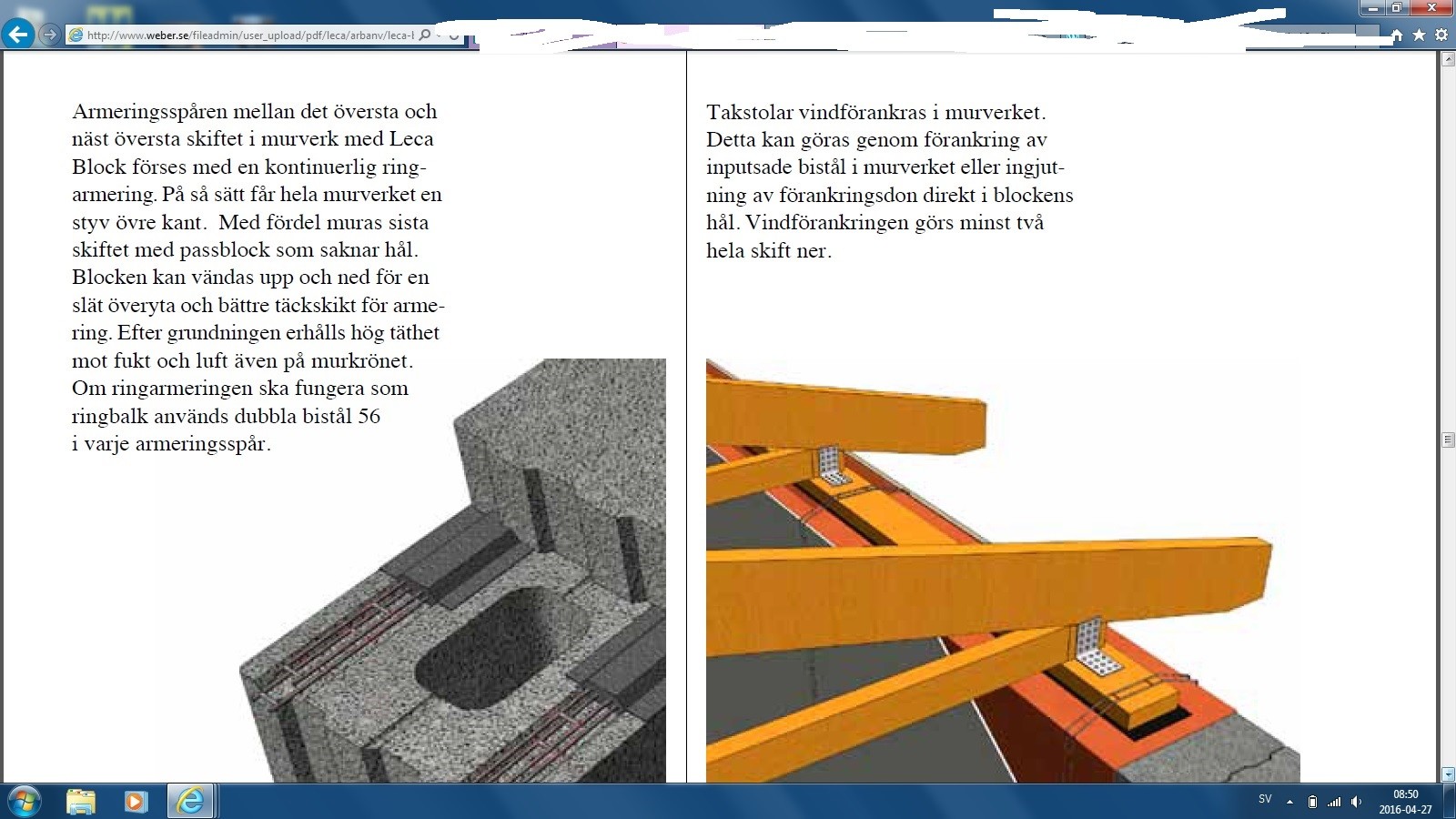
What should I consider at the joint between brick and leca? This attachment should be critical for the roof's wind capacity?
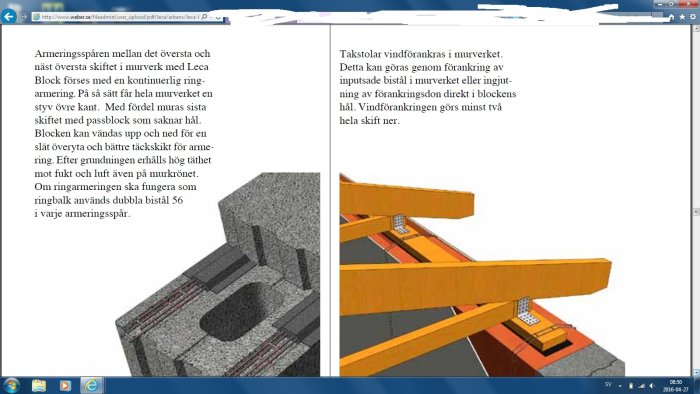
I see how they've made the attachment of the roof truss's collar beam here. How is the reinforcement steel actually attached? How would you have done it in my case? I really want it to be durable no matter the cost, want both belt and suspenders.
The rebar is probably embedded in a horizontal joint. To see what the joint between the existing brick and added leca can withstand in terms of lifting forces, you should probably check with the manufacturer of the mortar. Check at, for example, www.weber.se and see if you can find someone to call. Since the same type of mortar is used for brick and leca, no extra measures should be required.
Approximately 66cm of existing bricks need to be raised.
The simplest possible truss for a 4.4m span excluding the roof overhang? How is the simplest roof overhang constructed?
Would you have built the entire outer gable wall up to the ridge in leca or, as today, would you let the upper part of the gable be covered with wood paneling?
Vi vill skicka notiser för ämnen du bevakar och händelser som berör dig.