I have an old uninsulated outbuilding that I would like to make habitable.
The walls consist of some kind of plastered brick which is in quite good condition.
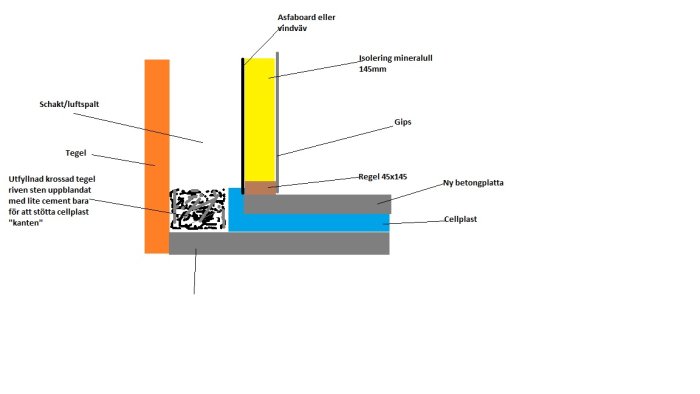
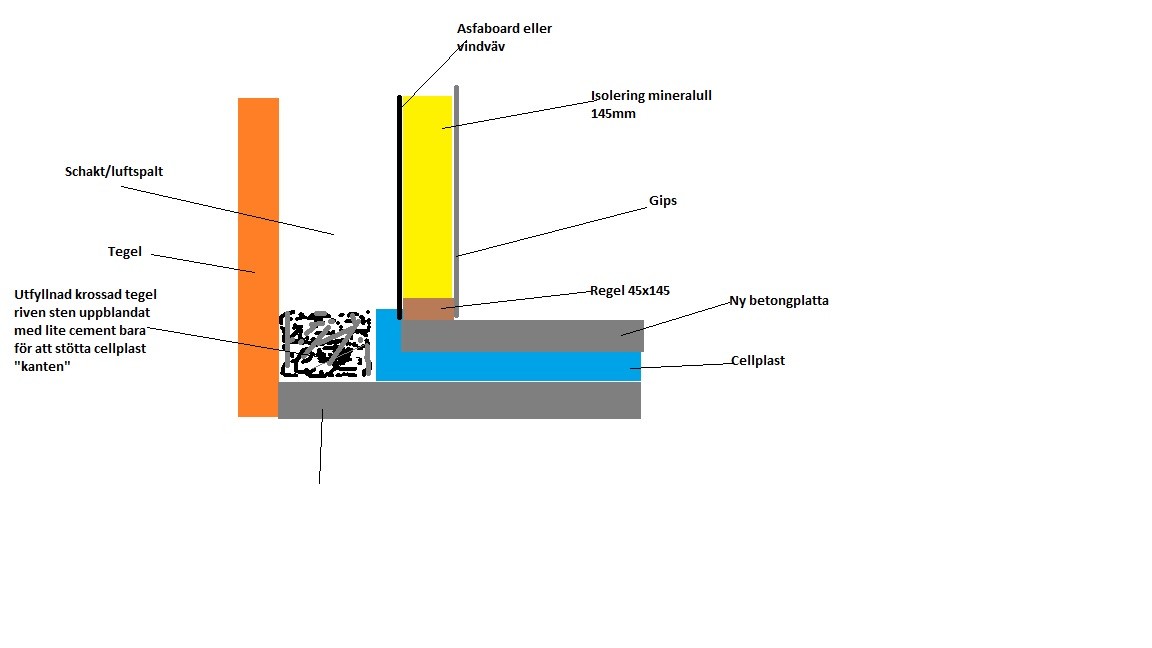
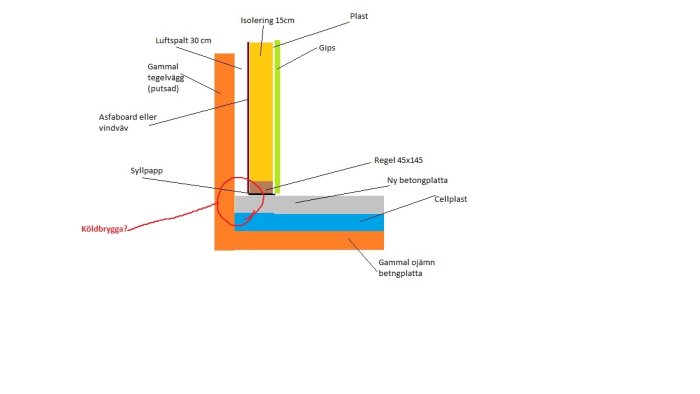
I was thinking of maintaining about 30 cm "air gap" (would have been sloped ceiling here anyway) and then building a wooden frame construction with asfaboard or wind barrier - insulation - age-resistant plastic - gypsum inside the brick shell.
Have I missed anything?
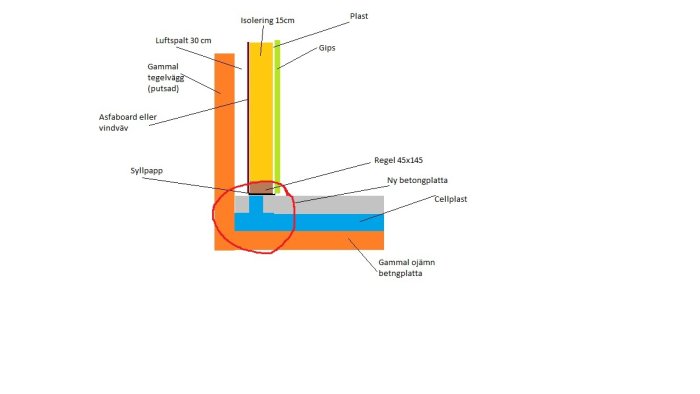
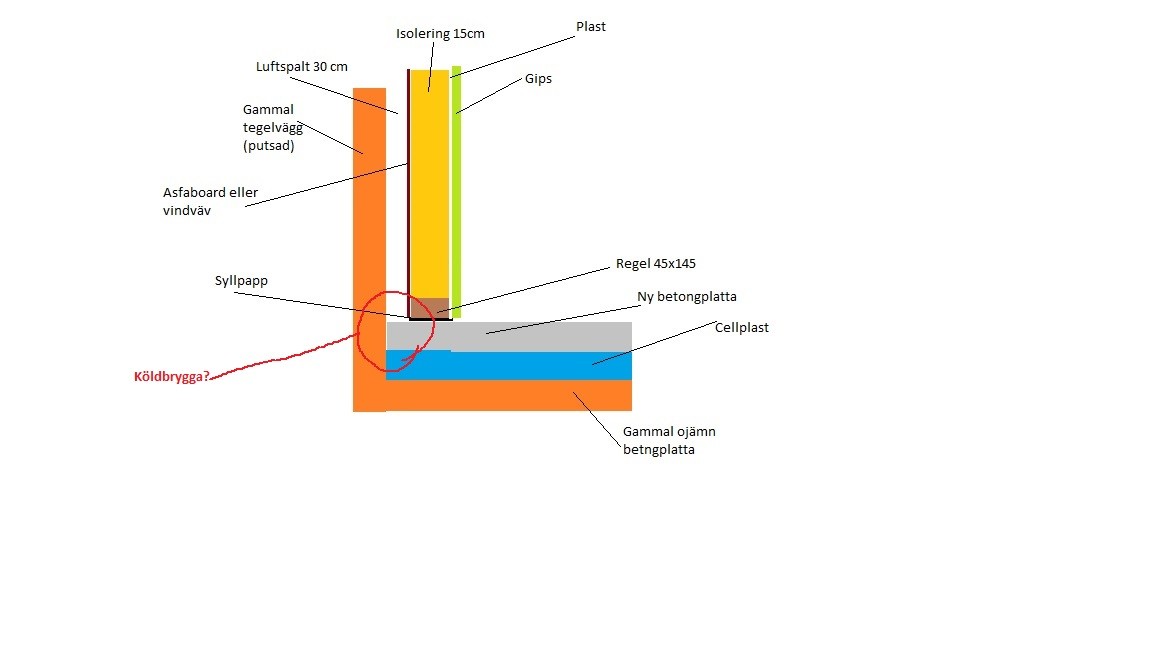
There is a rather thin concrete slab. Can I just lay foam plastic and then add more concrete since the walls form a "mold"?
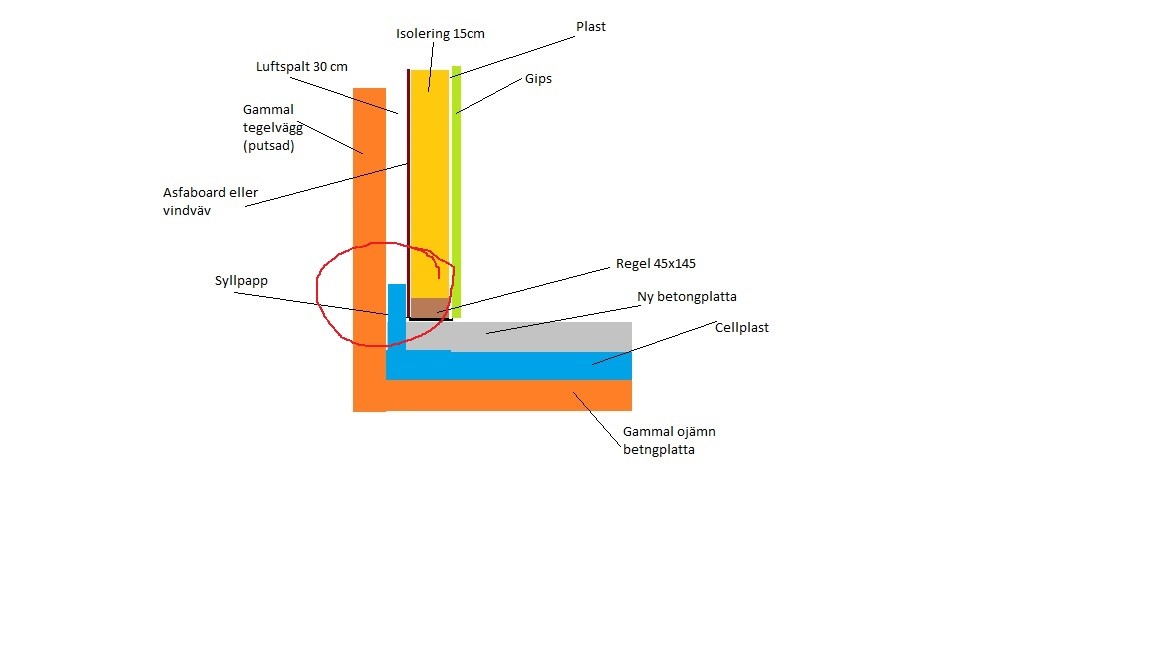
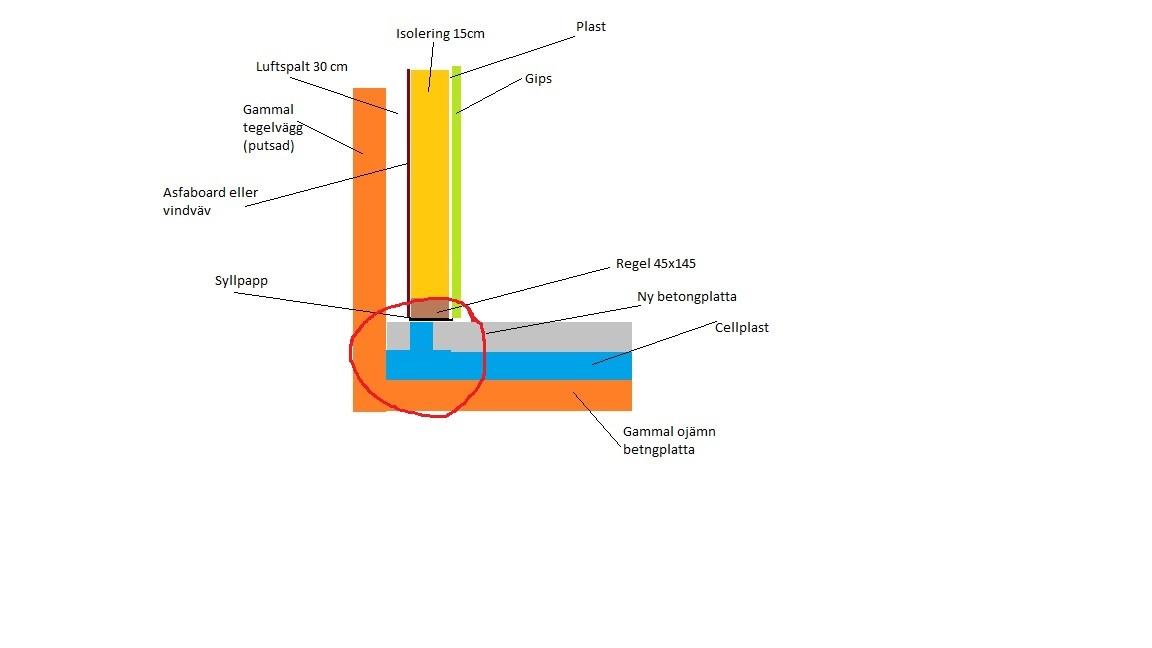
Should I in that case fill up with foam plastic and concrete also in the "30 cm air gap" or should I make a new wooden form and just cast along the interior walls?
Is there any particular reason you want to cast a new concrete floor on top of the insulation? Otherwise, a simple solution is to lay a ventilating plastic mat like Platon on the old slab, then cellular plastic, and then floating chipboard on top of that.
Not quite the air gap will be more or less 60cm in some places so then I have to get the foam to stand exactly where I want it without having mounted the inner wall...
In order to comment on the ideas, more information is needed. How big is the house in terms of floor area and height? Is it a full or half brick wall that is the outer wall? What is meant by the expression "air gap 30 cm"? 30 cm is a shaft! Do you want to build a house inside the house? In principle, it is great to cast a new slab on top of the old one with polystyrene in between and as edge insulation. But it becomes thick, 30 cm. The best is to make a diffusion-open inner wall with cellulose as insulation and without plastic foil.
Concrete is extremely cold-conductive, therefore an edge insulation is needed, at least as wide as the insulation underneath is thick. But you have plenty of space. A diffusion-open wall is limited by windproofing (available in many variants) on the inside and outside. Plastic foil must not be used. The insulation material should be naturally hygroscopic, i.e., not stone or glass wool. I'm a bit concerned about the brick wall. Load-bearing exterior walls are usually full brick (25 cm thick), meaning some bricks are laid crosswise and bind together. Half-brick walls (12 cm thick) are usually tied to a stud wall inside. But perhaps the house is very old? The U-value of brick is about one-tenth of mineral wool, so a full brick wall corresponds to about 25 mm of mineral wool. But it has other good properties.
If the house is to be heated year-round (around 20C), a moisture barrier is advisable. If the wall is thin and moderately insulated (around 10 cm glass/mineral wool), the moisture barrier can possibly be replaced with a vapor retarder. Everything depends on how much moisture will be added to the air, i.e., if many people (or animals) will constantly be inside and/or if there will be a frequently used bathroom, laundry room, or kitchen with cooking.
You are not exaggerating the thermal bridge.
You can fit as much insulation as you can put in.
The most important thing is to break the thermal bridge. If this is done with 5 cm of polystyrene, it makes a big difference. More difference than between 5 and 30 cm, I dare say.
The need for a vapor barrier depends on the choice of insulation material in the wall. Vapor barriers were introduced in the early 60s when it was noticed that mineral wool lost its insulating ability due to condensed moisture. If cellulose fibers are used as insulation material, a vapor barrier should not be installed. The outer wall is an old diffusion-open brick wall. It does not like having a new diffusion-tight wall inside! A full-brick wall is a fantastic heat reservoir that will provide the solar radiation with a desirable time delay. Today's sun provides warmth at night and vice versa. The standard solution for edge insulation of concrete is a 29 cm wide leca stone, which has half the U-value compared to polystyrene or mineral wool. I think the solution with crushed brick should be able to work.
Vi vill skicka notiser för ämnen du bevakar och händelser som berör dig.

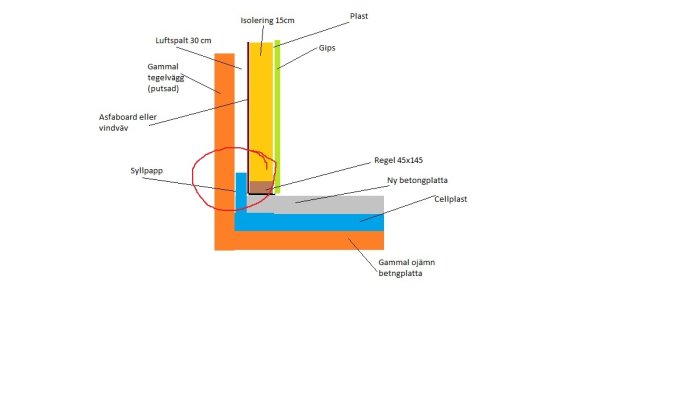

 small rodents no thanks to them.