Expect each lecaskift to build 20 cm in height. The remaining height is managed with a double wall plate. The appropriate construction of the truss depends on the roof pitch. Avoid roof pitches under 27°. The higher the better. It may be suitable to have the same roof pitch as the rest of the house. A W-truss (truss solution) for the current span and roof pitch of 27° requires 45x145 mm C24 for the rafters and collar tie and 45x120 mm C24 for the other parts. www.traguiden.se has examples of solutions. Depending on how much insulation you want in the attic floor, it may be appropriate to use a higher dimension for the collar tie. Let the rafters extend at least 30 cm beyond the facade line and attach a longitudinal board at the ends of the rafters. The outer roof panel should extend a tape measure width beyond this board. Then seal between the trusses above the lecasteen with k-plywood or tongue and groove boards. Do not make a ventilation opening at the roof eaves. It doesn't work with today's insulation thicknesses. It's easiest to put wood paneling on the gable peak. Which looks best is probably something you need to decide on-site.
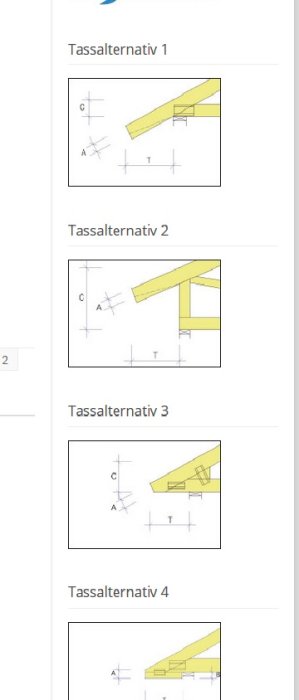
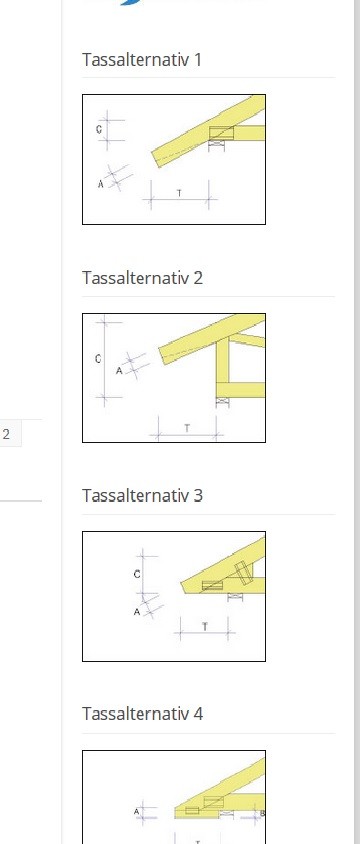
Thinking about paw alternative 4 on this image because then I have a bit to go on regarding exactly where the walls will be located? And prefab truss rafters?
Which paw alternative is the easiest?
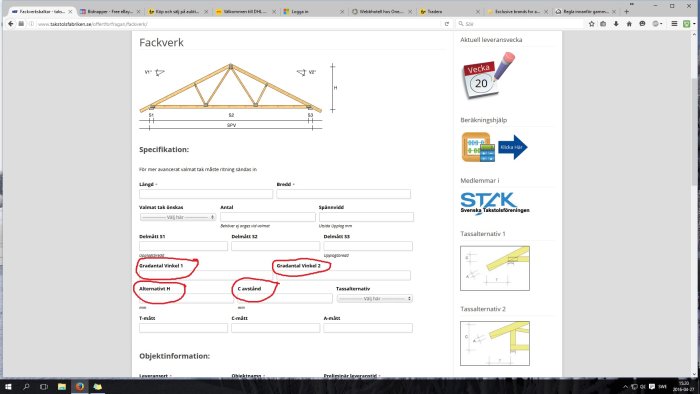
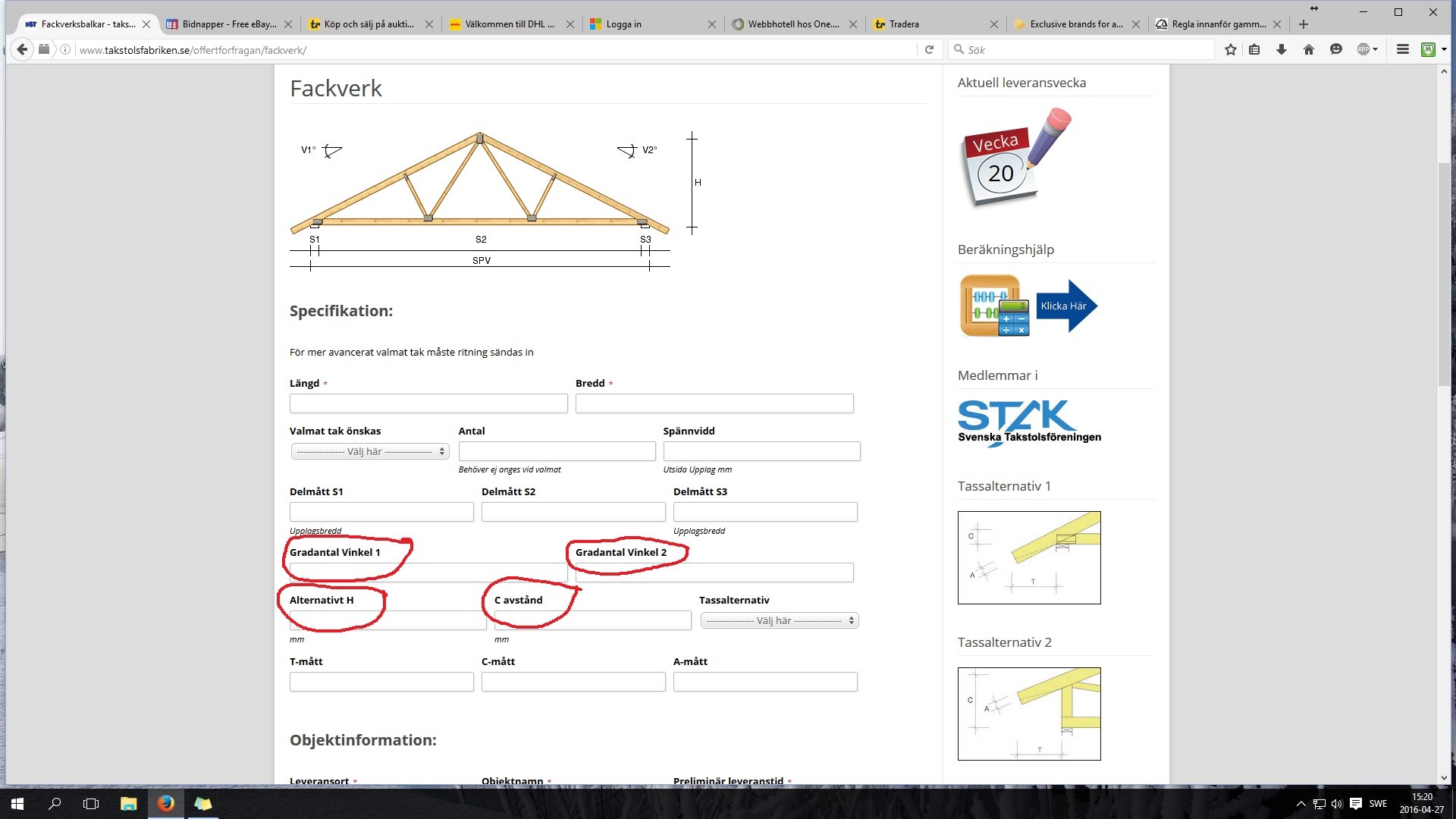
What do the dimensions circled in red on the quote mean?
What will S1 and S3 be in my case, the width of the brick wall? Or the width of the brick outer wall + leca inner wall?
Always good with prefab trusses if you have the right measurements and other conditions. With tass option 4, it becomes a box. You have to watch out so it doesn't become a gathering place for wasps etc. I interpret S1 and S2 as the beds on the wall plates. Angle 1 and angle 2 are the roof pitches for each side. (Should always be the same, but a manufacturer should naturally be prepared for deviating measurements.) H is the height that can be specified instead of the angles. C is the center distance between the trusses. Should be 1200 mm.
I think it's absolutely right to build with lightweight concrete inside the brick. I did the same in a bathroom, where I built with 15cm wide blocks with an air gap of about 3 cm and filled it with lightweight concrete pellets, a solution that will last for many years. Then I finished the surface with c-brick (built with b-brick) and then applied a waterproofing layer before tiling.
Tip: It's excellent to run electrical cables in the air gap, so you don't have to cut grooves afterwards.
It's also best to let everything be built for about 2-3 months and then plaster. Plastering too early increases the risk of cracks in the plaster.
Sending a picture of the living room where I did the same but with 9cm blocks.
When I quickly calculate, I get that the roof slope is now 45 degrees, can that be correct?
Are there any guidelines on what roof angle I should have?
If I choose Tass Option 1, can dimension A be the entire width of the rafter, or why is there a line drawn to "trim" the rafter? Is there anything to gain from this?
Is it crucial when I order prefab roof truss that all dimensions are to the millimeter, e.g., the span, or is it better to allow for a few extra centimeters so I have some leeway?
You mentioned a board between the roof trusses to cover the hole above the leca; can this just be nailed to the wall plate then? Or did you mean to cover the high legs in the roof overhang from below?
S1 and S2 are not the sum of inner wall + outer wall then? Wouldn't it be most stable to attach the collar tie with angle brackets to both the wall plate on the outer wall and the wall plate on the inner wall?
Andreas' insulation solution with lightweight clay aggregate, how does it compare with my 10 cm of mineral wool? Is 10 cm of foam insulation a better alternative? I have access to foam insulation in odd sizes, so there will be some seams, but maybe still a good option?
Are electrical installations in the insulation between the walls okay?
Is it possible to build a custom leca beam to place above a window, as 100 cm leca beams seem expensive?
Many questions, but extremely grateful for the engagement here!
If the current roof angle is 45°, keep it! It is a perfect roof angle with a long tradition. The load on the roof becomes much lower. With tassalternative 1, it is common to taper the high beam to achieve a more elegant impression. Not necessary but customary. Since your outer walls are probably not completely parallel, you should base on the largest width measurement. You must seal the opening above the leca and between the roof trusses so that birds and others cannot get in there. This can be done in many different ways. The roof truss manufacturer wants to know the width of the bearing (=hammer beam) and the free span to calculate the dimensions of the roof truss. Nothing prevents you from also attaching the roof truss to a second hammer beam on the leca wall. I believe lecakulor are like leca blocks in terms of insulation. You need to double the width compared to mineral wool. Polystyrene works well, but mineral wool adapts better to protruding mortar residues, etc. Regarding electrical channels in the cavity, there is a certain risk of condensation if they are too far out in the wall. I would check with an experienced electrician. Sure, you can build your own leca beam if you reinforce it and assemble it correctly. There are probably descriptions online.
Okay, what would you say is the standard measurement A for paw option 1?
If I attach the truss to both the inner and outer walls, will the total wall plate be 50cm? Or should I only provide the outer wall's wall plate to the truss manufacturer? Is it unnecessary to attach to both walls? Feels more robust though, right?
I've got a good deal on nail plugs, do these work in leca as well?
Okay, difficult to find out the widest measurement since I don't want to tear down the roof before I have the new trusses, long delivery time, etc. Is there any risk in adding 5cm to the measurement I have at the gable so I have some leeway and don't have a truss that's too short?
Is it possible to mortar 16mm flex/VP conduit into the horizontal joint on leca?
A should not be less than 7-8 cm. It should be possible to attach a fascia board there. To the manufacturer, you should provide the measurement to the outer wall, but it is absolutely fine to fasten to both. Nail plugs work in leca, but you must check with the manufacturer what load they can withstand in the direction of pull. You can measure the largest width of the space from the inside. Borrow a laser measure if you don't already own one. You should allow a little margin on the width measurement. The horizontal joint in the lecamuren should be compressed to about 10 mm. Some types of lecastenar may have grooves that suffice. Otherwise, it is easy to mill grooves in the outside of the lecamuren.
Saw a house where the rafters were recessed into the masonry wall instead of using a wall plate, which is actually best/easiest? How is the attachment done in these cases?
You said to skip ventilation at the eaves. Do you mean skipping masonite etc., so no air enters between the insulation and the sheathing? I should ventilate the cold attic at the ridge with a pair of ventilation grills, right?
It's a bit tricky to measure inside since there are actually interior wall studs + drywall now in very poor condition. Therefore, it's hard to measure. Is it better to extend the rafters by 10 cm?
The first rafter on the gable, how is this mounted edge-to-edge with the stucco or inside so there's room for framing for the exterior paneling, etc.? Is there any standard?
Considering the interior finish in the bedroom, which will have 3 walls in leca, just plaster and paint these? And the interior wall that will be drywall... Maybe an accent wall with wood paneling?
I want it somewhat simple and economical.
The same concern in the hall/laundry room, one wall in leca and two interior walls in drywall. Do you think I should plaster the laundry room too, even though it will also be a passage down to the bedroom?
Is it possible to build interior walls in 9 cm leca and skip wooden interior walls altogether? Seems a bit of hassle to run electrical in leca walls, though much simpler to run most electrical in the framed interior walls..?
I think the wall plate brings a bit more order and tidiness. Eaves ventilation, with today's large amounts of insulation, has proven to create more problems than it solves. Only use grilles in the gables. Earlier construction methods have only worked thanks to significant heat leakage into the cold attic. I realize that it is difficult to measure the house width accurately. I think 10 cm is a bit exaggerated. Try to create two parallel lines that are tangent to the outer walls and add 5 cm. The first rafters should be mounted flush with the plaster so that the gable peak panel is outside the facade line. Regarding the surface layers, there is much to consider. One aspect concerns room acoustics. Painted plaster dampens sound effectively. It can otherwise be a problem with small rooms with hard surface layers. I think one should aim for surface layers that stand the test of time. I think it's a good idea to use leca for interior walls as well. It is easy to mill electrical channels into leca.
Do all lecawalls require reinforcement, or is reinforcement only needed in the 60cm layer on the exterior walls? For the inside leca that is plastered, is finja plaster mortar c sufficient without mesh, etc.?
Is it better to use 25 or 20cm leca above the brick?
If I buy U-blocks and place them as the top layer, can I then cast some kind of fitting to have the attachment of the wall plate threaded with, for example, a nut?
How is it usually done with, for example, trim, etc., around an interior door mounted in leca on a plastered wall? Do you mount wooden studs against the leca which you then screw the frame into, or do you mount the interior door directly into the leca?
Is it better to build with 25 or 20cm leca above the brick?
If I buy U-blocks and place them as the top layer, can I then cast in some form of bracket to secure the wall plate with, for example, a nut?
How do you usually handle, for example, trim around an interior door mounted in leca on a plastered wall? Do you mount wooden battens against the leca to which you then screw the frame, or do you mount the interior door directly into the leca?
Someone else will have to answer what size the blocks should be. I would go with 20cm.
The advantage of u-blocks is that fastening the wall plates is not a problem, so yes, you can cast in fastenings there.
I only mesh plaster that will be exposed to weather and wind. So not indoors.
I wouldn't skim coat the leca on the inside, mainly because I can't get it smooth and nice. I think it's easier to put up strips on the wall that determine the thickness of the plaster and level off with a straightedge or something similar.
Vi vill skicka notiser för ämnen du bevakar och händelser som berör dig.