You mean. From the outside, brick wall - 3cm air gap - possibly masonite - 145mm studs + 145mm insulation - wind barrier - gypsum
What do you mean by moisture insulation in the bathroom here, is the wind barrier replaced by vapor barrier plastic then? Or do you mean waterproofing layer as moisture insulation?
"You mean, from the outside, brick wall - 3cm air gap - possibly hardboard - 145mm studs +145mm insulation - building paper - plasterboard." Yes. "What do you mean by moisture isolation in the bathroom, in this case, is the building paper replaced by vapor barrier plastic? Or do you mean waterproofing membrane as moisture isolation?" I mean that if you are building a stud wall in the bathroom, no windproofing is needed behind the waterproofing membrane, but it's okay if it's there. Do not use a vapor barrier. By paper strips, I mean strips, for example, of building paper that help keep the insulation in place. But if you are careful, they are not needed.
The air gap should be ventilated to the outside through mesh-covered holes at the top and bottom with a distance of several meters. Find a house with brick siding and study how it looks up close. How to make the holes must be determined on site. An interior wall with insulation and brick, e.g. leca, needs neither an air gap nor ventilation.
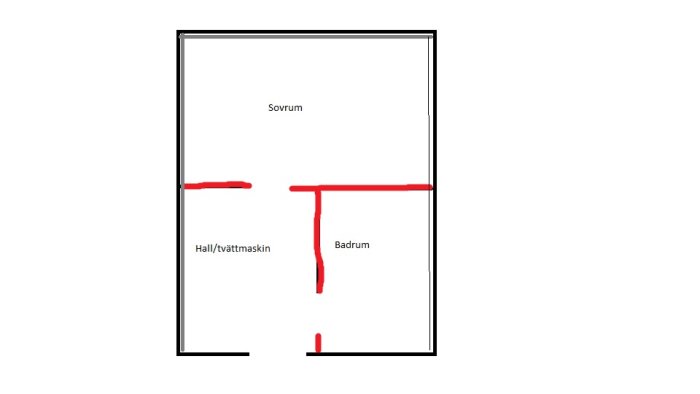
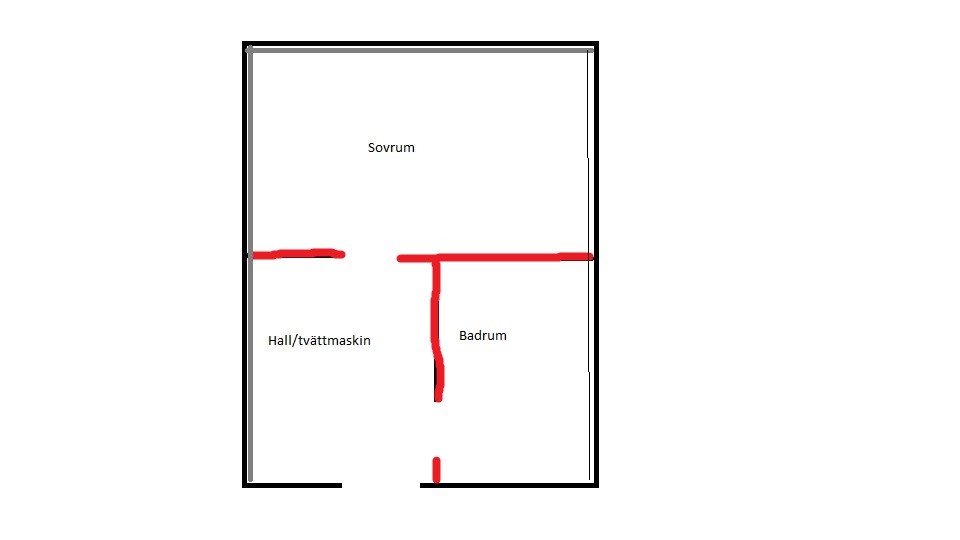
Ok I might have to backtrack and ultimately build walls in leca according to the gray in the picture. Will it be ok with wood-framed walls according to the red lines, meaning the "inner-inner" walls?
The disadvantage with leca is that the thickness of the wall should increase. What is considered the minimum thickness to achieve satisfactory insulation?
Don't want to steal too much floor space with the walls
The "red" walls can preferably be structural walls made of wood. When assessing the suitable thickness for insulation and leca blocks, you can assume that leca has half the insulation capacity (U-value) of mineral wool. The brick wall roughly corresponds to 2.5 cm of mineral wool. Ultimately, it’s about how well-insulated the space should be. Additionally, it's a bit troublesome to build with overly narrow leca blocks. I believe they are available from 8 cm to 29 cm. From 15 cm thickness, I think it is OK for an amateur mason. If you choose 10 cm of mineral wool and 15 cm of leca, the entire wall will have a U-value equivalent to 2.5+10+7.5 = 20 cm. Which is probably OK in this case. The standard for new builds is approximately 30 cm. The wall thickness will be about 50 cm.
Actually not. It depends on how well you do the bricklaying. The surfaces that are not to be tiled and are exterior walls should be plastered to make them tight.