
2 733 läst ·
28 svar
3k läst
28 svar
Isolering fråga i Engelska

Allvetare
· Västra Götaland
· 12 292 inlägg
What kind of ventilation do you have?
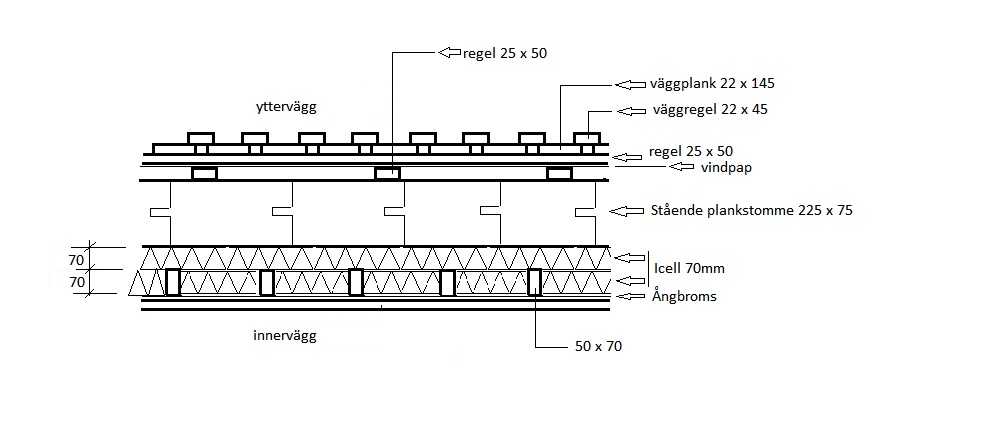
Sketch looks good. Even 3x70 would be good here if you have the room.
Sketch looks good. Even 3x70 would be good here if you have the room.
I had a chimne that was in a very bad shape so we had to remove that but then the ventlation was also gone so we made 3 pipes 160mm on the roof and from there pipes to the rooms. Självdrag.
In the livingroom I have room space enough for 3 x 70 but I think it does not look so good around the windows and doors because then they come approx 25cm deep.
In the bedrooms I do not have that space
In the livingroom I have room space enough for 3 x 70 but I think it does not look so good around the windows and doors because then they come approx 25cm deep.
In the bedrooms I do not have that space
Allvetare
· Västra Götaland
· 12 292 inlägg
If you only have självdrag you will probably have bad ventilation from time to time. Mechanical under pressure ventilation is far more safe.
OK that is correct but so far no problems.
When we bought the house the sälvdrag was done by the chimne but that gave problems like mold on the ceiling but since we change that to pipes we have no problems for 6-7 years now.
But does that harm the insulation methode ?
When we bought the house the sälvdrag was done by the chimne but that gave problems like mold on the ceiling but since we change that to pipes we have no problems for 6-7 years now.
But does that harm the insulation methode ?
Adding (thick) insulation on the inside of the outer walls could increase the risk of moist condensating in, and damaging, the old timber in the walls. In old houses, it's often draft that is the main culprit when the rooms are feeling cold. Also, the insulation effect is greatest for the first layer of added insulation.
Have you checked your house for draft, e.g. at windows, doors, intersections between wall and floor/ceiling etc? Is the outside wind paper in good condition? Another way of avoiding draft is to use lime or clay mortar on the walls.
If needed, I would also consider a thinner insulation layer. e.g. as @major_tom has done, or even without the extra air space, as can be seen in the construction example provided by Isolina (drawing US5-K).
The heating system is another system component to consider in order to get an economically sound heating comfort.
Just my two cents...
Have you checked your house for draft, e.g. at windows, doors, intersections between wall and floor/ceiling etc? Is the outside wind paper in good condition? Another way of avoiding draft is to use lime or clay mortar on the walls.
If needed, I would also consider a thinner insulation layer. e.g. as @major_tom has done, or even without the extra air space, as can be seen in the construction example provided by Isolina (drawing US5-K).
The heating system is another system component to consider in order to get an economically sound heating comfort.
Just my two cents...
So 50mm is the max for insulating from the inside ? I think that is not enough for the winter ?
If you mean is the house dry : yes
I check it every spring when I come and no draft or damp or moister, not in the house or near windows or doors. Bu I also have on both side an veranda with roof so rain or snow does not come that far.
As far as I know the winpaper is fine and I replace some paper where I change something in the outside wall. Between some construction beams is hemp (hampa) but only there where the beams are not close to eachother
Our house is different from major_tom his house, he have a timber house with insulation inside and he want to make an extra wall agains the original wall to fix kitchen cabinets but our house have no insulation and is made as a ståender planksomme house
We want to spent some time in the winter and I think it is to cold and therefor I want to insulate the house
Heating system is for now a woodstove (kamin) and luft-luft pump and electric heaters
If you mean is the house dry : yes
I check it every spring when I come and no draft or damp or moister, not in the house or near windows or doors. Bu I also have on both side an veranda with roof so rain or snow does not come that far.
As far as I know the winpaper is fine and I replace some paper where I change something in the outside wall. Between some construction beams is hemp (hampa) but only there where the beams are not close to eachother
Our house is different from major_tom his house, he have a timber house with insulation inside and he want to make an extra wall agains the original wall to fix kitchen cabinets but our house have no insulation and is made as a ståender planksomme house
We want to spent some time in the winter and I think it is to cold and therefor I want to insulate the house
Heating system is for now a woodstove (kamin) and luft-luft pump and electric heaters
Allvetare
· Västra Götaland
· 12 292 inlägg
You can insulate with 70+70 cellulose no problem. I was thinking you should have forced ventilation if going thicker.
In general, the more you change the conditions and structure of a healthy old house, the more risk you take. If you want to increase insulation in older houses, it's normally a safer bet to do that on the outside, but that also increases the work and cost, and change the exterior.Nol skrev:
No, I mean if there is draft in the house. If it's damp then you have other problems. How have you checked the draft? Draft is easier to check during the winter, when you can feel the cold and/or use a heat camera. Normally there is draft in an 80+ old house if the draft has not been checked and fixed in the last few decades. Have you lived in the house during winter time? If not, perhaps you can by doing that get a better feeling of how the house performs also during the winter season and find further input to your decision?
major_tom's house is not massive timber, but a timber frame construction (korsvirke), normally with clay or brick in the fillings. The good major didn't mention any additional isolation? Such timber frame houses have similar, although not equal, energy values as your house, and had no added insulation originally. I have such a house myself, where one of the outer walls has no additional insulation at all.
Houses with three inch timber walls are common in Sweden. Some of them have been additionally insulated on the outside, some on the inside, and some not at all.
A similar question to yours is discussed in this byggahus-thread, have you seen that? if not, perhaps Google translate can assist?

the house has been insulated internally with extra glasswool insulation at some point in the mid 1900s, but only with about 30 mm + ca 20 mm treetex, so I doubt it actually contributes much to the overall insulation of the house. I suspect it works more as draft proofing as an "alternative" to actually repairing the old daub (lerklining). much like @Microkatten says, in these old houses, draft is much more of a problem than poor insulation. My plan is to repair the daub first thing, before doing anything else - but my plans are hardly relevant to @Nol 's case imho since I doubt his walls were daubed to begin with.Microkatten skrev:
(and needless to say, the glasswool and the treetex from my walls are destined for the garbage dump)
ultimately, there are as many ways of adding insulation to an old house as there are old houses, and I doubt you'll be able to get one unison answer from the forum. some people will think that more insulation is better, some will think less is better but with more draft proofing. then if you turn to the manufacturers of the insulation, they might say something different. it's only possible to give definite answers when building new houses from scratch, but with old houses there are so many unknown variables. my attitude is simply to renovate with care and respect for the house.
I am sorry that I misunderstood "draft" but as far as I know the house is draftproof even I never been in the house in the winter.
We renovate the house and make every window and door drawproof with draft strips.
Reason for insulation is because we never been in the house during the winter and we like to be here.
I think, because the walls are not insulated, it is too cold and cost to much to be in the house.
Ceiling is insulated with 20cm isover and we have 3-glass and 2-glass windows which I want to replace later into 3-glass. The door to the veranda have 2-glass HR++
ultimately I think major_tom is right, many people - many solutions even we all want the best
I think that the best what is possible is how I draw it and maybe with a 12mm gap between de ångbroms and the inside wood/gips
What is your advice about the gap ? Yes or not ?
And finally should 140mm icel be enough for the winter ?
We renovate the house and make every window and door drawproof with draft strips.
Reason for insulation is because we never been in the house during the winter and we like to be here.
I think, because the walls are not insulated, it is too cold and cost to much to be in the house.
Ceiling is insulated with 20cm isover and we have 3-glass and 2-glass windows which I want to replace later into 3-glass. The door to the veranda have 2-glass HR++
ultimately I think major_tom is right, many people - many solutions even we all want the best
I think that the best what is possible is how I draw it and maybe with a 12mm gap between de ångbroms and the inside wood/gips
What is your advice about the gap ? Yes or not ?
And finally should 140mm icel be enough for the winter ?
Allvetare
· Västra Götaland
· 12 292 inlägg
140 will be ok in the winter. But you have the wood aswell. A decent heat source would be good.
Why the 12mm gap? There is no need except for reducing puncture risk
Why the 12mm gap? There is no need except for reducing puncture risk
Klicka här för att svara