

We're currently renovating our house in southern skane, and are considering to install an FTX system since basically the entire house is torn apart so there isn't really a better time to install duct work.
I'm trying to design the system so that I know what sizes of ducts to install. Sizing the ducts all seems to be about the amount of airflow in them, so the first step must be to calculate required airflow for each room.
I've found some different information around how to calculate the air flow in the rooms.
From the boverket I've found a guideline of 0.35 multiplied by the square meters in the room.
https://www.boverket.se/sv/PBL-kunskapsbanken/regler-om-byggande/boverkets-byggregler/ventilation/#
From some general searching I've found recommendations something like:
We have two floors on the house, the bottom floor has relatively low ceilings (2.2m) so the simplified rule is fairly straight forward to follow and produces similar numbers to the guidance above.
Where it is more complicated is in the kitchen the house is open from the bottom floor up to the second floor giving a ceiling height of approx 6m at the peak, (sloped ceiling following the roof)
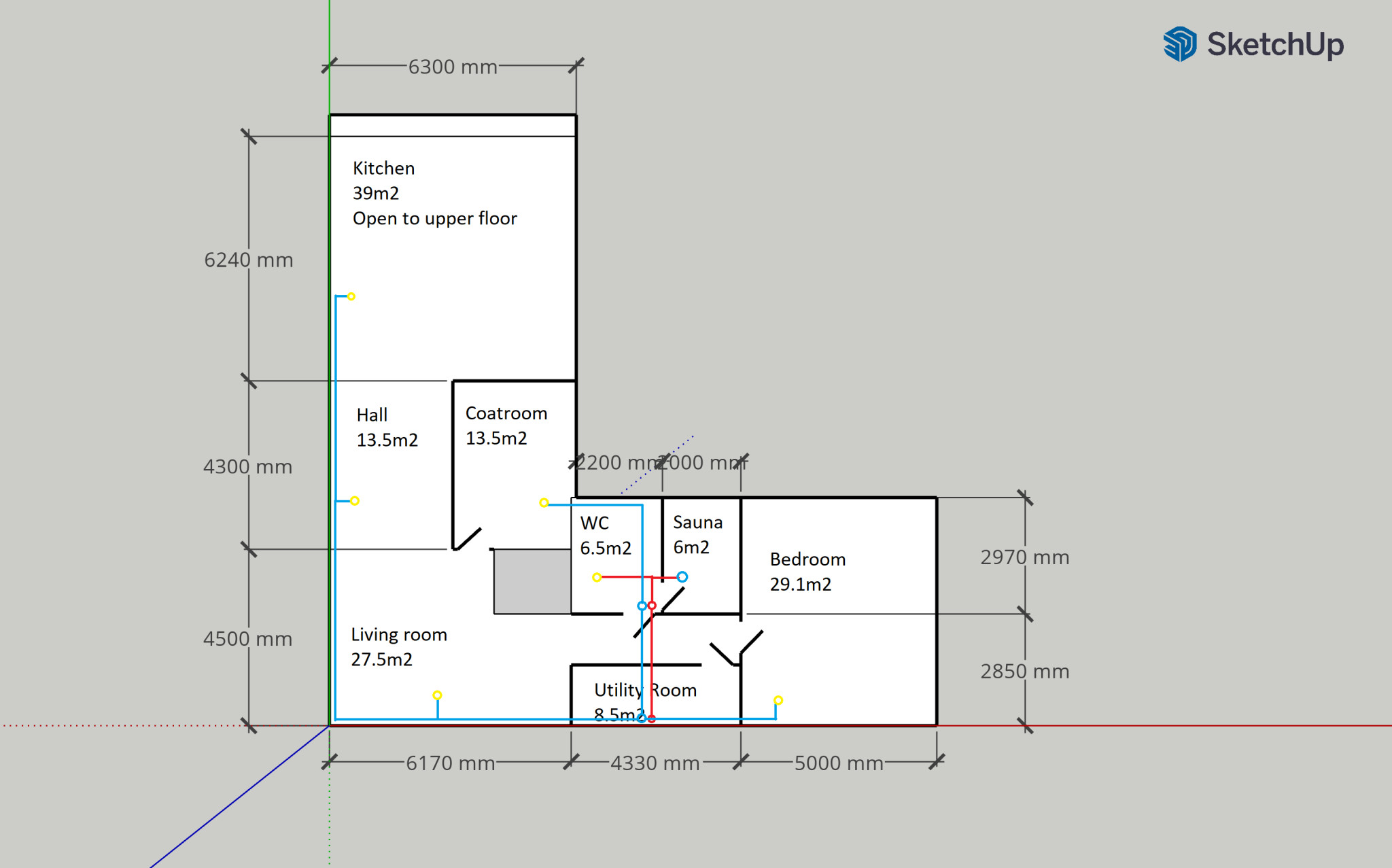
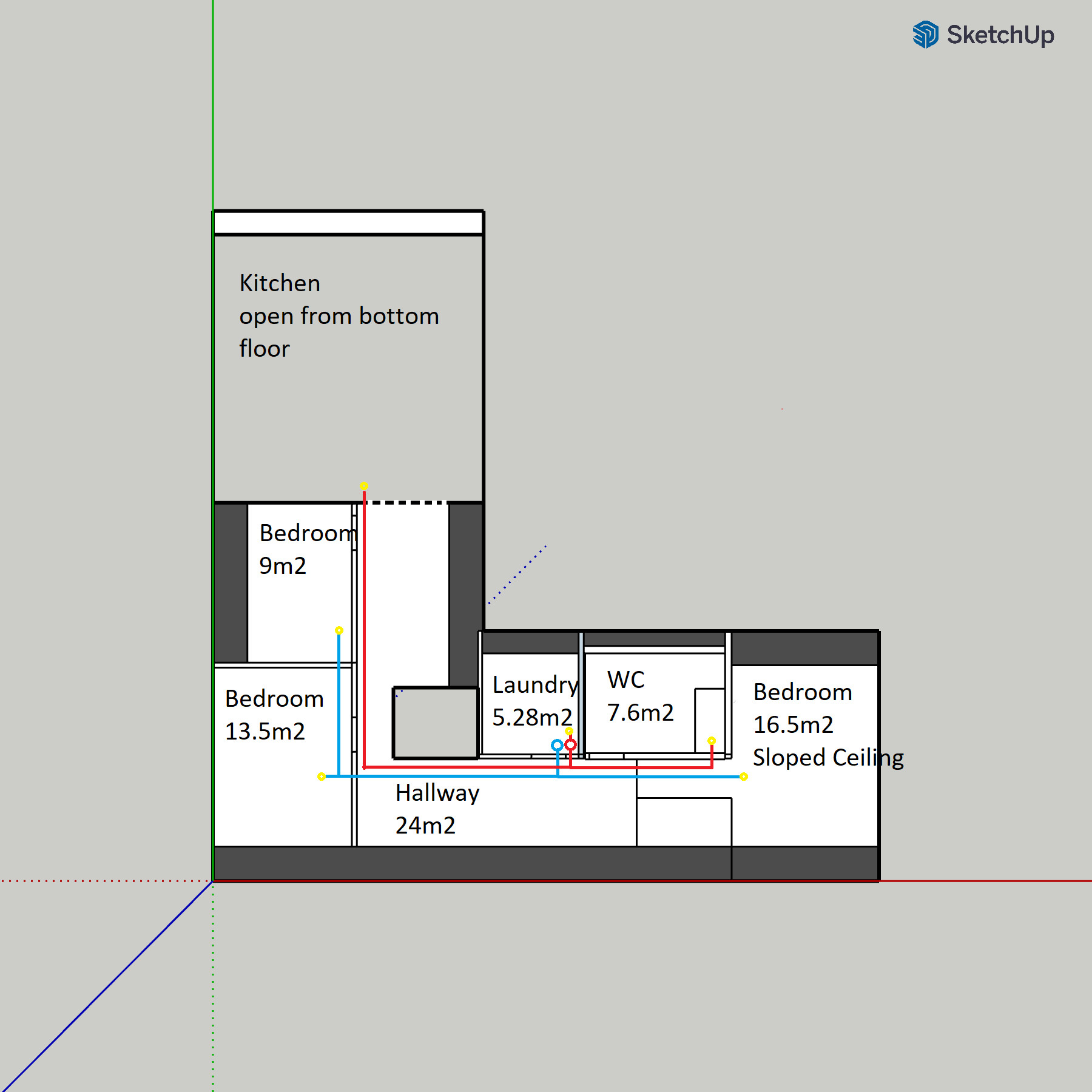
The rooms upstairs, are also having sloped ceilings. I have attached a couple of rough pictures that show the floor plan, and what I have in mind for running the duct work. The red lines are intended exhaust ducts, with the vents shown in yellow. The blue lines are intended fresh air ducts with the vents shown in yellow.
The questions I have now are:
- Should I calculate using this simplified 0.35 multiplication rule even with very high ceilings/sloped ceilings in various rooms?
- Should I calculate using the same basis for all rooms, or different depending on the type of room from the more general recommendations I've found?
- Should I hook up the sauna to the ftx directly, or rather vent the washroom with ftx, and connect the sauna to the washroom?
I'm sure more questions are coming, but that is where I am so far!
I'm trying to design the system so that I know what sizes of ducts to install. Sizing the ducts all seems to be about the amount of airflow in them, so the first step must be to calculate required airflow for each room.
I've found some different information around how to calculate the air flow in the rooms.
From the boverket I've found a guideline of 0.35 multiplied by the square meters in the room.
https://www.boverket.se/sv/PBL-kunskapsbanken/regler-om-byggande/boverkets-byggregler/ventilation/#
From some general searching I've found recommendations something like:
- Living rooms and bedrooms: 0.5-1 exchanges per hr
- Kitchens: 3-4 exchanges per hr
- Bathrooms: 5-6 exchanges per hr
- Laundry rooms: 6-8 exchanges per hr
We have two floors on the house, the bottom floor has relatively low ceilings (2.2m) so the simplified rule is fairly straight forward to follow and produces similar numbers to the guidance above.
Where it is more complicated is in the kitchen the house is open from the bottom floor up to the second floor giving a ceiling height of approx 6m at the peak, (sloped ceiling following the roof)
The rooms upstairs, are also having sloped ceilings. I have attached a couple of rough pictures that show the floor plan, and what I have in mind for running the duct work. The red lines are intended exhaust ducts, with the vents shown in yellow. The blue lines are intended fresh air ducts with the vents shown in yellow.
The questions I have now are:
- Should I calculate using this simplified 0.35 multiplication rule even with very high ceilings/sloped ceilings in various rooms?
- Should I calculate using the same basis for all rooms, or different depending on the type of room from the more general recommendations I've found?
- Should I hook up the sauna to the ftx directly, or rather vent the washroom with ftx, and connect the sauna to the washroom?
I'm sure more questions are coming, but that is where I am so far!
I guess you should use the "0,35" for the HRV.....as a minimum calculated for the whole house.
Using square meters while changing out air measured in cubic meters is really weird, as you found out already.
Then we start with bedrooms...
Now we are measuring in l/s suddenly. 4l/s (14,5m3/h) per person....
Kitchen: 10l/s (36m3/h)
Shower: Preferably 15l/s (54m3/h)
Ah, sorry for not explaining more, but there are plenty of guys that knows more than I do about this and I've got a job to do right now.
We are mixing ways units and probably just so people should get confused.
My point is that if we are using m3 for all calculations it would be much easier to understand what we are doing
Using square meters while changing out air measured in cubic meters is really weird, as you found out already.
Then we start with bedrooms...
Now we are measuring in l/s suddenly. 4l/s (14,5m3/h) per person....
Kitchen: 10l/s (36m3/h)
Shower: Preferably 15l/s (54m3/h)
Ah, sorry for not explaining more, but there are plenty of guys that knows more than I do about this and I've got a job to do right now.
We are mixing ways units and probably just so people should get confused.
My point is that if we are using m3 for all calculations it would be much easier to understand what we are doing


Det ska nog vara det största värdet av 4 l/s och person respektive av 0,35 l/kvadratmeter.A Antemoo skrev:
Toalett utan dusch och bad: minst 10 l/s
Tvättstuga: minst 10 l/s
Man räknar ut vad 0,35 l/s ger för ett våningsplan först.
Sen räknar man ut vad frånluften i kök, bad, tvätt etc. på samma våningsplan ska vara som minst.
Om summan av frånluftsvärdena är mindre än värdet för våningsplanet får man fundera på om det finns en klädkammare, hall eller annat rum där man är kort tid som också kan ha frånluft. Om det inte finns det behöver man öka på frånluften i de rum som ska ha frånluft.
Sen fördelar man tilluften på de olika rummen med hänsyn till yta och antal personer.
Thanks for your replies!
So the 0.35 l/square meter can be used as a minimum, which makes it quite easy to calculate:
220 square meters total space results in a minimum air flow of 77L/s.
I guess the second part I'm confused by, is if I should just have a standard amount per room (for example 10 L/s in the kitchen) or if I should take into account the volume of the room and how many air exchanges should happen.
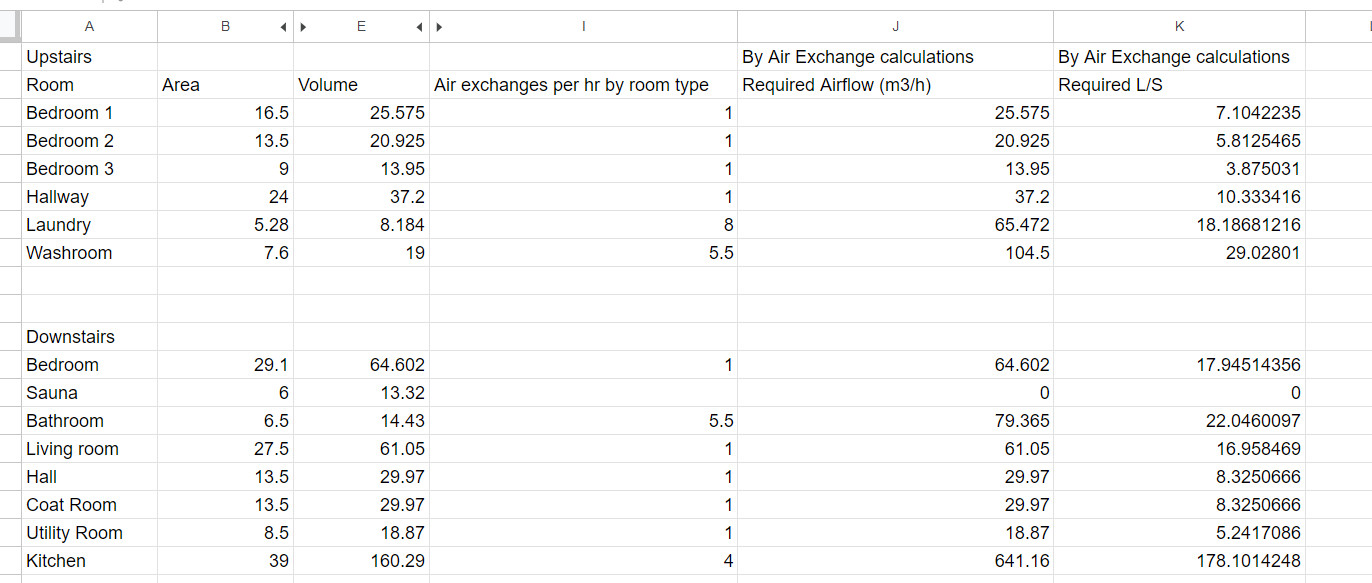
For example I made this sheet that has the volume of each room in m3 it in turn has the volume in m3/h which I then converted to L/s. Does that seem correct, or should I just divide the minimum up by the various rooms? It feels like the size of the room should have something to do with the ventilation?
So the 0.35 l/square meter can be used as a minimum, which makes it quite easy to calculate:
220 square meters total space results in a minimum air flow of 77L/s.
I guess the second part I'm confused by, is if I should just have a standard amount per room (for example 10 L/s in the kitchen) or if I should take into account the volume of the room and how many air exchanges should happen.
For example I made this sheet that has the volume of each room in m3 it in turn has the volume in m3/h which I then converted to L/s. Does that seem correct, or should I just divide the minimum up by the various rooms? It feels like the size of the room should have something to do with the ventilation?
Klicka här för att svara