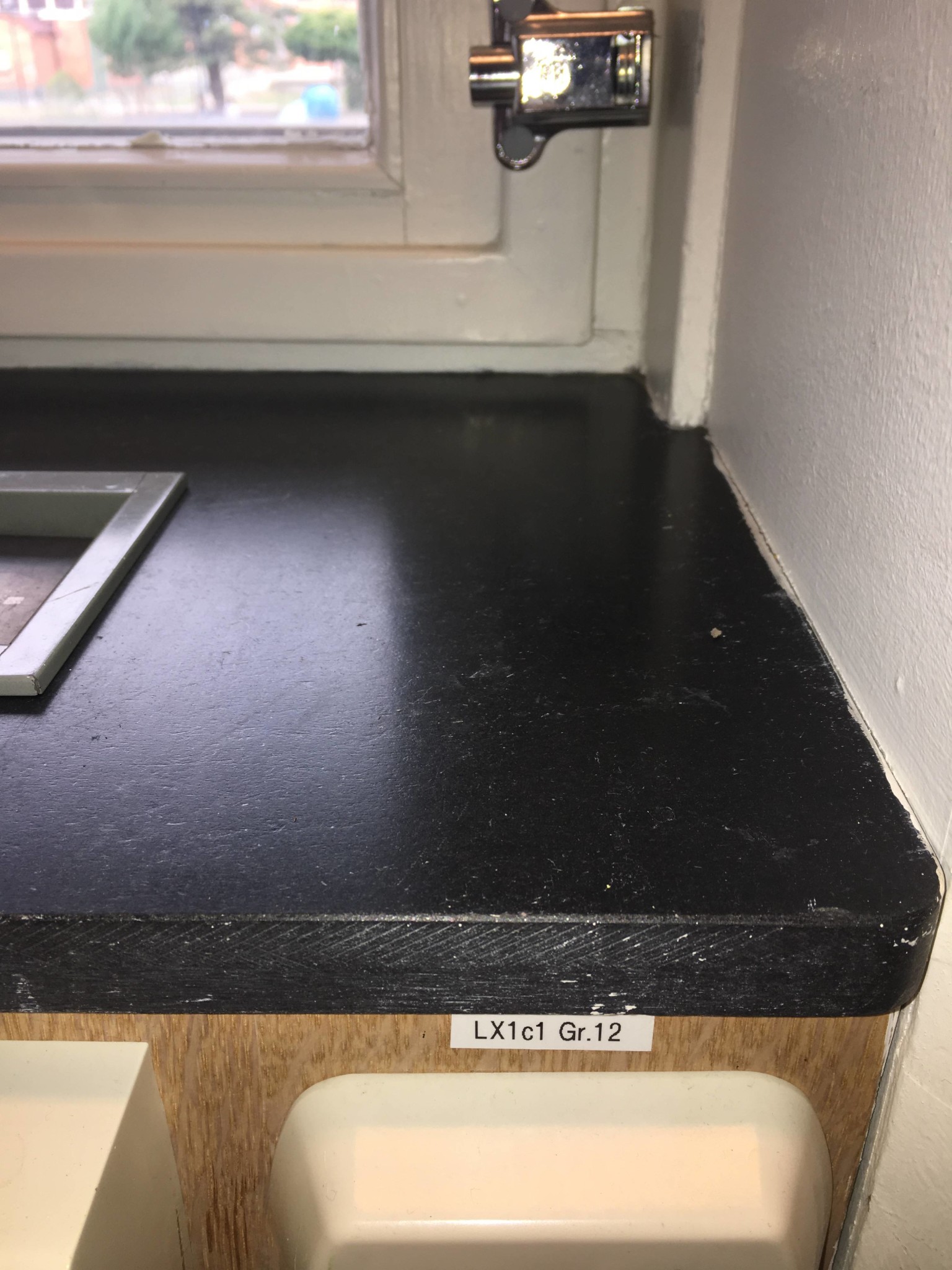
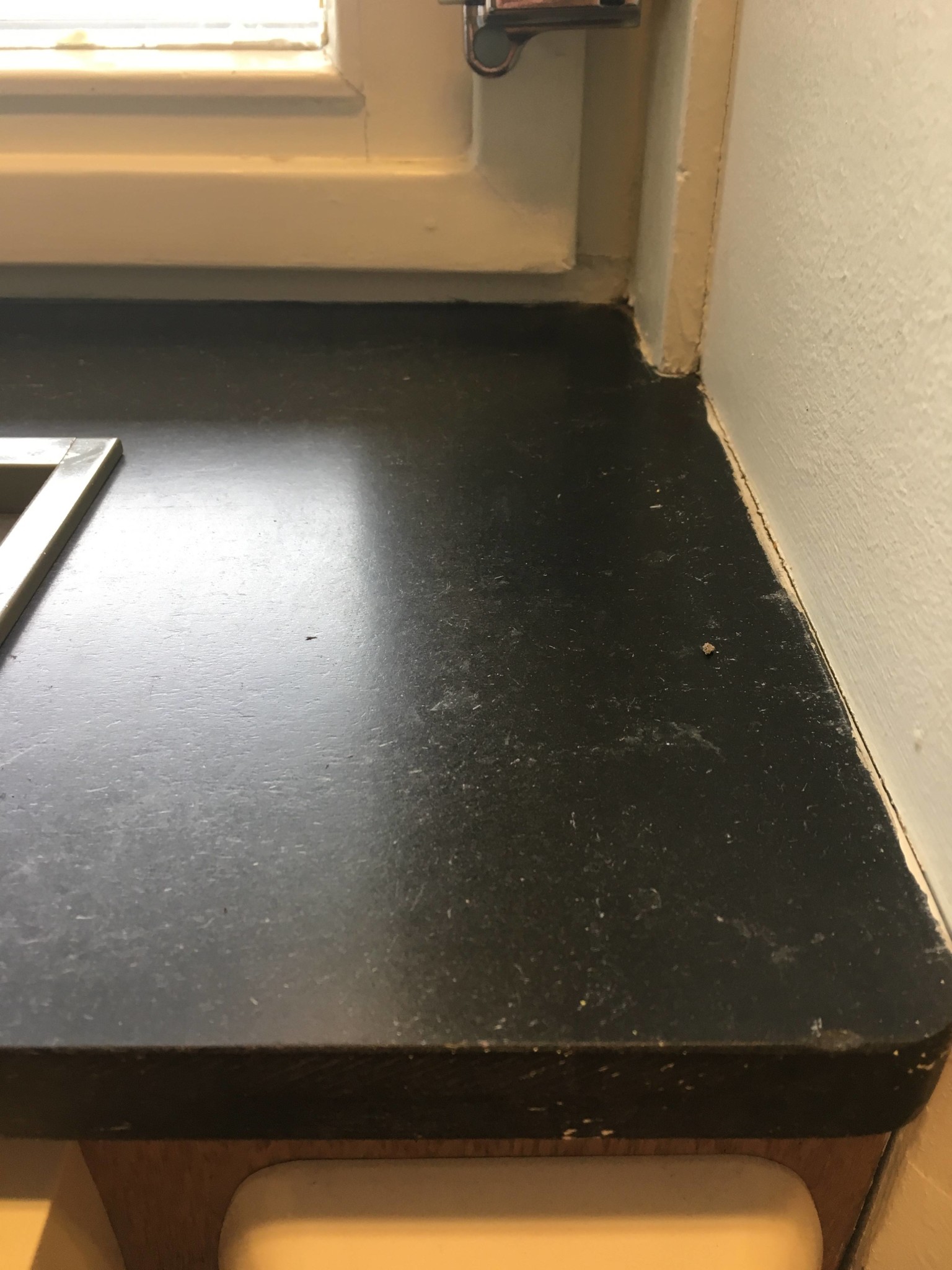
Here's a slightly clearer picture - you can see that the pattern on the side seems to be different on half of the disc. Diagonal cuts on the upper half and horizontal on the lower. There's been a little interesting discussion here at work about what this really is...

Close-up of a countertop edge with diagonal patterns on the upper half and horizontal on the lower, labeled "LX1c1 Gr.12", near a window.
 
  • A kitchen counter with a black surface, next to a window. The surface shows light diagonal and horizontal marks, causing a discussion about its pattern.
Last edited:
Staffans2000
The cuts are from the saw that once cut the board.
 
I was more thinking about the fact that the cuts are different for half of the disc. Was wondering if anything indicates more or less that it's asbestos cement or something else.
 
It looks like someone has sawed quite roughly and then sanded the edge.
 
  • Like
mexitegel
  • Laddar…
Now, I have a bit of a special sense of humor, but if I were worried about asbestos dust and no one listened to me, I would put on a disposable coverall and a respirator and continue working just as usual.
 
Yes, I guess it "unfortunately" is... eternit feels like something you don't want in your office...

I know it's a work environment issue and not a poison, but still
 
H hullan said:
Yes, I guess it is "unfortunately"... eternit feels like something you don't want in your office...

I know it's an occupational health issue and not a poison, but still
It is not an occupational health issue until you have to tear them out. You can calmly continue to work there!
 
H hullan said:
Yes, I guess "unfortunately" it is that... eternit feels like something you don't want in your office...

I know it's a work environment problem and not a poison, but still
Concrete also dusts when you demolish it. Yet people are in concrete buildings daily without getting anxious...
 
useless useless said:
Concrete also dusts when it's torn down. Yet people spend time in concrete buildings daily without getting paranoid...
You are absolutely right. I'm just wondering if this cut-out for the vents was made afterwards and if it affects the material's tendency to crumble and dust at the edges? Or is it just as "firm" even though it’s been worked on afterwards?
 
How do you deal with everything that is in the regular air 24/7 wherever you go, there are five hundred and eleven billion times more particles than your windowsill will emit during its entire lifespan anyway.....
Asbestos is still a natural product. There are particles around us all the time just like there are mold spores around us all the time plus everything else then..........
 
H hullan said:
You are absolutely right. I'm just wondering if this cutout for the valves was done afterwards and if it affects the material's tendency to crumble and dust at the edges? Or is it just as "solid" even though it has been processed afterwards?
You don't need to worry, it's only while processing it that there's a risk.
 
Yes, the disc is 'homogenous', so there won't be any other more porous surface appearing when you cut out a hole.
 
T
H hullan said:
Here is a slightly clearer picture - you can see that the pattern on the side seems to be different on half of the disc. Diagonal cuts on the upper half and horizontal on the lower. An interesting discussion has arisen here at work about what this actually is...

[image]
asbestos is only dangerous if you're afraid of it / regards, plumber💪
 
  • Haha
Stickan56
  • Laddar…
Click here to reply
Vi vill skicka notiser för ämnen du bevakar och händelser som berör dig.