I have spoken with Norrlandsträ now. The deviations are within their tolerances but they mentioned that they can still compensate me for the boards that are too warped, the most important thing for them is that it turns out well. Which I think is great.
So I need to come up with a new technique to get them in place. I'll get back to you
I've spoken with Norrlandsträ now. The deviations are within their tolerances, but they mentioned they can still compensate me for the boards that are too warped, the most important thing for them is that it turns out well. Which I think is great.
So, I need to come up with a new technique to get them in place. Will update later
Some moderately long battens with a bit of give might work? A sawed notch that pushes the panel upward/forward and then tilt them slightly against the floor.
Nice that the supplier is willing to take part.
Some moderately long studs with a little give might work? A cut notch that pushes the panel up/forward and then tighten them slightly diagonally against the floor. Nice that the supplier wants to take a part.
/Höghus
What I've done now is screw in a piece of plywood and brace against it with the crowbar. But it takes time. Unsure about getting the right forward force without damaging the parquet or panel with your method (if I understand it correctly).
The next tactic to test is plastic wedges that I plan to insert between the board and a scrap piece of the ceiling to create pressure so I don't have to stand with the crowbar and press.
Smart thing! But I think it will ruin the vapor barrier (at least more than necessary). But it might be something.
I feel like a picture might be appropriate
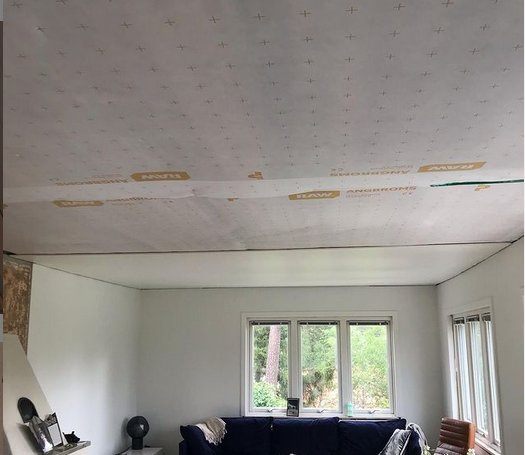
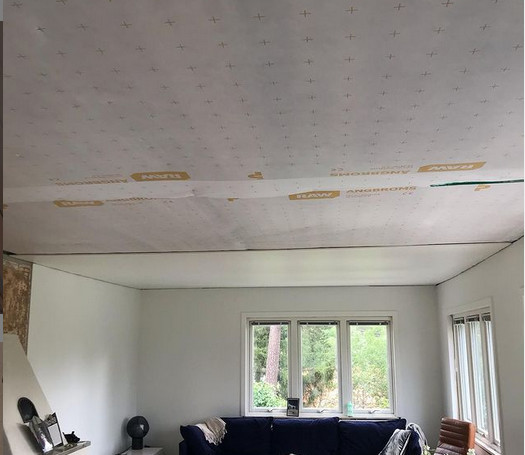
The panel is nailed against an under-roof of raw planks, and before the raw planks, there's a vapor barrier. So it will probably be difficult with the tools that need studs to get leverage.
What I've done now is to fasten a piece of plywood and brace against it with the crowbar. But it takes time. Unsure about getting the right forward force without damaging the parquet or panel with your method (if I understand it correctly).
To spare the panel, you could take a strip from the tongue side of a scrapped panel and use it as a buffer to press on. If the rule-against-the-floor doesn't work, maybe a two by four of adequate length tensioned with support poles would work to lever against. So, perpendicular to the panel and braces against the wall at the other end. Cut a panel width for each round.
How did it go with the warped panel, did you get a new panel?
I had the same problem myself, the panel was a skimmed tongue and groove from the same manufacturer. I had kept the packages stored dry indoors at the same temperature as where they were to be installed. In some packages, as many as four out of six had this problem.
I managed to fix it quite well with the help of a wooden block that was screwed in place and then by bending with a hammer/crowbar, but unfortunately, some gaps did not turn out perfect. But as you say, it takes a darn long time.
Quite a few boards had to be discarded. But with a bit more muscle on site, it was possible to handle things better. Did not use block and crowbar. That wasn't where the trouble was. So the usual warp that exists in planks was handled by hand to avoid damaging the panel and vapor barrier more than necessary. The remaining gaps we either had to live with or discard.
I believe the panel was enough down to the last board, even though we accounted for a lot of waste.
Click here to reply
Vi vill skicka notiser för ämnen du bevakar och händelser som berör dig.


Viktor.J said:
I've spoken with Norrlandsträ now. The deviations are within their tolerances, but they mentioned they can still compensate me for the boards that are too warped, the most important thing for them is that it turns out well. Which I think is great.Höghus said: