
37,465 views ·
190 replies
37k views
190 replies
Trusses that are sagging
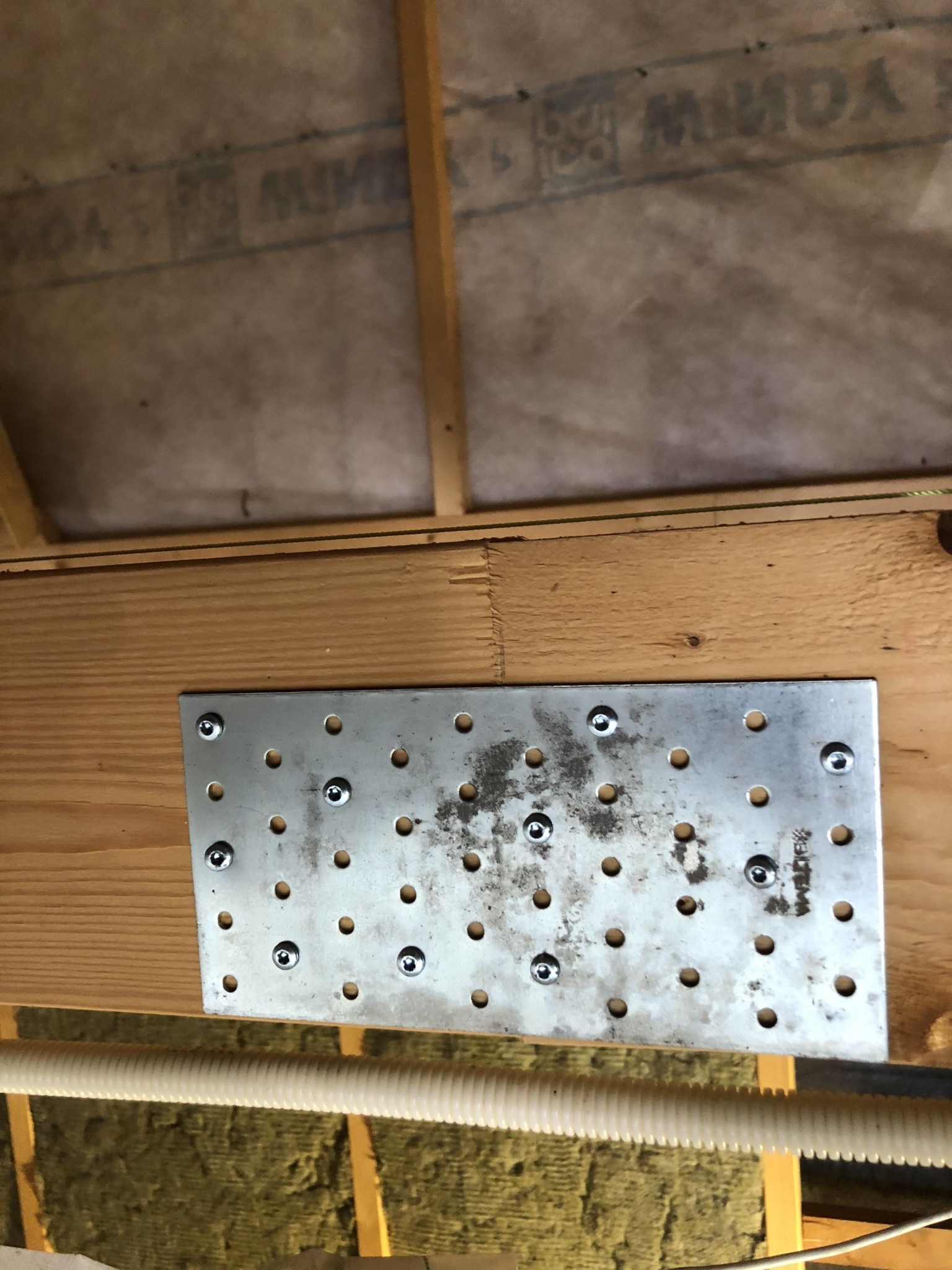
Looks like the carpenter who screwed in the anchor screw was confused about which holes he should use.M M@ZE said:
If I understand the problem correctly, it is the ceiling that is sagging. If the bottom edges of the intermediate beams are shifted toward the middle (red arrows) by a few centimeters, the ceiling will be lifted (green arrow upward). That's how I would do it, it costs 0 kronor. But it probably requires loosening some anchor screws at the top as well due to the heavy timber in the intermediate beams that counteracts the twisting. Definitely, you need to apply pressure from below during the reconstruction to support the ceiling, otherwise, you won't be able to realign the trusses. One truss at a time.

Additionally, they should be more level and be supplemented with trusses toward the ridge to prevent the outer roof from being pulled downward (green arrows downward). See images from takstolsfabriken in Sjöbo. The carpenters are probably skilled carpenters, but when it comes to truss construction, they should have sought help. Unnecessarily heavy intermediate beams otherwise.


Additionally, they should be more level and be supplemented with trusses toward the ridge to prevent the outer roof from being pulled downward (green arrows downward). See images from takstolsfabriken in Sjöbo. The carpenters are probably skilled carpenters, but when it comes to truss construction, they should have sought help. Unnecessarily heavy intermediate beams otherwise.
Last edited:
Do you have any tips on how to proceed with using a brace to get the rafters plumb before screwing in my finger-jointed 6.5m 45x145 into the lower chord of the rafters?
And then it will be time to buy 56x225 glued laminated timber and try to install it. How should they be attached to the wall plate? Angle brackets?
And then it will be time to buy 56x225 glued laminated timber and try to install it. How should they be attached to the wall plate? Angle brackets?

Member
· Blekinge
· 10 117 posts
Member
· Blekinge
· 10 117 posts
Don't you mean in level? Use your laser measure. If it's the sag in the middle that you need to lift, start by measuring the height next to the outer walls.
Yes, levelJ justusandersson said:

Measure from the floor up to the underside of the armrest on the sides along the wall and then in the middle?
Member
· Blekinge
· 10 117 posts
Yes. Note that it is called underram.
Member
· Blekinge
· 10 117 posts
The slab is certainly not completely flat, but this is not science either. A deflection of 20 mm without load just due to its own weight is way too much.
I agree with you, it sounds like a lot and now without the snow load. Do you think it can be fixed by screwing in the finger joints when they are aligned?J justusandersson said:
The strange thing is that you don't see any obvious gap at the seam itself.
Member
· Blekinge
· 10 117 posts
If it's just about deflection due to the subframe's own weight, then it's not a solution, since it increases proportionally. However, the construction can handle a greater load. Note that I have never suggested this because I believe the measure is theoretically pointless. At the same time, I must admit that 20 mm is a significantly larger figure than one would calculate. In a thread discussion like this, you can only advocate for a solution you believe in; arguing against others' proposals just becomes tedious. TS must evaluate the posts themselves.M M@ZE said: