If it only concerns deflection due to the underframe's own weight, then it's not a solution, since this increases proportionally. However, the construction can handle a greater load. Note that I have never suggested this because I think the measure is theoretically pointless. At the same time, I must admit that 20 mm is a significantly larger figure than one can calculate. In a thread discussion like this, you can only advocate for a solution you believe in, arguing against others' suggestions just becomes tiresome. The original poster must evaluate the posts themselves.
I understand, but I'm not knowledgeable in the subject, so I find it difficult to determine the best course of action to reduce and straighten the deflection. Since I had already purchased 6.5m finger-jointed, I thought I could use them constructively in the solution.
I understand that it becomes confusing for you. But I find it difficult to pretend to believe something other than what I do. At least try attaching a finger-jointed rule and evaluate it. It might be that today's unjustifiably large deflection is due to the bad joints. If you can get down to a third of 20 mm, you have definitely achieved something.
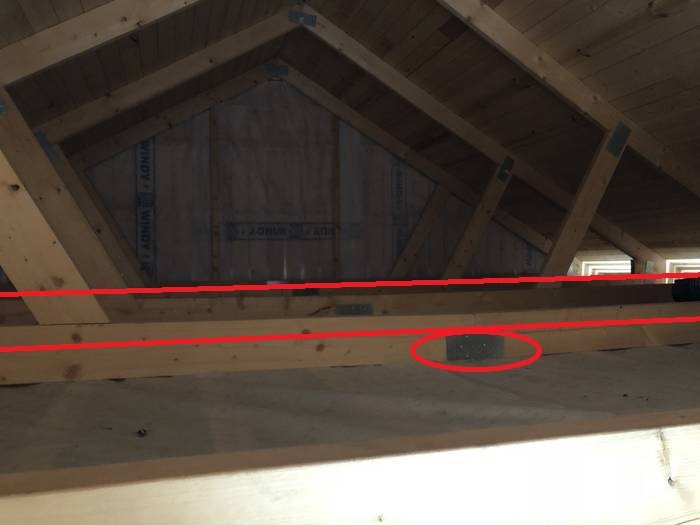
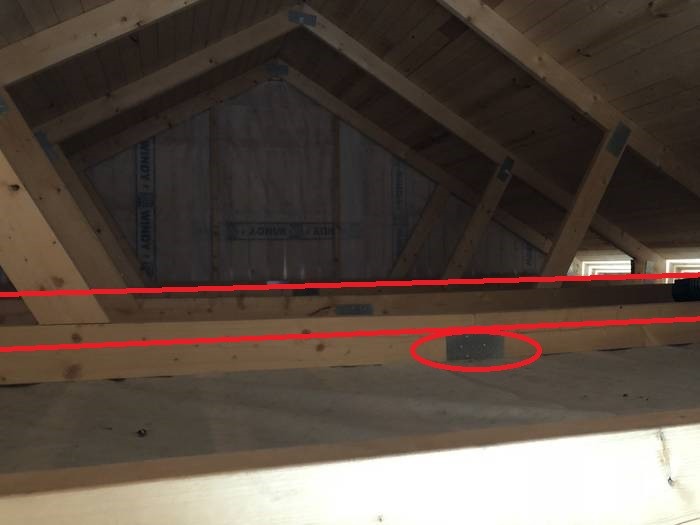
I've only read parts of the thread, but why make it so difficult for yourself? If you've already bought finger-jointed 45x145, attach them alongside the existing ones but raise them up by half the width. This way, they relieve the weakest point of the trusses, which is the circled joint that was poorly made from the start. Additionally, you'll get a loft that can hold lighter items. Some deflection should be acceptable on a garage loft, you're not planning to live there, right?
I have only read parts of the thread but why make it so difficult for yourself? If you have already bought finger-jointed 45x145, attach them next to the existing ones but raise them by half the width. That way you relieve the weakest point of the trusses, which is the circled joint that was really poorly made from the beginning. Additionally, you'll have a loft that can hold lighter items. Some deflection must be acceptable on a garage loft, you aren't planning to live there, are you?
[image]
No, absolutely not, I have no intention of living there, just to get up some things that you normally have in the garage. Of course, I don't want to make it difficult for myself, on the contrary, but I want a sustainable solution to remove the deflection, and I want to be able to place a few things in the loft, not much more than that. But as I said, there are many suggestions that sound reasonable to me here, and I am extremely grateful for all the help & input. However, I find it hard to assess what I need to do now . You must really excuse me, but I don't know much about this, yet I'm not completely clueless either. But if I'm going to do this, I want to be sure that I'm doing it right
I understand, however, I am not knowledgeable in the subject so I find it difficult to decide what is best to do to reduce and straighten the sag. Since I had already bought 6.5m finger-jointed boards, I was wondering if I could use them for something constructive for the solution.
If it can ease your process, my advice is to value justusandersson's advice higher than most others. His answers can be backed up with theory and he does not speculate.
If it can make things easier for you, my advice is to value justusandersson's advice higher than most others. His answers can be supported by theory, and he does not speculate.
Yes, that's true, as he is a designer. However, there have been many good suggestions. However, I'm not sure how I should proceed with the existing ones to straighten them out.
I understand that it becomes confusing for you. But I find it difficult to pretend that I think something other than what I think. At least try attaching a finger-jointed plank and evaluate it. It may be that today's unjustifiably large deflection is due to the poor joints. If you can come down to a third of 20 mm, you have definitely gained something.
Ok, I'll have to try with the first 2. Got a good suggestion on how to attach them:
Wood screws 6.0x80 s200 in double rows. Possibly even denser just where the struts meet the underframe.
I've only read parts of the thread, but why make it so hard for yourself? If you've already bought finger-jointed 45x145, attach them next to the existing ones but raise them by half the width. That way, they relieve the weakest point of the trusses, which is the circled joint that is really poorly made from the start. Additionally, you'll have an attic that can support lighter loads. Some deflection must be acceptable for a garage attic, you don't plan on living there, do you?
[image]
Your solution seems, of course, the simplest and clearly feasible without any extra cost. However, I wonder if it will result in the same deflection (even if I level them before)?
Certainly a worthwhile alternative, and I'm looking at and listening to all the smart suggestions.
Your solution certainly looks simplest and clearly doable without any extra cost. However, I'm wondering if it will have the same deflection (even if I get them level beforehand)?
But definitely worth considering and I'm open to all smart suggestions.
No, the deflection will decrease significantly. As it is built now with an overly weak collar tie that is also jointed in the middle with a very weak nail plate, almost the entire weight from the struts is resting on the small screws placed in the nail plate. If you first straighten the truss with a jack from below and then attach the finger-jointed ones as I showed, you will have a collar tie that in practice is ~220mm at the same time as it will distribute the load from the struts across the entire length and not just at the joint.
The builders who made the trusses didn't have much knowledge. Factory-ordered and home-delivered trusses for an entire garage usually cost 300-400 euros more than buying all the material from the lumber yard. I can pretty much guarantee that they charged more for the labor time it took to build them than that, and you would have gotten correctly sized trusses from the start.
No, the deflection will decrease significantly. As it is built now with an overly weak collar beam that is also butt-jointed in the middle with a too thin nail plate, almost the entire weight from the struts rests on the small screws placed in the nail plate. If you first straighten the truss with a jack from below and then attach the finger-jointed beams as I showed, you will have a collar beam that is essentially ~220mm while distributing the load from the struts across the entire length and not just on the joint.
The builders who made the trusses didn't have much knowledge. Factory-ordered and home-delivered trusses for an entire garage usually cost 300-400 euros more than buying all the material from the lumberyard. I can probably guarantee that they billed more for the labor time it took to build them than that, and you would have received properly dimensioned trusses from the start.
Yes, it's possible that this was poorly done and executed by the carpenters, but as a layperson, I trusted their expertise.
So this is a solution that could be a really good alternative both economically and performance-wise. I have such a hard time knowing if this is a solution that would work in terms of load-bearing (not going to have much up there) and not sag too much.
When I calculate it, I come to the conclusion that the construction can handle approximately 50 kg per sqm including its own weight. However, the solution is not compatible with my proposal with glulam. What is the roof pitch and in which snow zone is the garage located?
When I calculate it, I find that the construction can withstand about 50 kg per sqm including its own weight. However, the solution is not compatible with my suggestion of glulam. What is the roof slope and in which snow zone is the garage?
The roof slope is 30 degrees and snow zone 2 (Stockholm - Tyresö)
That's right, as he is a designer. However, there have been many good suggestions. Still, I am not sure how to proceed with the existing ones to straighten them.
It's because you're not getting the answers you want. Namely, that you can set your prime finger-jointed rules as reinforcement on existing trusses and that everything will turn out great with good load capacity and minimal deflection. Instead, acknowledge your mistake and learn from it for next time. In some subjects, it's better to ask first and act later rather than the other way around.
This type of confirmation-seeking endless threads is not uncommon, either on BH or other forums.
Appreciate the answers you get, assess by yourself or with others' help who has the best answer from an objective perspective (often the one who can back up with facts, references, calculations, etc., and whom no one can or will argue against).
In this thread, it is clear that you should take Justus' solutions and copy them directly. No disrespect to other writers (including my own posts), but thread after thread, Justus has demonstrated how well he knows this type of subject. If you compile all his posts, you can create a to-do list in bullet form on how to handle both the existing deflection and the floor for the upper floor's storage purposes. Print out that list and start checking it off from top to bottom, then you're all set.
That is because you're not getting the answers you want. Namely, that you can use your prime finger-jointed rules as reinforcement on existing roof trusses and that everything will turn out great with good load capacity and minimal deflection. Instead, recognize your mistake and learn from it for next time. In certain subjects, it's better to ask first and act later than vice versa. This type of confirmation-seeking endless threads is not uncommon either on BH or other forums.
Appreciate the answers you get, evaluate by yourself or with others' help who has the best answer from an objective standpoint (often the one who can back with facts, references, calculations, etc., and which no one can or will dispute).
In this thread, it is crystal clear that you should take Justus's solutions and copy them straight out.
No offense to other writers (including my own contributions), but in thread after thread, Justus has shown how well he understands this type of subject. If you compile all his posts, you can come up with a to-do list in bullet points on how to handle both existing deflection as well as the floor structure for the storage purposes of the upper floor.
Print that list and start checking it off from top to bottom, then you're set.
However, I don't think you've read my post carefully enough. I have not acted first and asked later, but the finger-jointed rules were intended to complement existing roof trusses so I would get cc60 instead of cc120 and that WITHOUT having any idea of how much it really sagged. So my post came after that and had nothing to do with reinforcing or saving an initially poor construction.
Then there can be good ideas and thoughts that, for example, maybe @justusandersson hasn't considered but could be a viable solution with already purchased material. I'm not crying over having 6 finger-jointed boards lying around; it was more about whether "can they be utilized" for something that could contribute to a solution or part of a solution. It could be that someone who can calculate load hasn't thought of alternative solutions like the latest from @Finndjävel. But for me, it might be harder to evaluate the proposal if it could work load-wise, something that, for example, @justusandersson or someone who understands constructions/load could do, but some might not want to comment on others' solutions or ideas for all I know.
I have also understood that if I follow Justus's suggestion, I’m set, but I can't dismiss if another proposal comes up which in my ears sounds reasonable as well. Then we can discuss that solution together if it is about load something that could work. If I was the one who understood this and a suggestion popped up that might also work, I would at least say, "yes, not a bad idea, that could also work, though only for loads of 50kg/m2." There may not be only one sole solution to the problem, even if I am very aware of Justus’s expertise in this area.


 . You must really excuse me, but I don't know much about this, yet I'm not completely clueless either. But if I'm going to do this, I want to be sure that I'm doing it right