I just had a five-hour power outage, so I haven't had the opportunity to respond.
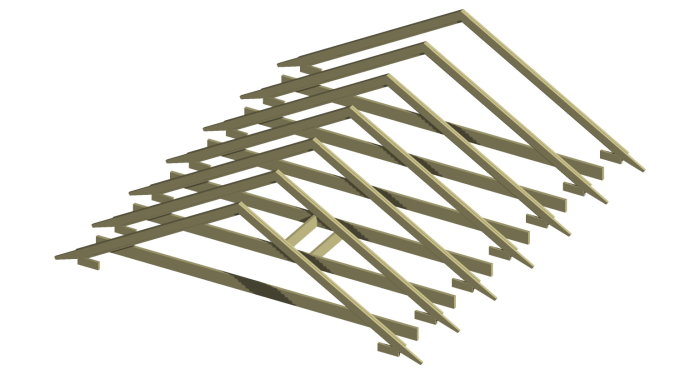
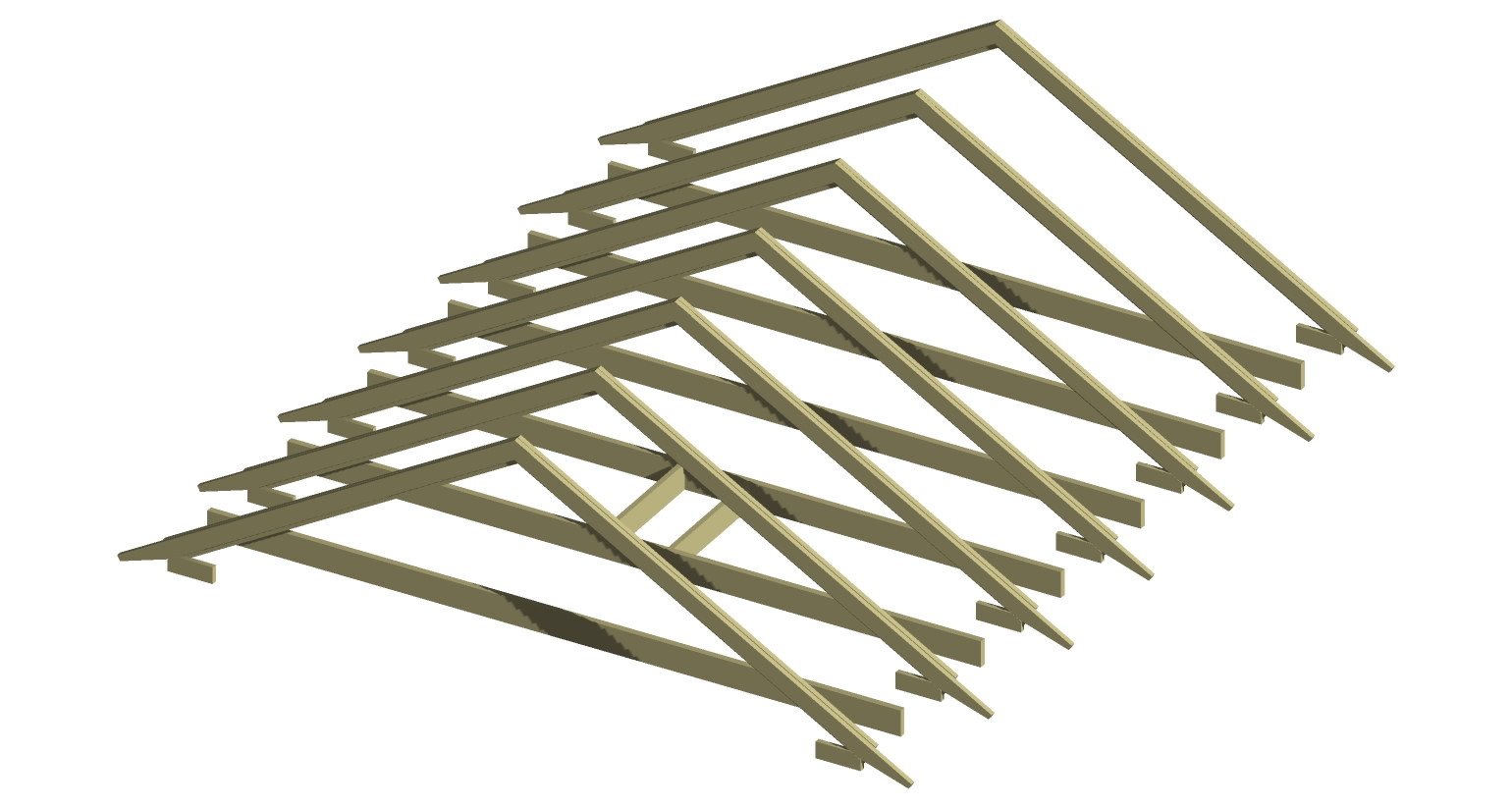
I entered the discussion in this thread when I discovered that no one mentioned that 6-meter long 45x145s do not in any way handle that span. I then suggested switching to glulam beams between the original roof trusses. Over time, I understood that the trusses, even without a load, deflect significantly. I then believe there is only one sensible action left, in line with what @Slarvpellen suggested. Reinforce the upper chords of the trusses by screwing an additional beam alongside the existing ones. Then remove the supports and cut off the lower chords near the wall. The glulam beams will handle the loads you want to store in the attic and at the same time absorb the tensile forces that the lower chords would otherwise handle. Additionally, you'll have a loft without supports, which is significantly easier to use. My first thought was that you should use your finger-jointed 45x145 for this. It works if you can get the old and new to cooperate by glue-screwing them. In practice, this might be difficult. Then it's easier to screw on new 45x195 beams.
I just had a five-hour power outage, so I haven't had the opportunity to respond.
I joined the discussion in this thread when I discovered that no one mentioned that 6-meter-long 45x145s do not support that span. I then suggested switching to glulam beams between the original trusses. Over time, I have come to understand that the trusses without load still sag significantly. I then think there is only one reasonable action left, in line with what @Slarvpellen proposed. Reinforce the truss upper chords by screwing an additional beam alongside the existing ones. Then remove the braces and cut off the lower chords next to the wall. The glulam beams will handle the loads you want to store in the loft and simultaneously take up the tensile forces the lower chords would otherwise be responsible for. In addition, you'll have a loft without braces that is much easier to utilize. My first thought was for you to use your finger-jointed 45x145s for this. It will work if you can get the old and new to cooperate by gluing and screwing them. In practice, this might be difficult. Then it's easier to screw on new 45x195 beams.
Hm tried to find that suggestion from @Slarvpellen and wonder if I missed it . I'm not quite following this (sorry if I'm a bit slow here). You mean to reinforce what's going up towards the ridge (the upper beam) with the same dimension 45x145 and then glulam beams instead like today 45x145 and cut the braces. Doubling the upper beam with an extra 45 would be wider than the glulam beam's 56mm.
Ah, now I understand, I thought I was supposed to replace the existing lower arm that is sloppy with glulam beams, but I now understand that they are placed between each rafter.
So this is the solution that would work best according to you and can handle the snow load without the lower arm and support, you mean?
This is undoubtedly the best solution in terms of load-bearing capacity and usability. Maybe not the cheapest, but you will get rid of the misery caused by your poorly constructed trusses. Note that the truss top chords are reinforced with screwed 45x195 C 24 timber.
Some general principles that might be good to keep in mind for the future: 1 The span is always the most critical factor for horizontal load-bearing structures, regardless of dimensions. The internal moment, which has a deflecting effect on a beam, increases proportionally to the load but with the square of the span. 2 For roof beams (which support the outer roof), the roof pitch is very important. The more a roof slopes, the larger the portion of roof loads becomes normal forces along the length of the roof beams. From 30° upwards, the value of snow loads is also reduced so that they are zero at 60° (applies to the most common roof shapes).
This is undoubtedly the best solution in terms of load-bearing capacity and usability. Maybe not the cheapest, but you get rid of the disaster that your misshaped trusses have caused. Note that the upper frames of the trusses are reinforced with screwed-on 45x195 C 24 timber.
Some general principles that might be good to consider for the future: 1 The span is always the most critical factor for horizontal load-bearing structures, regardless of dimensions. The internal torque, which acts to bend a beam, increases proportionally to the load but with the square of the span. 2 For roof beams (which bear the outer roof), the roof pitch is of great importance. The more a roof slopes, the greater the portion of the roof loads becomes normal forces in the longitudinal direction of the roof beams. From 30° and upwards, the value of the snow loads is additionally reduced so that they are zero at 60° (applies to the most common roof shapes).
I understand I missed that it was 45x195 timber in the upper arms. I realize that my finger-jointed ones will simply become firewood for the stove this winter.
Assuming you mean that I then cut it as in the picture and then remove the underarm and support legs after I have screwed together 45x195 on the upper arm. How far down should the 45x195 go?
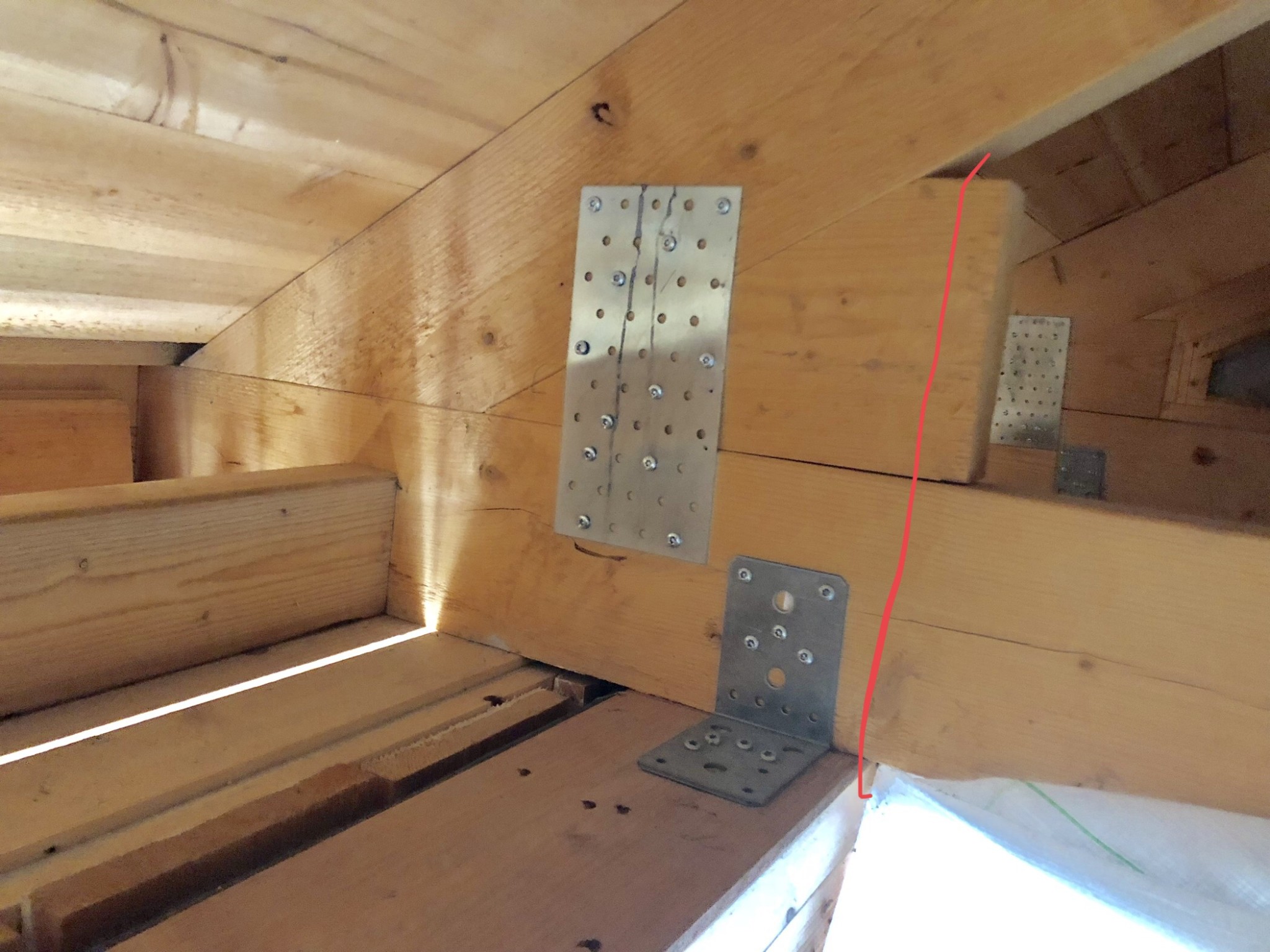
Preferably as far as the existing upper frame. An eave usually doesn't look like yours. The upper frame usually continues at full height past the subframe. The latter is usually beveled.
As one can interpret the image, the "new" trusses are supposed to be triangles, is this correct? Is it intended that the new glulam beams should rest on the wall plate? Such a construction relies on even load on both sides, otherwise you have a mechanism (Yes, one can discuss the stiffness in the joints but that is not something known). As you say, you feel a certain uncertainty about how to simplify the work a bit, is, for example, the removal of the support leg absolutely necessary?
Yes, of course one becomes uncertain, because now there's a different solution than what I initially thought (to support the existing tie beams once they are propped up level & screw 45x145 onto the existing ones) and then use glulam in between for the actual floor.
As I interpret the "new" trusses, they will not have any tie beams or braces at all (that feels very strange). But it's hard for me to assess. I don't really understand how they will manage with the pressure that will be down against the wall plate from the remaining part of the tie beam that gets cut off.
But I understand there's a point in reinforcing the upper chord where all the load from the roof/snow will be. But removing the braces & tie beams sounds a bit scary
I must admit that I became a bit concerned when I saw the picture of the eaves. I think it will be easier for you if you don't bother removing the old subframes and support legs. The new glued laminated beams must be positioned above studs in the outer wall. I have assumed they are at c/c 600 mm.
I have to admit that I became a bit concerned when I saw the picture of the eaves. I think it will be easier for you if you don't bother removing the old subframes and support legs. The new glulam beams need to be placed above the studs in the outer wall. I have assumed they are spaced c/c 600 mm.
Now I'm not quite following, should I not bother propping up and reinforcing the existing subarms at all? And only place glulam beams between each rafter??
The glulam beams should be positioned in the middle of the rafters. I have emphasized this all along. It is also clear from my pictures. I have never advocated reinforcing the existing lower frames. A reinforcement of the upper frames should result in a reduction of the load on the lower frames. And that they are only loaded by their own weight.
The glulam beams should be placed in the middle between the rafters. I have emphasized this all along. This is also clear from my pictures. I have never advocated for reinforcing the existing lower frames. Reinforcing the upper frames should lead to a reduction in the load on the lower frames. And they should only be loaded by their own weight.
That's correct, glulam beams between each rafter I understand, you've said that all along so it's crystal clear. However, I got the feeling that I could try propping and reinforcing the existing lower arms with 45x145 after previous posts and discussions. If I look very closely at the roof tiles from below and up towards the ridge, it actually looks like it sags in the middle. But that's with the naked eye without any special measurement, but there were 2 of us looking and we thought the same. Reinforcing the upper arms I can understand would reduce the pressure on the lower arms, but the question is whether the 2cm deflection that currently exists will then decrease, probably not? I thought more like a try to lift the lower arms and reduce the existing deflection.
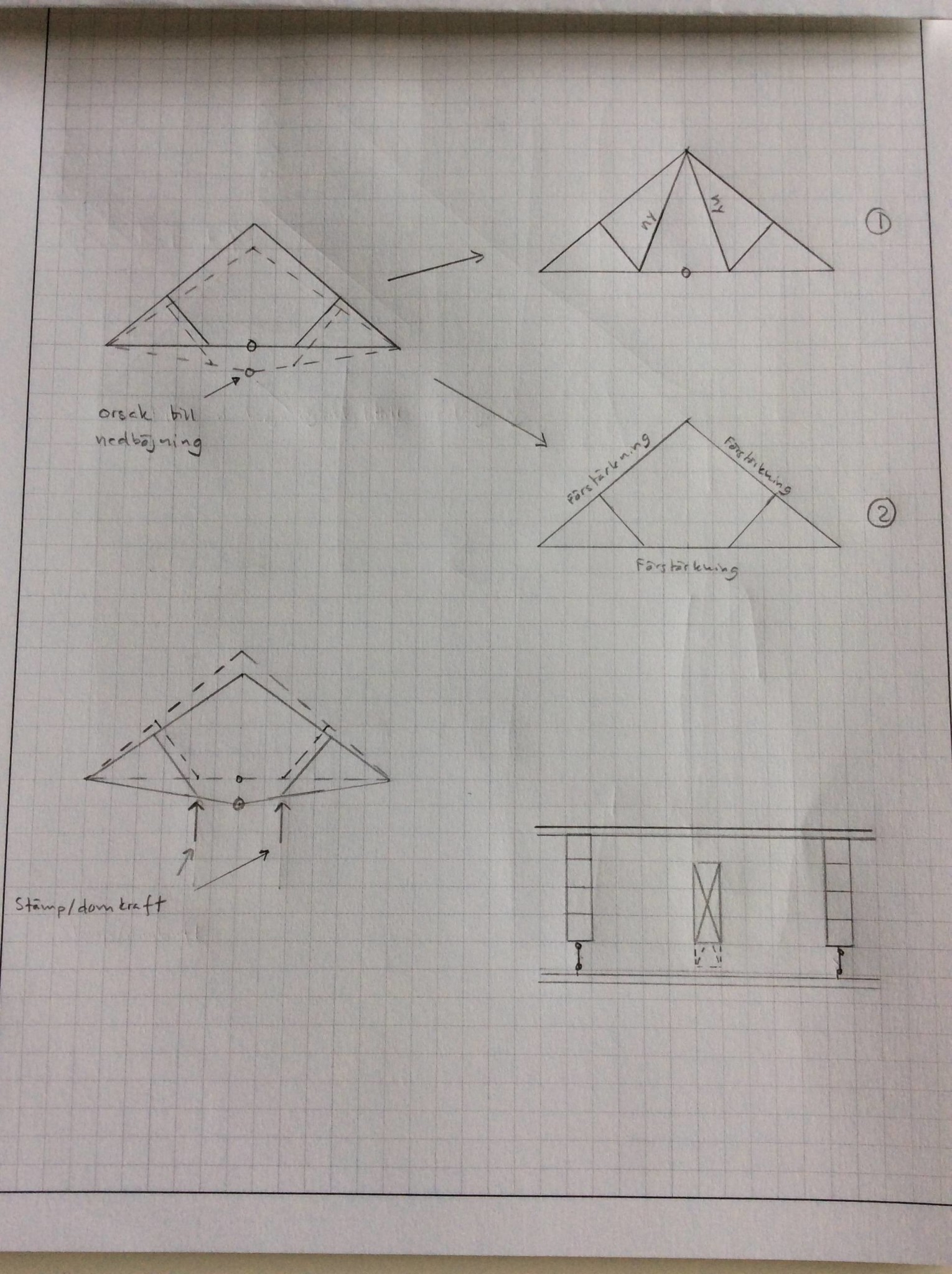
The reason for the sagging is the joint in the middle of the lower frame. What is more or less supporting the roof today is only the upper frame, as the lower frame cannot bear any vertical load due to the joint. The trusses must be reinforced because they are completely misconstructed. As I see it, there are two relatively easy measures. One, add tie rods up to the ridge. Two, reinforce both the lower and upper frames. Regardless, you need to prop up the truss before the reinforcement is done; these should be placed under the diagonals. You then hang the inner roof down from the new glulam beams so that it passes the truss with a gap, making the inner roof independent of how much the truss sags due to snow etc. In the absence of anything else, I'm trying to describe with a picture
Vi vill skicka notiser för ämnen du bevakar och händelser som berör dig.


 . I'm not quite following this (sorry if I'm a bit slow here). You mean to reinforce what's going up towards the ridge (the upper beam) with the same dimension 45x145 and then glulam beams instead like today 45x145 and cut the braces. Doubling the upper beam with an extra 45 would be wider than the glulam beam's 56mm.