
37,381 views ·
190 replies
37k views
190 replies
Trusses that are sagging
Glad you give upC crazytok said:That picture felt completely different from the first one. I give up!
Wow, only 145mm at 6m. Yeah, that was weak! But, if the roof has held with snow load etc. on 145, then I can't imagine it wouldn't hold for a few things in the attic! But I still maintain that you add a 45 on top so as not to affect the existing trusses at all when you put in the floor. Instead, supplement with more 45x145 (but you might as well go up to 45x190 at once instead of an extra 45 on top).

Very good advice and many suggestions, which is good. Now I'm a bit unsure how I should proceed.
But you mean:
1. Use my existing 45x145x6500 as ordered and delivered by Fredells.
2. Screw on an extra 45x45 on top of them so they become 45x190 (is there even 45x45 in 6.5m?) or maybe 6m works on them even though the others are 6.5m.
3. Since it becomes cc120, what did you plan to screw on as flooring?
Last edited:
You don't necessarily need full lengths; in this case, it's just about building up in height to not be level with the rafters, not about structural integrity.
In our cold attic, we have 22mm raw pine tongue and groove as a walkway between cc120. It obviously flexes but supports me walking on it without any issues. And also having some stuff on it. What flooring you lay depends on what you want to store up there. It's suitable for lighter boxes, skis, suitcases, and such.
But if you want to store heavier items and perhaps have a little margin, then it's best to buy additional joists to set at cc60. An alternative could be laying crosswise 45s over everything and then raw pine tongue and groove/chipboard flooring on top of that. I don't know which is easier or cheaper in your case.
In our cold attic, we have 22mm raw pine tongue and groove as a walkway between cc120. It obviously flexes but supports me walking on it without any issues. And also having some stuff on it. What flooring you lay depends on what you want to store up there. It's suitable for lighter boxes, skis, suitcases, and such.
But if you want to store heavier items and perhaps have a little margin, then it's best to buy additional joists to set at cc60. An alternative could be laying crosswise 45s over everything and then raw pine tongue and groove/chipboard flooring on top of that. I don't know which is easier or cheaper in your case.

As I have previously pointed out, an extension with only 45 mm on your 45x145 does not give an acceptable result with respect to deflection. You need to extend with at least 95 mm, preferably 120 mm, preferably with 6-meter lengths.
I haven't accounted for deflection.
Does deflection play a role in storing stuff?
Or do you mean that 45mm of clearance isn't enough because it flexes to the point where it will touch the existing trusses?
I didn't see that you replied to my post earlier, just read it now.
With 2cm of deflection in the middle, you still have 25mm free before it would touch the truss beams. Plus, you'll distribute the weight when you lay flooring on top. No, it won't win any prizes for structural integrity, but it should work for storing lighter things up there.
45x220 or larger is of course better. But I'm trying to find a solution so he can use what he's already bought...
Does deflection play a role in storing stuff?
Or do you mean that 45mm of clearance isn't enough because it flexes to the point where it will touch the existing trusses?
I didn't see that you replied to my post earlier, just read it now.
With 2cm of deflection in the middle, you still have 25mm free before it would touch the truss beams. Plus, you'll distribute the weight when you lay flooring on top. No, it won't win any prizes for structural integrity, but it should work for storing lighter things up there.
45x220 or larger is of course better. But I'm trying to find a solution so he can use what he's already bought...
Last edited:
2 cm in addition to the 2 cm that are usually accepted (=1/300 of 6 meters) making a total of 4 cm. It looks unsightly, especially when the beams are fitted with a ceiling.
1. The Limträ dimension is 56x225.M M@ZE said:
2. How it compares in difference. When calculating, it is primarily the height that provides better load-bearing capacity, so the meager 5mm difference doesn't make much of an impact. However, in the difference between C24 45x220 and Limträ GL28cs 56x225, it is the case that Limträ is stiffer/stronger due to multiple layers and therefore can handle a bit more load and results in less deformation. Is this what you were wondering about?
3. Regarding your existing 6.5m 45x145. They will not be able to support very much if you use them as floor joists as they are right now. I would aim to reinforce the roof structure with these and strengthen the underlying frames. If you still wish to use your 45x145 as floor joists, I would probably do as crazytok suggests, but perhaps even add a 45x70, or as justusandersson suggests, have an additional 45x95, which is screwed and glued in place (standing) with relatively tight screw spacing. If you buy standard timber at 5.2 m, it will be sufficient if you place them centrally, as it will still be difficult to store much towards the eaves, and out there they won't contribute much to either load-bearing capacity or deformation resistance.
Note: You cannot have the floor joists on just s1200! It won't support much at all. Pure 45x220 timber would barely support 50kg/sqm. When you screw together joists at home, you can't expect them to be as strong as solid material. But maybe you aren't planning to store anything heavy?
Taking into account the differences in both moments of inertia (a pure function of cross-sectional dimensions) and modulus of elasticity between 45x220 C 24 and 56x225 glulam, the glulam beam is almost 60% stiffer, regardless of the span.
Those finger-jointed 6.5m will be extremely wobbly. You can test it yourself by setting them up with support only at the ends and then loading them, you will see that it's wobbly enough. They will not add any load-bearing capacity. With a vertical connection to the ridge, you get the equivalent of a 3.25-meter span instead, which makes this joist more stable. 3.25 meters is completely sufficient, I wouldn't bother with an inverted V, this makes the joist only marginally more stable, but much harder to use for skis and sleds. An inverted V might make the outer roof somewhat more stable. You would then have a W-truss if you place the support legs correctly. But if you're not planning to load the inner ceiling with any significant weights and the roof otherwise seems to handle potential snow loads, then there's no reason for W-trusses. I would either sell your 6.5m or use this wood for the suspension.M M@ZE said:
Tried to draw on your picture... but it's a bit dark
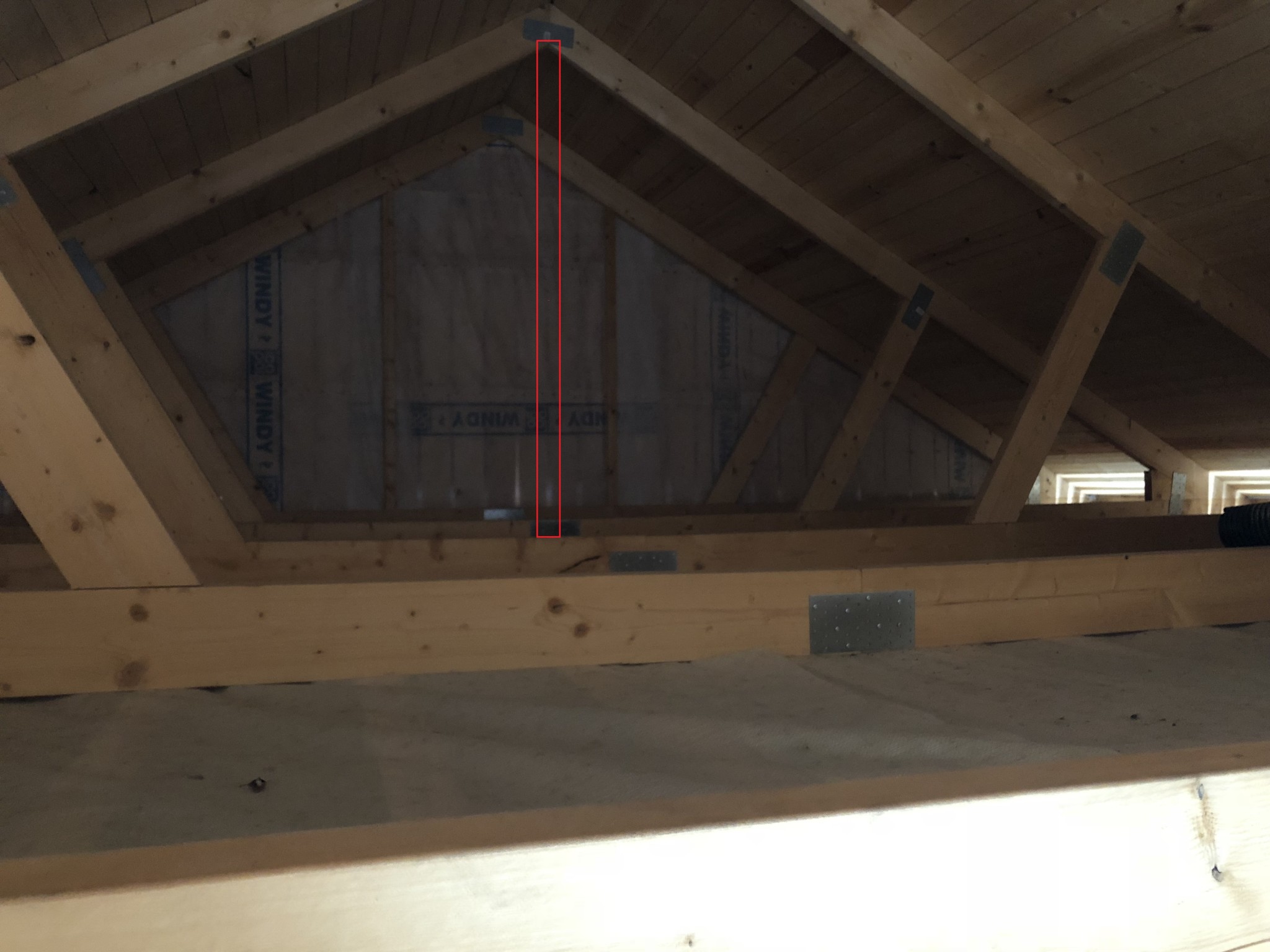
It looks like the existing horizontal lengths are joined only with nail plates; I would guess this is a major contributing factor to why the inner ceiling wants to sag. So a suspension in the ridge should probably have been done from the beginning.
Thanks for the advice on the brace up to the ridge. Impressive how much help and knowledgeable people you get help fromD Djurmo said:Those finger-jointed 6.5m will become highly wobbly. You can test it yourself by setting them with support only at the ends and then loading them, you'll see that it's wobbly enough. They won't add any bearing capacity. With a vertical connection to the ridge, you get a corresponding 3.25-meter span instead, which makes the floor structure sturdier. 3.25 m is completely sufficient, I wouldn't mess with an inverted V, this only makes the floor structure marginally sturdier but much harder to use for skis and sleds. An inverted V would possibly make the outer roof somewhat sturdier. You then get a W-truss if you place the support legs correctly. But if you don't plan to load the inner ceiling with any large weights and the roof otherwise seems to handle possible snow loads that may occur, then there's no reason for W-trusses. I would either sell your 6.5m or use this timber for the suspension.
Tried to draw on your picture... but it's a bit dark
[image]
It looks like the existing horizontal lengths are joined, only with nail plates, I would guess that this is a major contributing factor to why the inner ceiling wants to sag. So a suspension in the ridge should probably have been done from the start
.I'll try to see if I can get the construction company that built it about 9-ish years ago to come out.
There are so many good tips here with different solutions, it's fantastic. However, the following might be the closest solution unless you manage with just making braces on each truss up to the ridge.
1. Prop up existing trusses vertically
2. Screw together existing trusses with my finger-jointed 45x145 to at least get them in order.
3. Buy glulam beams as suggested above, which won't be more expensive than building additional trusses.
The only problem I see with this is how to get them in place with how it looks today. The alternative is to tear down gypsum, battens, and plastic.
If I were you, I would skip laminated beams. It seems to be quite cramped anyway, so not much load will likely come up at all. Building new rafters might be cheap in material... But a veritable nightmare to get them in place. Also a whole lot of extra hours.M M@ZE said:Thanks for the advice with the brace up to the ridge. It's impressive how much help and knowledgeable people you get help from
I'll try to see if I can get the carpentry company that built it 9-ish years ago to come out.
There are so many good tips here with different solutions, it's fantastic. However, it might be the following that's closest if you can't manage by just making braces on each rafter up to the ridge.
1. Stamp the existing rafters vertically
2. Screw the existing rafters together with my finger-jointed 45x145 to at least get them in order.
3. Buy laminated beams according to the above suggestion, which isn't more expensive than building new extra rafters.
The only problem I see with this is how I'm supposed to get them in place with how it looks today. The alternative is to mess up the plaster, battens, and plastic.
Make a trestle out of your 6.5m which you place right under the ridge and on the same line as the ridge. Make the trestle a few cm lower than the ceiling height, then take regular tension straps and play together the legs of the trestle so that it presses up the beams. You probably need three to four pairs of legs on the trestle. When the back of the trestle is adjusted so the beams are level, you climb up and attach your vertical braces.
But that's how I would have done it... I might be lazy
How about placing a glue-laminated timber along the brace for the entire length, one on each side. With support in the wall plate on the short sides, it reduces the span on the lower arm.
It can be attached with designated nail plates or a 45*90 that is screwed into the angle at each rafter/brace.
The floor can then be laid lengthwise of regular planks or a cheap pine floor (second grade).
It can be attached with designated nail plates or a 45*90 that is screwed into the angle at each rafter/brace.
The floor can then be laid lengthwise of regular planks or a cheap pine floor (second grade).
Hmm unfortunately, I'm not quite sure what you mean .. on the other hand, I'm not the right person to judge whether it is a good solution anywayC corre said:How about placing a glulam along the brace for the entire length, one on each side. With support in the wall plate on the short sides, it reduces the span of the bottom chord.
It can be fastened with intended nail plates or a 45*90 screwed into the angle at each rafter/brace.
The floor can then be laid lengthwise with regular planks or a cheap pine floor (second grade).
I realize my unclear wording...
A glulam beam across the rafters, lying right at the edge of the braces that are there today. It can then reduce the bearing on the bottom chord and relieve sway and deflection. The relieving of that beam in the wall plate. By then supporting the bottom chord of all rafters, load and deflection are distributed more evenly.
You can install a simple floor, and if you want, build shelves between the rafters on top of the glulam beam.
It can be fastened with brackets designed for it or by screwing a 45*70 block on each side of the rafter against the beam.
https://www.biltema.se/bygg/byggbeslag/stolpskor/gaffelankare-48-mm-fzv-15-mm-2000022888
https://www.biltema.se/bygg/byggbeslag/takasfasten/takasfaste-2000023690
From an economic perspective, I would consider taking your existing 45*145 and doubling them in height. Lay them on the ground side by side, cut plywood to 2400*280, and screw-glue these on both sides of the new beam you're building, with overlapping scarf joints so there isn’t a general seam.
A glulam beam across the rafters, lying right at the edge of the braces that are there today. It can then reduce the bearing on the bottom chord and relieve sway and deflection. The relieving of that beam in the wall plate. By then supporting the bottom chord of all rafters, load and deflection are distributed more evenly.
You can install a simple floor, and if you want, build shelves between the rafters on top of the glulam beam.
It can be fastened with brackets designed for it or by screwing a 45*70 block on each side of the rafter against the beam.
https://www.biltema.se/bygg/byggbeslag/stolpskor/gaffelankare-48-mm-fzv-15-mm-2000022888
https://www.biltema.se/bygg/byggbeslag/takasfasten/takasfaste-2000023690
From an economic perspective, I would consider taking your existing 45*145 and doubling them in height. Lay them on the ground side by side, cut plywood to 2400*280, and screw-glue these on both sides of the new beam you're building, with overlapping scarf joints so there isn’t a general seam.
Carpenters normally do not have the expertise required to make that type of assessment. Clearly, it is possible to build roof trusses suitable for a garage with that span, those lumber dimensions, and splice with nail plates. At least in southern Sweden where the snow loads remain around 2 kN/sqm or lower. I have such roof trusses in my garage, purchased as a kit from Mellbygarage. 6 meters span, c/c 1200 mm, and they can support quite a bit of storage. The problem with your roof trusses is that they are probably misconstructed. For a nail plate joint to be OK, it must be in a momentless position. Beams spanning over several supports normally have such positions at specific distances from the supports. The supports on your roof trusses look like on a truss with the difference being that the important central supports are missing. They should be vertical to handle the tensile forces that are relevant. Rebuilding your roof trusses on-site, I believe, is risky for several reasons. Therefore, I recommend a solution with new laminated wooden beams, so that your roof trusses can just be roof trusses.