
37,022 views ·
190 replies
37k views
190 replies
Trusses that are sagging

Yes, you can also do that. But if you already have the wood, I would run it along the entire way to do it properly. If you’re only going a couple of meters on each side, I would put splints on both sides of the bottom frame and screw straight through the entire cross-section of 135 mm with substantial screws of 6(or 8)x120. Preferably even SFS WT-T 6.5x130.M M@ZE said:Thank you for the input. I think I understand how to use my already purchased finger-jointed 45x145 the entire length (6.5m) then, I assume? And screw it into the existing ones that are jointed in the middle after getting it to a neutral position. Or would it be enough to screw a 45x145 a few meters on the sides of the joint?
That actually sounds very sensible.
Without having calculated it myself, I would be nervous about the nail plate joint, but that’s just me.
Yes, as justusandersson writes, it will address the deformation. However, I am doubtful that it will hold with the execution as it is today. But that is up to the person who designed it.
Provided the floor is flat, you can measure the height from floor to bottom frame at the outer walls and then compare it with the floor to bottom frame in the middle. Otherwise, I think a string sounds like a good idea.
If it's only to store things in the attic, I think extra trusses sound like a lot. Better with just beams as long as it’s not a significant amount of weight going up there?
Approximately, you can load 45x220 C24, length of 6 m, s-distance 600 mm with about 100 kg/sq m. However, the deformation might be slightly more than what is acceptable in residential buildings. But as I've understood, it's a garage and attic floor, so maybe you can accept larger deformations? If not, you have to either place the beams closer together or go up in size somewhat and choose glulam or Kerto instead.
Can't you use the finger-jointed studs you already bought, place them between each rafter. Then you lay an additional 45 on top, and then flooring on this. This way, you don't affect the rafters at all, only the wall construction in your garage. Thus, you'll have an air gap between the existing rafters and the floor of 45mm.
However, you will have 120cm between the studs, so it might sag a bit depending on what you plan to use as flooring. But then you either add extra finger-jointed studs next to each rafter and 45 on top. Alternatively, you place 45s on top with cc30, for example, and then flooring.
However, you will have 120cm between the studs, so it might sag a bit depending on what you plan to use as flooring. But then you either add extra finger-jointed studs next to each rafter and 45 on top. Alternatively, you place 45s on top with cc30, for example, and then flooring.
Since we started the discussion in this thread, the span has decreased from 6.5 to 6 meters, which is not an insignificant change. It means you can place glue-laminated timber 56x225 between the rafters and handle a load including dead weight of 100 kg/sqm without abnormal deflection. This should be the main option. 45x145 + 45x45 screwed and glued results in 2 cm extra deflection in the middle. 45x220 results in 1 cm extra deflection in the middle. Why spend money on something that is almost good?
Building extra rafters can work if they are properly sized, but it's a huge job to get them in place without removing the roof. Truss rafters are the safest type for larger spans, but then the entire attic becomes full of posts.
Building extra rafters can work if they are properly sized, but it's a huge job to get them in place without removing the roof. Truss rafters are the safest type for larger spans, but then the entire attic becomes full of posts.
J justusandersson said:Since we started the discussion in this thread, the span has decreased from 6.5 to 6 meters, which is not a negligible change. This means you can place laminated timber 56x225 between the trusses and handle a load including self-weight of 100 kg/sqm without abnormal deflection. This must be the main option. 45x145 + 45x45 screw-laminated gives 2 cm extra deflection in the middle. 45x220 gives 1 cm extra deflection in the middle. Why spend money on something that is almost good?
Building extra trusses can work if they are correctly dimensioned, but it's a huge job to get them in place without lifting off the roof. Truss roof trusses are the safest type for larger spans, but then the entire attic is full of posts.
I calculated how much it would take to make my own trusses if I look at the existing ones, it would be 35 meters per truss at 25.95 per meter x 6 trusses. This becomes 6300:-.J justusandersson said:Since we started the discussion in this thread, the span has decreased from 6.5 to 6 meters, which is not a negligible change. This means you can place laminated timber 56x225 between the trusses and handle a load including self-weight of 100 kg/sqm without abnormal deflection. This must be the main option. 45x145 + 45x45 screw-laminated gives 2 cm extra deflection in the middle. 45x220 gives 1 cm extra deflection in the middle. Why spend money on something that is almost good?
Building extra trusses can work if they are correctly dimensioned, but it's a huge job to get them in place without lifting off the roof. Truss roof trusses are the safest type for larger spans, but then the entire attic is full of posts.
5 laminated timber 56x225 costs at byggmax 5094:-. They weigh 36kg, fairly manageable. Then it might be difficult to move them into place between the bays since half of the garage is lathed and screwed with gypsum so I wonder if one can twist them into place in each bay. But considering the effort involved, it is the quickest and easiest in my layman's ears.
Then it would require quite a few 36mm boards, though I can't find any in that measurement
 . What type of boards were you thinking for the floor?
Last edited:
I agree with that, on the other hand, you can get away with about half the price for 45x220 instead of glulam 56x225 to reduce the deformation by 1 cm. In residential houses, I would definitely recommend glulam; in garages, the deflection is not as important. But it's probably up to the TS to consider what level they want to aim for.J justusandersson said:... This means you can place glulam 56x225 between the rafters and handle a load including its own weight of 100 kg/sqm without abnormal deflection. This should be the main option. 45x145 + 45x45 screw-bonded gives 2 cm extra deflection in the middle. 45x220 gives 1 cm extra deflection in the middle. Why spend money on something that is almost good?
Showed the picture of the rafters to some colleagues who were a bit fascinated that it has lasted this long. Has it been mentioned roughly where in the country this garage is?
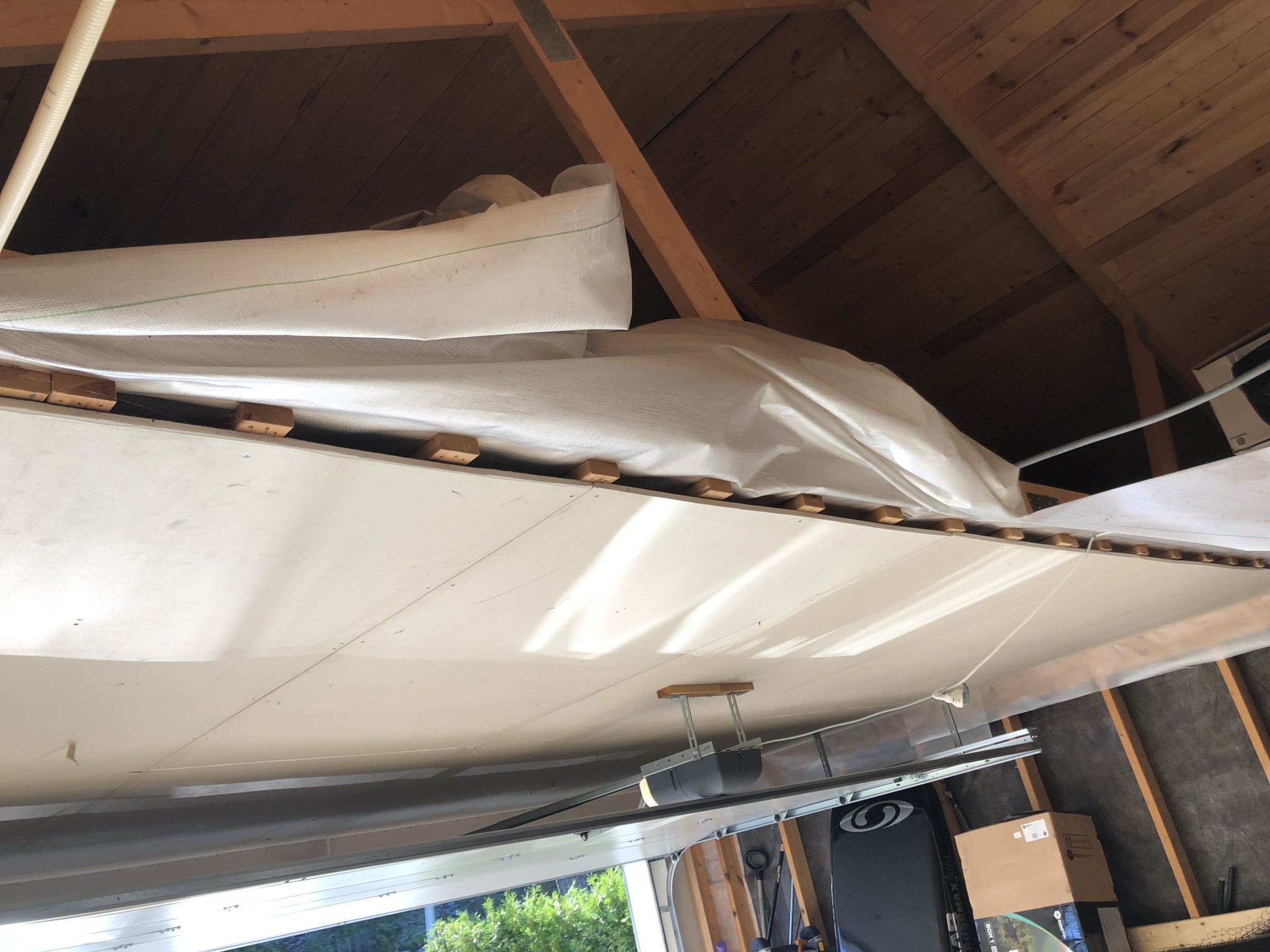
Excuse me, but would it be 6.5 meters between the walls in your garage??? It's hardly 6.5 meters if you look at the picture with the roof trusses. You can even see the sparse inner ceiling slightly. If you have 30 cm cc, it feels like a maximum of 4 meters wide.....
What??C crazytok said:
The inner measurement is 5836mm measured with my Blue Bosch laser meter a couple of times
It's the finger-jointed 45x145 that were ordered in a fixed length of 6.5m because that's how they were available.
Last edited:
You mean 45x220 glulam right? The less I spend, the better, but of course, it should be in relation to being good enough without the roof looking like a bananaF FreddruS said:I can agree with that, on the other hand, you can get away with about half the price for 45x220 instead of glulam 56x225 to reduce deformation by 1 cm. In residential houses, I would definitely recommend glulam, in garages, it's not as important with the deflection. But it's probably up to TS to think about what level they want to put it at.
Showed the picture of the roof trusses to some colleagues who were a bit fascinated that it has lasted so long. Has it been revealed approximately where in the country this garage is?
It’s priced at 599:-/each at Bauhaus. That makes it 250:- cheaper per beam compared to 56x225.
No, by 45x220, I mean C24. It will support about 100kg/sqm, but as already commented, it will deform slightly more (as previously stated 1 cm more) than if you go with 56x225 glulam.M M@ZE said:
It's miscalibrated!!
Then the picture is really deceiving, it does NOT look like 6.5m in width!
But do you have 60cm between the beams then? It's usually 30-40cm on roof beams.
Regardless, if you now have 6 meters. Place your 45x220 crossways as you planned! But as I wrote earlier, add a 45mm brace on top so that you come above the truss beam. Try to construct the floor in a way that doesn't affect the existing trusses at all, I think. Complement with more 45x220 depending on how heavy you plan to load up there and how stable you want it to be. It will, of course, sag, and you should be mindful when placing things, place them as close to the outer walls as you can.
Then the picture is really deceiving, it does NOT look like 6.5m in width!
But do you have 60cm between the beams then? It's usually 30-40cm on roof beams.
Regardless, if you now have 6 meters. Place your 45x220 crossways as you planned! But as I wrote earlier, add a 45mm brace on top so that you come above the truss beam. Try to construct the floor in a way that doesn't affect the existing trusses at all, I think. Complement with more 45x220 depending on how heavy you plan to load up there and how stable you want it to be. It will, of course, sag, and you should be mindful when placing things, place them as close to the outer walls as you can.
Ok sorry, I thought you meant laminated timber. How does C24 compare to the same dimension in laminated timber 45x225?F FreddruS said:
Haha, it maybe liesC crazytok said:It is miscalibrated!!
Then the picture really lies, it does NOT look like 6.5m in width!
But do you have 60cm between the rafters then? You usually have 30-40cm on ceiling rafters.
Regardless, if you now have 6 meters. Place your 45x220 across as you intended! But as I wrote earlier, add a 45mm beam on top so you come above the truss beam. Try to make a floor construction that does not affect the existing trusses at all, I think. Supplement with more 45x220 depending on how heavy you intend to put up there and how stable you want it. It will of course flex, and you'll have to be mindful when placing things, put it as close to the outer walls as you can.
... but no, it's correct, there are 5 pieces of 120 gypsum and the last one is slightly cut, couldn't get the first gypsum in the picture ...Now I don't have 45x220 Finger-jointed C24 but 45x145 as I, as a layman, bought the same as the trusses which span in prepared 6.5m lengths.
Last edited:
That picture felt completely different from the first one. I give up!
Oh, only 145mm at 6m. Yes, that was weak! But if the roof has held with snow load, etc., on 145, I can't imagine it wouldn't hold for a few things in the attic! However, I still maintain that you add a 45 on top so as not to affect the existing rafters at all when you lay down the floor. Instead, add more 45x145 (though you can upgrade to 45x190 at once instead of an extra 45 on top).
Oh, only 145mm at 6m. Yes, that was weak! But if the roof has held with snow load, etc., on 145, I can't imagine it wouldn't hold for a few things in the attic! However, I still maintain that you add a 45 on top so as not to affect the existing rafters at all when you lay down the floor. Instead, add more 45x145 (though you can upgrade to 45x190 at once instead of an extra 45 on top).
