37,022 views ·
190 replies
37k views
190 replies
Trusses that are sagging
Of course, it's unfortunate to read this in hindsight, but are there glulam beams in 45x145?J justusandersson said:Yes. You can't store anything that weighs the slightest up there. Use light insulation and don't put any flooring on top. 6.5 meters is an incredibly long span for that dimension. The beams will sag at least 6 mm due to their own weight alone. If you want to increase the load-bearing capacity, you have to supplement with glulam beams at determined intervals.
In my naivety, I thought that Finger Jointed according to the link on Moelven intended for load-bearing structures would work for the purpose. Why are they available up to 8m for order if they aren't meant for load-bearing structures?

Last edited:
No, glulam beams are not available in that dimension, and even if they were, they would still be too weak. Glulam beams are simply a way to build larger wood beams than what is possible to saw from a tree trunk.M M@ZE said:Of course, it's sad to read about this afterward, but are there glulam beams in 45x145?
In my naive assumption, I thought that finger-jointed according to the link on Moelven intended for load-bearing structures would be suitable for the purpose. Why then is it available up to 8m and to order if it is not meant for load-bearing structures?
The reason it is available up to 8 meters could be, for example, because it can be used as part of a truss or as a wall plate.
As previously suggested, you need to build a floor with glulam or Kerto joists between the outer walls that are higher than the bottom chord of the trusses so that the chipboard doesn't load the bottom chord.
You also have a joint in the bottom chord that might not be dimensioned for a bending moment that you create by starting to load as you intended.
But I don't think you should get discouraged; it can work out well as long as you do it right.

You must differentiate between beam length and span. The latter is the greatest distance between the supports on which the beam rests. It is always an advantage for the beam to lie whole across multiple supports. Glulam beams come in many dimensions, but not in 45x145, and it would not hold anyway. The minimum height is usually 180 mm. The height of glulam beams must be greater than the bottom chord of the rafters so that these are not loaded. Which dimension is suitable depends on how much you want to load the attic.
I understand, it sounds like you are knowledgeable on the subject. But of course, I get a bit depressed now that I've ordered and received all the materials, even though the beams were not super expensive. Now I'm a bit unsure about how to proceed to get this right so I can use the loft/attic for storage. Sorry if I ask, but can I send a PM for advice?W witten said:No, glulam beams do not exist in that dimension and even if they did, they would still be too weak. Simply put, glulam beams are just a way to build larger wooden beams than what is possible to saw from a tree trunk.
The reason they are available up to 8 meters could be because they can be used, for example, as part of a truss or as a wall plate.
As previously suggested, you need to build a floor structure with glulam or Kerto beams between the outer walls that are higher than the lower frame of the roof trusses so that the chipboard does not burden the lower frame.
You also have a joint in the lower frame that may not be designed for a bending moment which you create by starting to load as you intended.
But I don't think you should get depressed; it can be good as long as you do it right.

Wise from experience, never store things in the attic. The amount of stuff increases over the years and it just becomes a junk collection spot.
I've cleared out many attics over the years, both from deceased and living relatives. Sometimes finding things that have been there since the houses were built a hundred years ago.
I cleared out my own attic last year. It was full of moldings and other lumber from the previous homeowner (who didn't have a clue about the load-bearing capacity). Even there, the rafters had started to bend and you can see it in the ceiling if you look for it. I sawed up firewood that lasted an entire winter from what was in the attic. Today I only have a couple of planks laying there allowing me (and craftsmen) to inspect and move freely. I considered creating a more permanent solution, but then you might mislead the next homeowner into thinking it's possible to store things there.
I've cleared out many attics over the years, both from deceased and living relatives. Sometimes finding things that have been there since the houses were built a hundred years ago.
I cleared out my own attic last year. It was full of moldings and other lumber from the previous homeowner (who didn't have a clue about the load-bearing capacity). Even there, the rafters had started to bend and you can see it in the ceiling if you look for it. I sawed up firewood that lasted an entire winter from what was in the attic. Today I only have a couple of planks laying there allowing me (and craftsmen) to inspect and move freely. I considered creating a more permanent solution, but then you might mislead the next homeowner into thinking it's possible to store things there.
It is possible to hang the horizontal beams from the ridge. This will give you a functional span for them. Of course, this will load the roof itself. Additionally, you will have to live with a row of posts in the middle of the space. But if you only store light items like cross-country skis and sleds, it will certainly hold.
You nail a batten to the rafter above the horizontal beams. Preferably right under the ridge. Then you attach the horizontal beam to this batten. It is important to get the lengths of the battens right. Otherwise, the inner ceiling will look wavy.
You nail a batten to the rafter above the horizontal beams. Preferably right under the ridge. Then you attach the horizontal beam to this batten. It is important to get the lengths of the battens right. Otherwise, the inner ceiling will look wavy.
Ok I think I understand, so it's attached at the top of the rafter where they break (where there is a nail plate today) and then down to the middle where they are joined together with nail plates?D Djurmo said:It is possible to hang the horizontal beams from the ridge. Then you get a functional span for these. Of course, this will load the roof itself. And you will have to live with a row of posts in the middle of the space. But if you only place light items like cross-country skis and sleds, it will absolutely hold.
You nail a beam to the rafter above the horizontal beams. Preferably right under the ridge. Then you attach the horizontal one to this beam. The lengths of the beams are important. Otherwise, the interior ceiling will look wavy.
So my 6.5m Fingerjointed 45x145 is not a good idea to put up between each rafter?
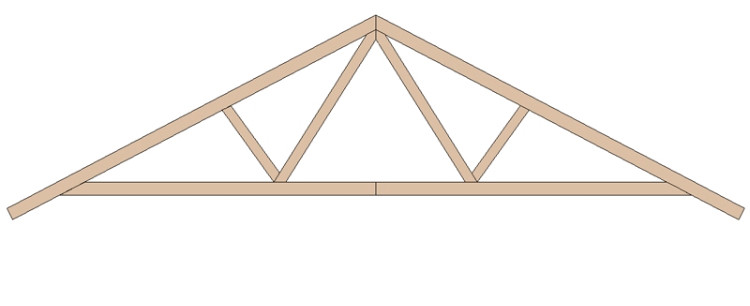
You mean something like this?pacman42 said:
I would really like to get in touch with someone about how I should do it, just don't know where to turn
Last edited:
No, I was thinking more about the upside-down V in the middle. However, that requires you to access the ridge. With wire or spikband, you can then hang up your 145x45 at the ridge without the suspension becoming too heavy. It's not a heavy floor going in, and no heavy load.
You cannot do it right without building new trusses or having really strong beams (glulam or as previously suggested 2x145 in height), the question you have is rather, how do you achieve an OK solution and in that case, suspension from the ridge might not be so bad. It is not recommended, but based on what you want to achieve, it might be an acceptable compromise after all...
I meant the upside-down V in the middle, the other braces are already there. When you mean ridge, you don't mean at the top where they meet, do you?You can't do it right without building new trusses or having really strong beams (glulam or as previously suggested 2x145 on the height), the question you have is rather, how do you get an OK solution and then hanging from the ridge isn't so bad. It's not recommended, but given what you want to achieve, maybe it's an acceptable compromise after all...
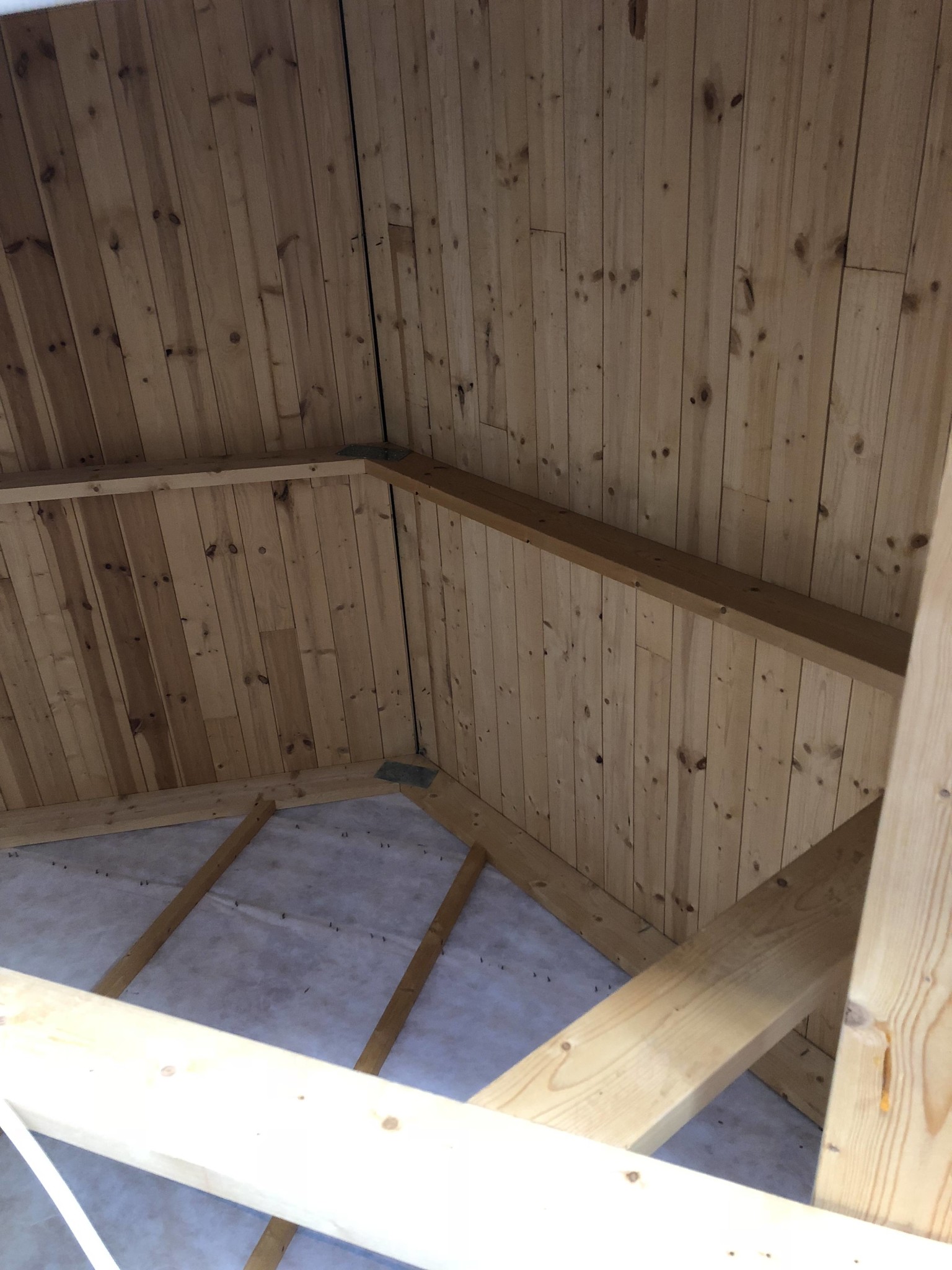
This is what it looks like up towards the roof ...