Otherwise, it might be just as easy to put triple cellplast against the wall, I have some cellplast lying around. How do you lay the leca block you're talking about? Under the inner wall or?
The comparison with lecablocks was just to provide an idea of how much insulation one should have. Lecablocks are only used when you are newly installing a concrete slab on the ground. Styrofoam is obviously better than crushed bricks! It is the total thickness that counts. It's okay with several thinner sheets.
Polystyrene withstands moisture. Ensure that the roof has proper overhangs. The space inside the brick wall should be ventilated to the outside in a way that insects or rodents cannot get through. No plastic nets as mice love plastic. What do you do with window openings?
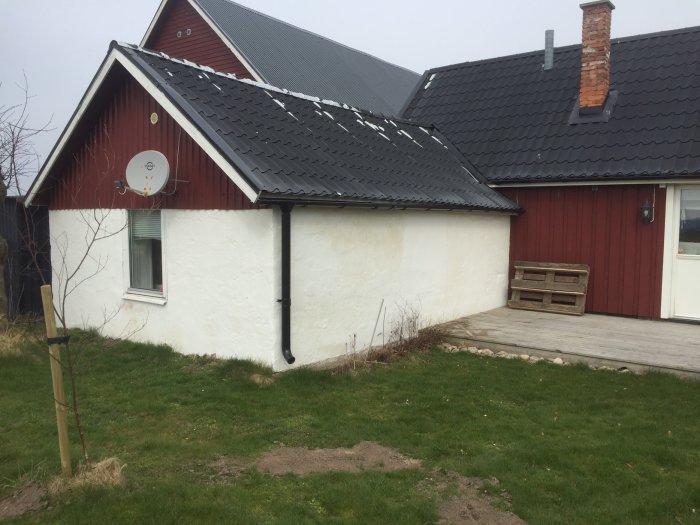
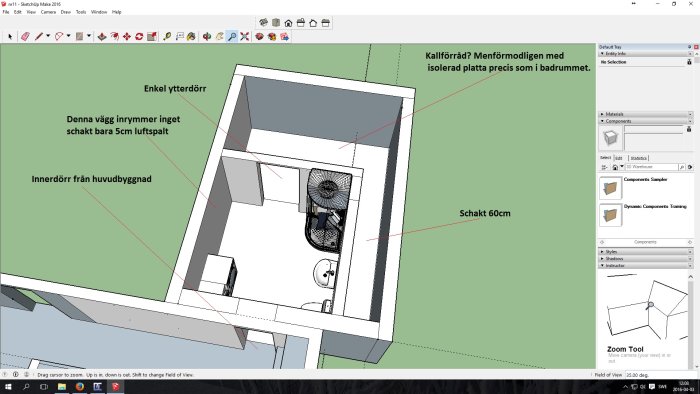
This building is positioned at an angle to the existing main building. It will probably only house a bathroom/laundry room and a cold storage room. No window openings are actually planned.
However, I'm not sure whether I should use the space outside the bathroom as cold storage or also put up interior walls here. The area is not intended to be part of the residence except possibly as cold storage since I want to keep the heating cost as low as possible. A bathroom, however, is a must...
Then it becomes immediately clearer… Under these circumstances, the shaft does not need to be ventilated. You probably also have to compromise on the insulation requirements. 10 cm of styrofoam + 5 cm concrete slab should suffice for the floor. The best would be if the interior walls could also be built of brick (with insulation behind them). Concrete floors and brick walls provide a much better foundation for tiles and contribute to significantly higher longevity.
I have a lot of studs, etc. lying around, and I'm considering framing the walls and drywalling even though I know that masonry interior walls would be better.
I read that you're a former architect; I'm not sure how you feel about having a cold storage inside the bathroom, but the idea is to prepare it so that it can be heated in the future if an extra room is needed. In that case, I'd probably let the duct go all the way to the gable for simplicity.
Considering the proximity to the bathroom, I would spontaneously think that the best option is to make it a heated storage room (and thereby also have a heat source there) but lower the heat so it's just frost protection. So that you CAN raise the heat if there are problems with moisture coming from the bathroom.
Otherwise, you should probably have a door that seals completely against the bathroom (i.e., a regular exterior door) so that moist air cannot escape into the cold storage room and condense.
From experience I have to say that it's much nicer to have a well-made heated storage room with the heat turned down as a cold storage room than an ordinary cold storage room. Why? Well, often heated storage rooms and mouse-proofing go hand in hand because in conjunction with the insulation, etc., you ensure there are no gaps where mice can get in
If you have it as a warm storage area but with lowered heat, I would probably think you can install a regular interior door (and then keep an eye on it + increase the temperature if needed) (That's what we've done with the upstairs where we don't use it daily but mainly for storage. The thermostat is set to around 10 degrees and monitors the humidity so we can increase the heat if the humidity becomes worryingly high).
Considering only OSB for the walls in the storage?
Can the bathroom walls be built as if it were an exterior wall with wind barrier and maybe 145 mm insulation to be able to completely shut off the heat in the storage if one would want to..?
The gap between the brick and inner wall should be filled with a hydrophobic insulation in a diffusion-open solution... Cellulose large gaps otherwise become spaces for drafts...
The inner wall should be placed on concrete, so choose slotted metal studs to avoid a thermal bridge.
Then you screw into the concrete, so the cellular plastic remains stable.