There are no principal obstacles for the roof beams to be thinner at the wall supports. What is reasonable should mainly be checked with regard to the current shear forces. What is the best and most practical approach in such a renovation is difficult to determine from a distance. Many times I think it is easier to leave the existing structure and put in a new one in between.
I find it easier to accept a slightly larger deflection on the roof beams than on the ridge beam. The latter is a primary structure that affects other structures. As long as you don't walk on it, it is much a question of aesthetics which is also related to the chosen roofing material.
So then we need to get hold of a local engineer after all. I hoped we would manage with what we had. It is not easy to find someone.
Aesthetically, I think it looks nice with a fairly wide beam in the ceiling, and I want it to be visible, that is, protruding below the ceiling covering and "breaking the pattern". So it is not a problem for it to be substantial. It will be a panel ceiling, horizontal. We have panel ceilings (about 10 cm wide) throughout the house, here they will be wider but in the same direction (i.e., along the house).
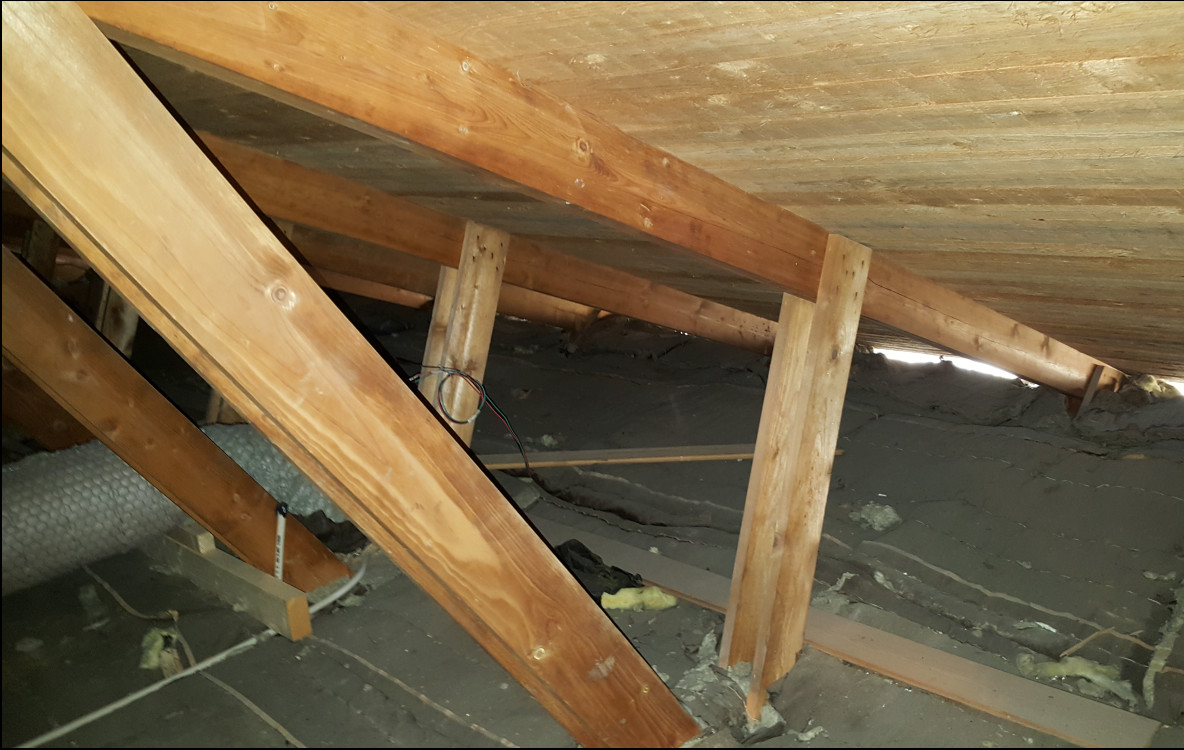
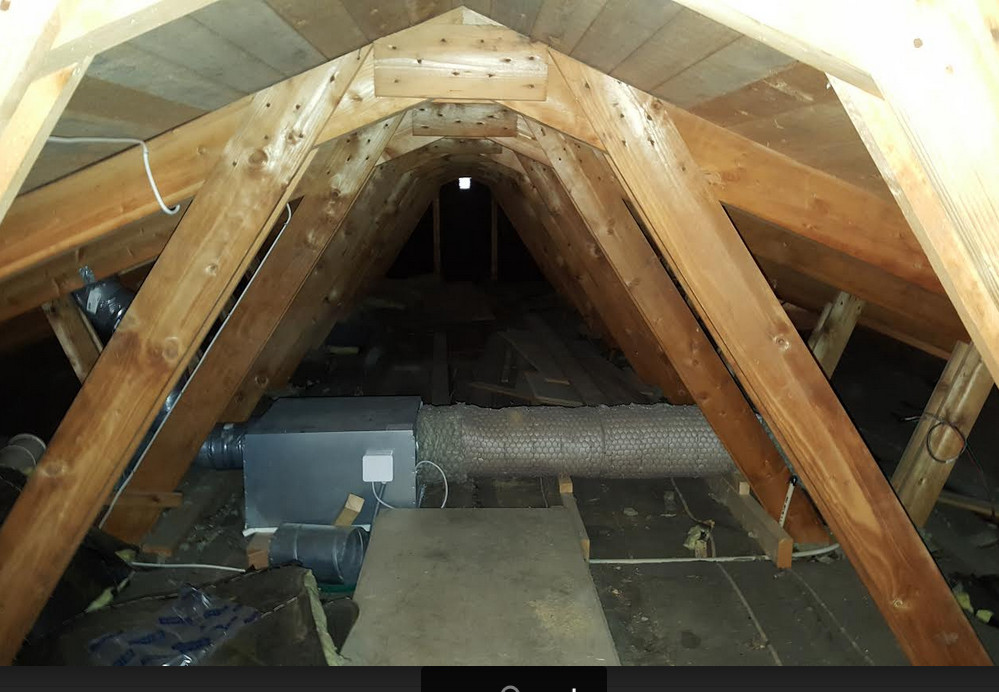
Here are two pictures from the attic/on the roof trusses: the pictures are taken where it is cc 100 cm between them, above the kitchen (it's the kitchen fan you see)
Yes, it was primarily bossespecial who asked for a dimensioned sketch. I was a bit uncertain about what needed to be dimensioned and shared what I had, i.e., how the floor joists were constructed and how they rested on the basement wall, as well as how long the "wall section" that would become load-bearing was/is. Then there were the roof trusses in the house, as they are currently the only anchor points that can stabilize a wall. Then I posted a picture of how they look (perhaps hoping that from these pictures one could also see whether to choose to build new ones in between or build onto the existing ones). I'm honestly hoping to get the missing pieces to be able to build according to the sketch
I am entirely convinced that you will have a much easier journey if you insert new glulam beams between the existing rafters. Partly because it will be much easier to remove all the support legs once the glulam is in place, and partly because the design (tapering) of the eaves section will be better. Since it was bossespecial's idea about the internal support for the ridge beam, I think he should respond to that.
I agree on waiting for the boss special just explained all the images.
Just want to double-check:
- new glue-laminated beam (225x42 according to Beijer calculation) between existing joists.
- existing joists will remain, should they be extended for insulation? They constitute the eaves and the roof sheathing is nailed to them, so they need to stay.
- gives approximately 60 cm spacing.
it's better to nail the panel that way too.
What do you mean by narrowing of the eaves, do you mean the part that aligns with the old roof closest to the interior walls?
roof covering is 17 mm roof sheathing, roofing felt, and two-piece Vittinge roof tiles.
ventilation is installed.
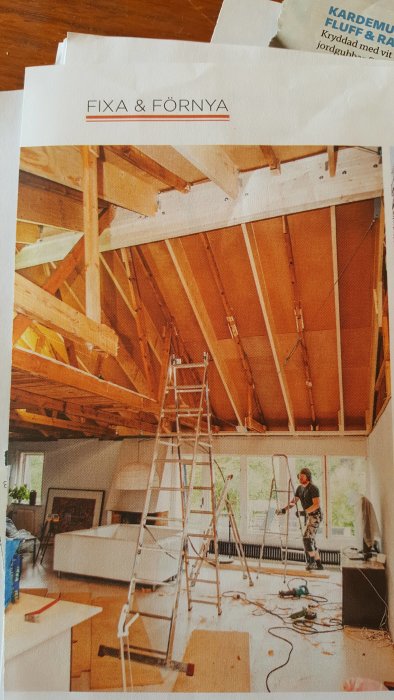
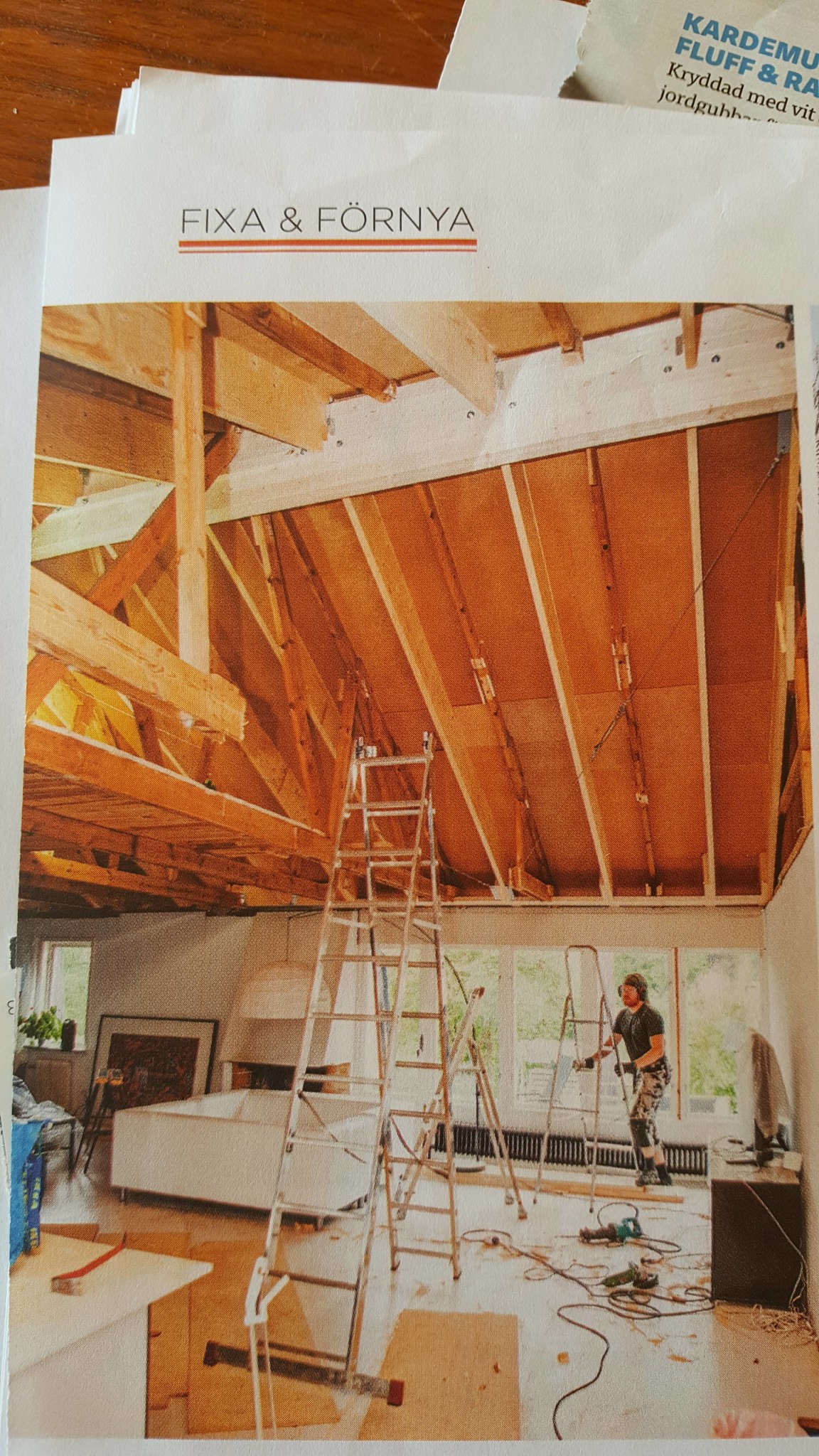
found this image in a pile of collected materials: Is it the lying board closest to the outer wall you are referring to? generally speaking, build like the picture (but they seem to have cut existing rafters at the top along the beam) but I see no point in that in our case as we want it to stick down. they seem to have a much larger beam than 31 cm.
That picture quite nicely shows the advantage of doing as I suggested. Whether a 42x225 glulam is sufficient, I don't know since we haven't seen any data on roof loads, but they're in the right ballpark. By narrowing at the eaves, I mean that the new beams should fit between the outer roof and the wall plate. If you choose a diffusion-open roof membrane, you won't need an air gap closest to the sheathing, which is smart. Whether you need to extend the old roof beams depends on the design of the insulation you choose.
roof loads?
In Beijers program, I specified insulation and heavy roof covering, concrete or tile. Also, living in Gothenburg. The roof has already been changed to breathable membrane and Vittinge double pantiles. The planned interior includes a panel ceiling and approximately 20 cm of insulation.
When I calculate the roof loads, I find that 42x225 is sufficient, and the deflection is less than L/300. As for the roof insulation, it can be resolved without adding to the existing beams. If you want a nail/screw distance for the roof panel of 1200 mm, it requires somewhat thicker boards. If you need to use a thinner panel, around 16 mm, you must reduce it to c/c 600 mm.
I myself have lived in Gothenburg for 40 years and miss the city mentally, but am equally shocked each time I visit by how the traffic volume has increased...
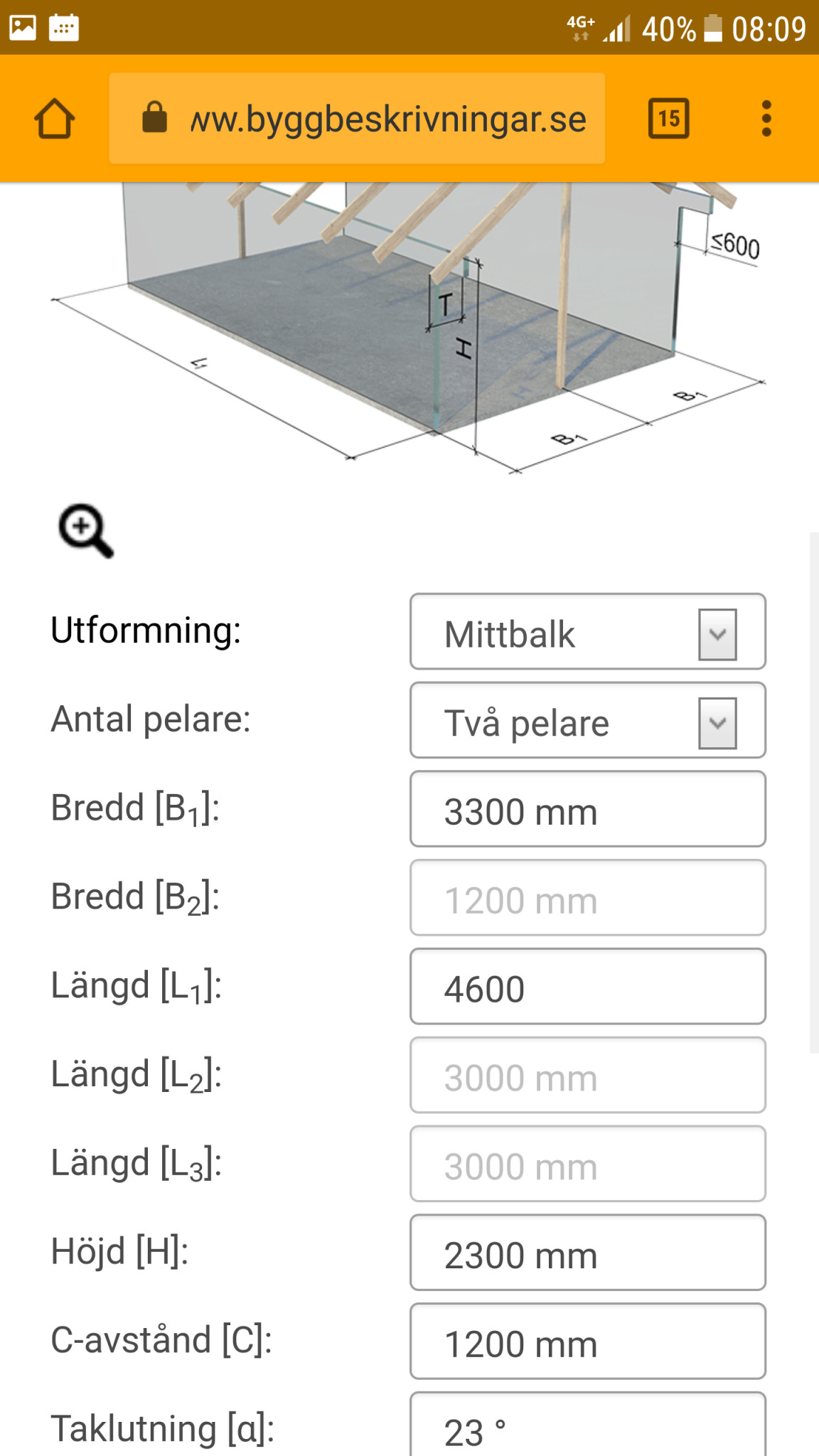
When I calculate the new span (i.e., the pillar is located by the stair railing) on Beijer's app, a 90x90 pillar in the outer wall is sufficient. And a smaller ridge beam, but I think it looks nicer with a wider one, so I probably want at least 90 for aesthetic reasons. If I input it correctly, does this mean I can have two 90x90 pillars and a 90x315 ridge beam? They have larger dimensions on the cross beams (i.e., our existing roof trusses), but does that affect the pillar's dimension? Also, I don't understand what is written at the red star markings
[image] [image]
I'm pondering something. When we calculated above on the pillar to the left of the stairs, a ridge beam of 90x315 was more than adequate. If I instead calculate the entire room, which is 4.6 m, meaning one more meter, not even 115x315 is sufficient, and I have to go even bigger. What happens with that extra meter that requires the ridge beam dimensions to be so much larger, the pillars remain unchanged?
The question encompasses many aspects. Comparing the moment of inertia, the difference between 90x315 and 115x315 is not that significant. An increase in beam width provides a rather poor yield. When I calculate backwards, I find that you have used a roof load of about 3.5 kN/sqm, which I think is unnecessarily high, especially considering that the snow load on the ground in Gothenburg is 1.5 kN/sqm. I suspect you are programming the app incorrectly. If you reduce the roof load to 2.5 kN/sqm, the deflection with 90x315 becomes 15 mm, which corresponds to L/300. Then it's not surprising that a larger span results in significantly thicker dimensions, as the bending moment increases with the square of the span.
I've counted and double-checked in the app 100 times and I'm choosing the one called taktäckning tung, concrete or clay with råspont, insulation, and ceiling. It's probably too heavy, but hard to tell since in words it matches our house snow is 1.5 as you say.
I understand that the beam's dimensions depend on the span. But in the app, it was like there was a breakpoint when it suddenly became a much heavier dimension within the meter I added. But this kind of stuff is interesting, I like to calculate but forces aren't what I do in my daily life...
It is probably the case that it requires some knowledge of structural mechanics to use an app of this kind. And those who have that knowledge don't use apps... But that the roof construction would weigh 2 kN/sqm, i.e. 200 kg/sqm, is not reasonable.
If you draw curves of quadratic equations, you can also see clear breakpoints.
yes, that's how it is. As a chemist, I always make sure to stay within the linear range in these curves and now that you mention it, I realize that the weight of the roofing material is also unreasonable. Thanks for the explanation!
Ho ho! Hope someone is still here
The work is getting closer, and now that the ceiling is down, we realize we can't take the easy route with new laminated beams between the existing rafters but have to take the hard route of sistering the rafters. How do we do it?
According to the drawing we have, it’s sistered with a 170x45, which seems reasonable. But does it matter that it won't have any support on the wall plate and hangs "in the air"?
How else do you do it?
How do you attach it? Nail plate and glue?
What are the pitfalls?
Click here to reply
Vi vill skicka notiser för ämnen du bevakar och händelser som berör dig.