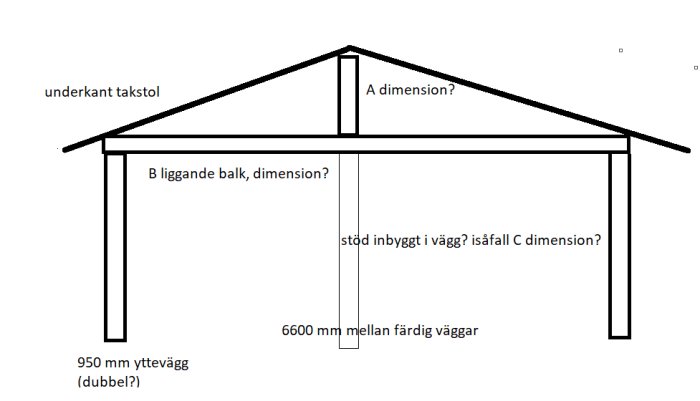
can also say that the living room is about 4.5 m between the facade and the post. and there are 3 rafters between those at the posts, the center-to-center between these is 120 or 100.
Almost a bit of a teasing position for the new pillar. If understood correctly, the center pillar ends up right on the side of the wall. Do you have the opportunity to make any local adjustments to the wall in the basement? The beam, I think, complicates things a bit since you mention that it doesn't seem to serve any function but is still present. I myself would not use this and would probably try to direct the load past it, alternatively ensuring that the beam is well anchored to the wall. Have you looked into the possibility of adding a beam across the house instead of the pillar that's just in the way?
Now that you mention it, we have seen such solutions when we googled around for roof openings. Do you mean something like this:
Where B is a steel beam (probably the slimmest)? We have 95-studs in the walls and no problem to open up and rebuild in the exterior walls, they are admittedly additionally insulated with a horizontal 95 (stud) outside, but we have no finished surfaces inside and all wall coverings will be replaced. You might manage without the support in the middle purely from a structural perspective? My thought was mostly a support point, it could also simplify the construction when it is being put in, maybe by building a corner with two 95s at an angle or similar and placing it on.
But if you're going to replace the bottom chord of the truss with a steel beam, how do you do that practically without the house collapsing?
I think it's time for some lateral thinking. With the right dimensions of the ridge beam, the post can probably be placed on the other side of the stairs. Glulam has the advantage of being completely exposed and can actually be an attractive structural element in the room.
I like to think laterally! The post can preferably stand on the other side of the staircase, where we currently have a post holding the railing to the stairs. That roof truss by the kitchen should not really be cut off but will still be built-in; however, the ridge beam needs to start there (coming out from the wall) because it looks odd otherwise.
But doesn't the problem of support underneath still remain? Since the center of the roof truss misses both the basement wall and the center of the H-beam?
Almost a bit of a teasing location for the new column. If understood correctly, the central column ends up right on the side of the wall. Do you have the possibility to make some local adjustment to the wall in the basement?
The beam seems a bit problematic because you mention that it doesn't seem to serve any purpose but is still there. I myself would therefore not use it and would probably try to redirect the load past it, or alternatively, make sure that the beam is well anchored to the wall.
Have you considered the possibility of putting a beam across the house instead of the column which is just in the way?
We can make a local adjustment to the wall in the basement, it's a plastered but not yet painted lightweight concrete wall. Do you mean we make the wall thicker under the pillar? That requires cutting up the floor so we can build down to the foundation. But the hall has been cut up and patched in stages, most recently to connect a new sewer pipe, so it is completely adaptable.
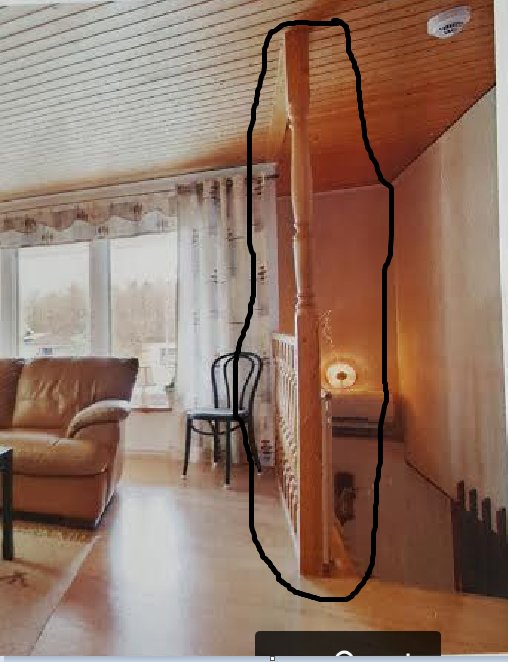
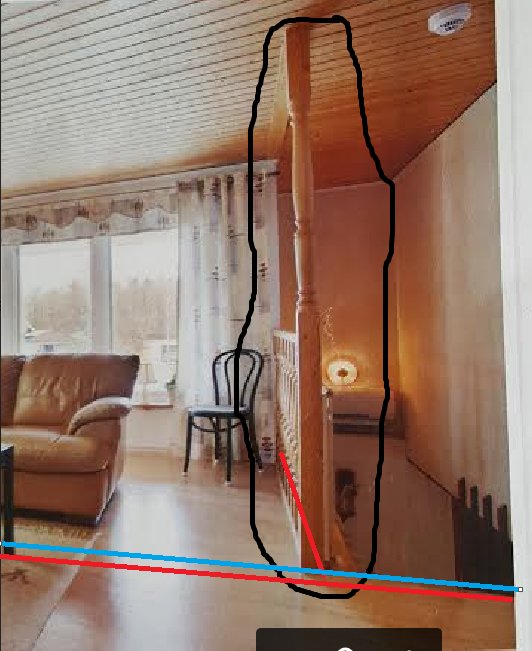
Found a picture from the prospectus (the post is no longer in its original position today):
So a way forward, perhaps the simplest, is that the post in the picture (located under the next roof truss) becomes a glulam 115x115, the basement wall is raised so there is support under the entire level up to the H-beam, this is not visible under the stairs anyway. In the roof truss that remains in the wall, only the ridge beam is aesthetically attached (which can be the same dimension as calculated, i.e., 315x115) since it remains intact.
Do we still need a 115 glulam beam? I assume so since the dimension below is 90x90 and we need 115 for the support for the ridge beam, but worth asking
Edit: When I think about it, two basement walls meet here because the basement follows the original shape of the house with a recessed living room (today it's extended and the wall follows the wall in the stairs according to the floor plan), see picture. That should make it easier and there is also a wall to the left as it's a T-junction there.
The problem is that we've drawn up the water in the beams right there, since the pole was supposed to be on the other side... Hopefully, there's enough space to push them aside so that the pole can come down.
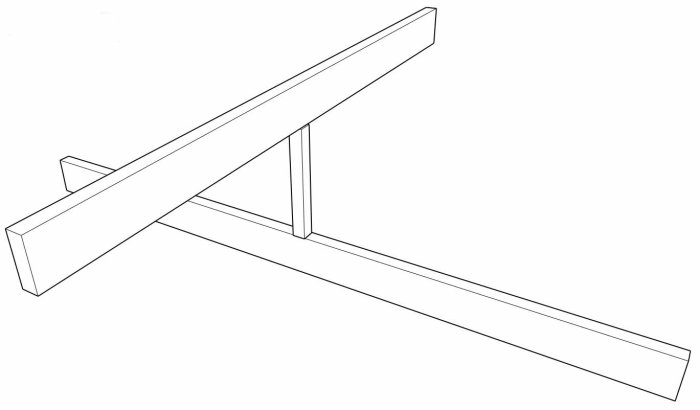
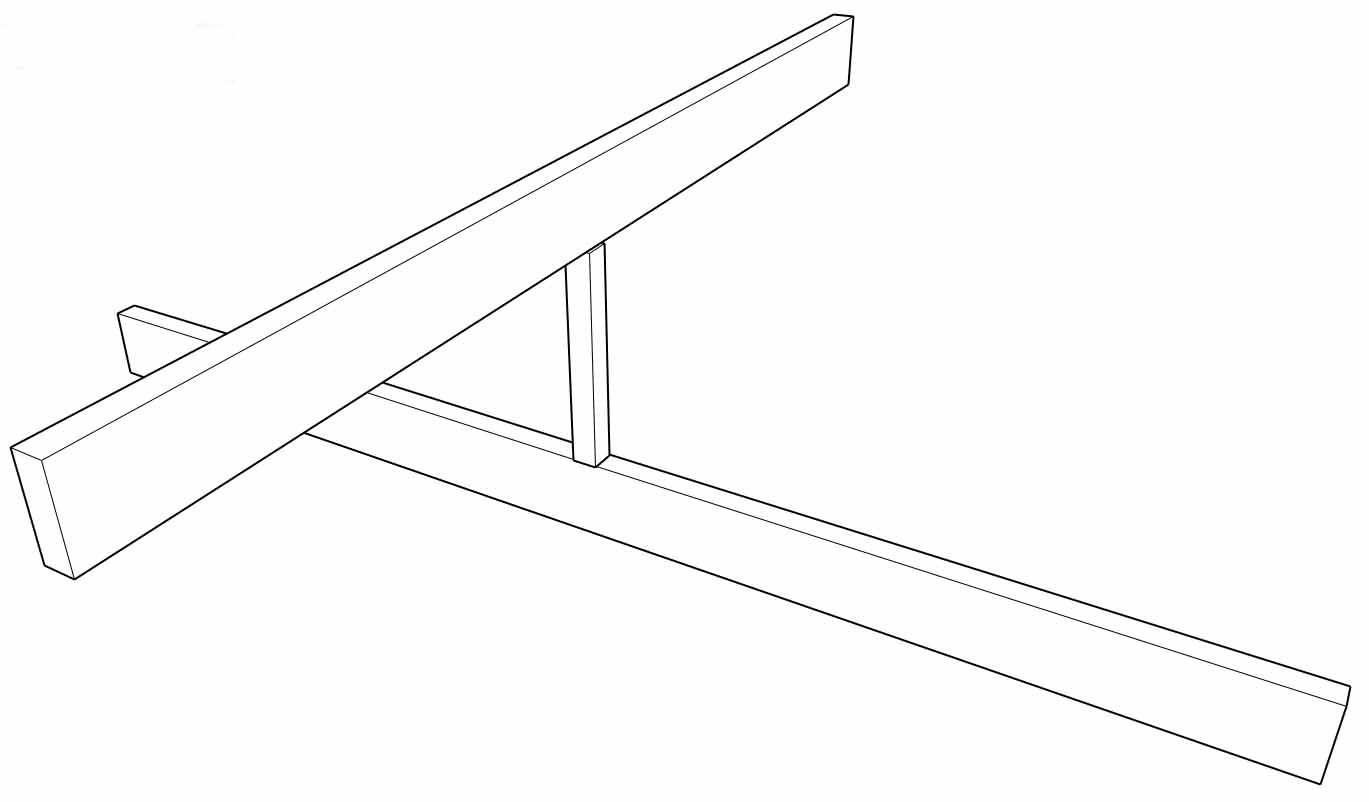
Another variant is to arrange a midpoint cross in the style of this image:
By placing the post in the middle under the ridge beam (it doesn't have to be the absolute middle), you handle essentially half of the roof load while the end supports are subjected to smaller loads and can be made simpler. The ridge beam can also be made slimmer. Consider it input from the side. What do you think bossespecial?
I assume the top one is the ridge beam, but how long is the post, where does it end, and where is the lower beam located? Do you mean that we can rebuild the existing built-in roof truss above the kitchen wall and reinforce it enough so that we don't need any post at all at that end?
Or would the lower beam be visible in the middle of the living room ceiling?
I see it as an input from the side, because I still don't understand yet
I may have misunderstood your intentions and how it looks. Sorry if that's the case. The top one is a nockbalk, the length of the column I don't know since I don't know the exact dimensions. The lower beam goes from outer wall to outer wall in a suitable position, to avoid the stålbalken in the floor.
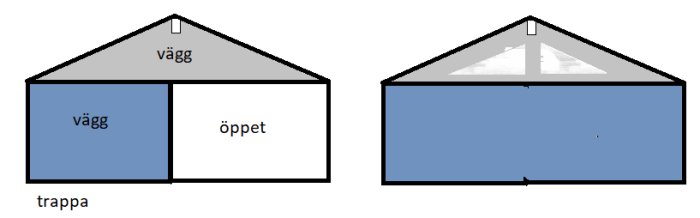
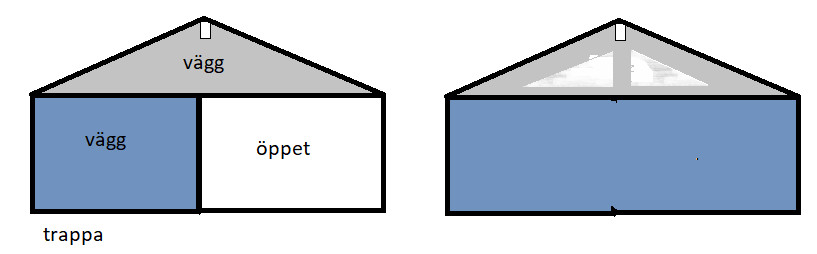
In short, we want to remove the ceiling in the room in the picture and achieve this:
The first picture is that you are standing in the room where the photo was taken and looking to the right in the photo, and the second is the outer wall (i.e., to the left in the photo). The basement walls go according to the red lines in the picture and there is also an H-beam in the floor structure according to the blue line. The problem is that the midpoint of the roof truss does not hit any of these lines well. See the previous picture in the thread.
I will wait and see how bossespecial responds because I think he has a good understanding of the conditions.
But thanks for the input that the post does not need to stand in the kitchen wall, it currently seems like the best solution despite the water pipes to place the post where the staircase post was when we moved in. It also provides an attachment point for a railing, which will be required anyway.
There is a roof truss above the kitchen wall and a roof truss by the post.
But then I've probably got it right. You want to open up to the ridge and replace the old roof trusses with a ridge beam and rafters in the position of the old high posts.
My posts aim to broaden the perspective somewhat. The eccentrically placed steel beam is a problem that needs to be addressed in some way. Instead of opting for steel, posts, and beams, which you build into the walls, you can choose glulam that is exposed. Glulam also always becomes cheaper and more attractive, and you avoid the problems that arise when steel and wood are combined. I'm also curious about what bossespecial thinks. I thought we could have an interesting discussion.
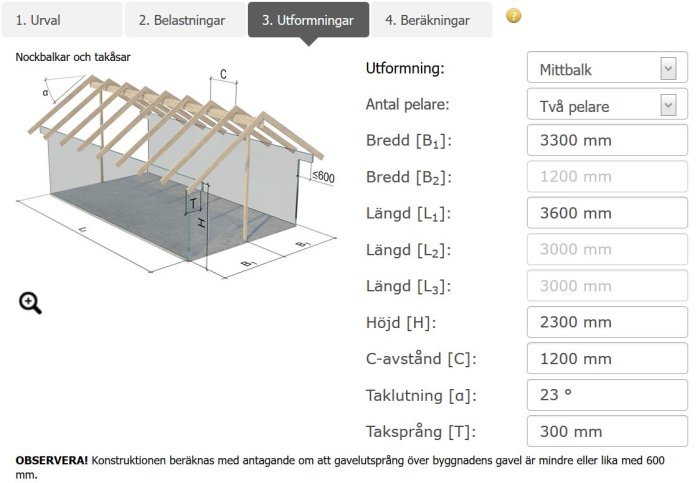
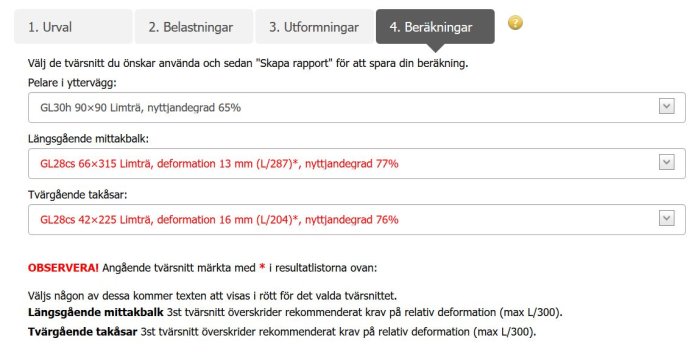
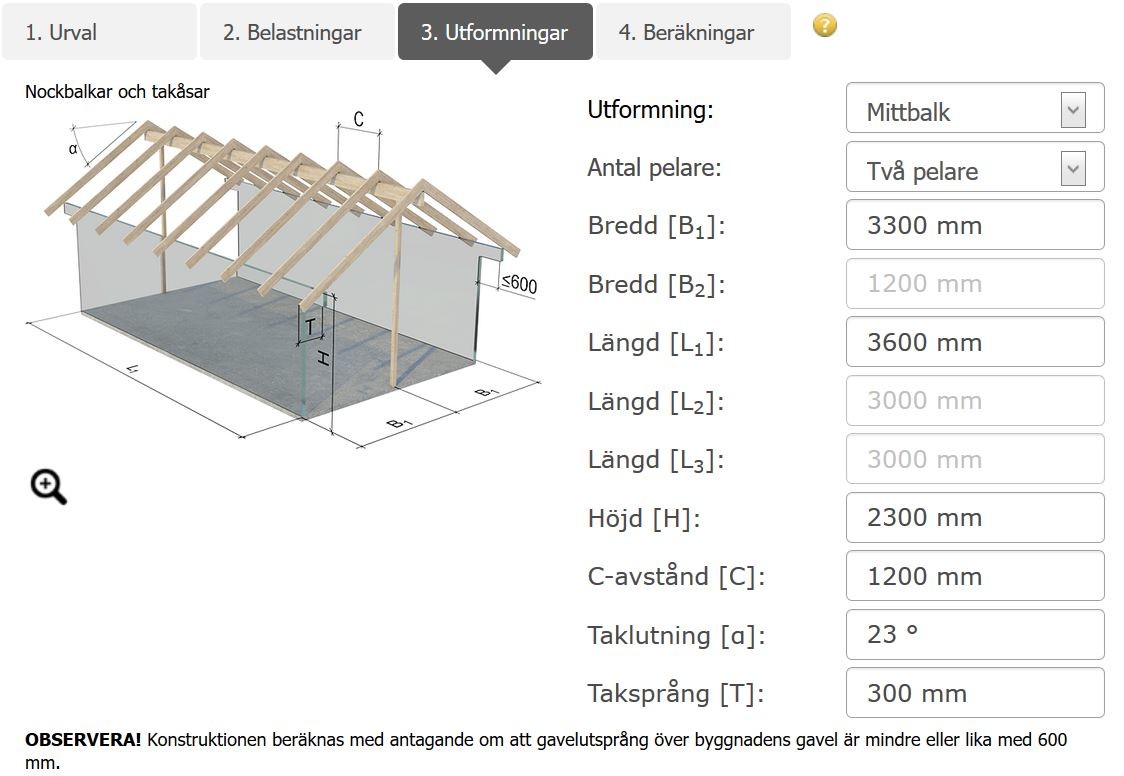
When I calculate with the new span (i.e., the column is located by the stair railing) on Beijer's app, a 90x90 column in the outer wall is sufficient. And a thinner ridge beam, but I think it looks nicer with a wider one so I still want at least 90 for aesthetic reasons. Does this mean if I've entered everything correctly that I can have two 90x90 columns and a 90x315 ridge beam? They do have larger dimensions on the transverse ones (i.e., our existing roof trusses) but does that affect the column's dimension? Also, I don't understand what is written at the red star markings.
The red text indicates that the combination of dimension and load results in a deflection greater than 1/300 of the span. (With 90x315 the text would be black)
LLane said:
affects the dimension of the post
No. The dimension of the post depends on the total load on the ridge beam and is not affected (except very marginally) by the self-weight of the roof beams.
Vi vill skicka notiser för ämnen du bevakar och händelser som berör dig.