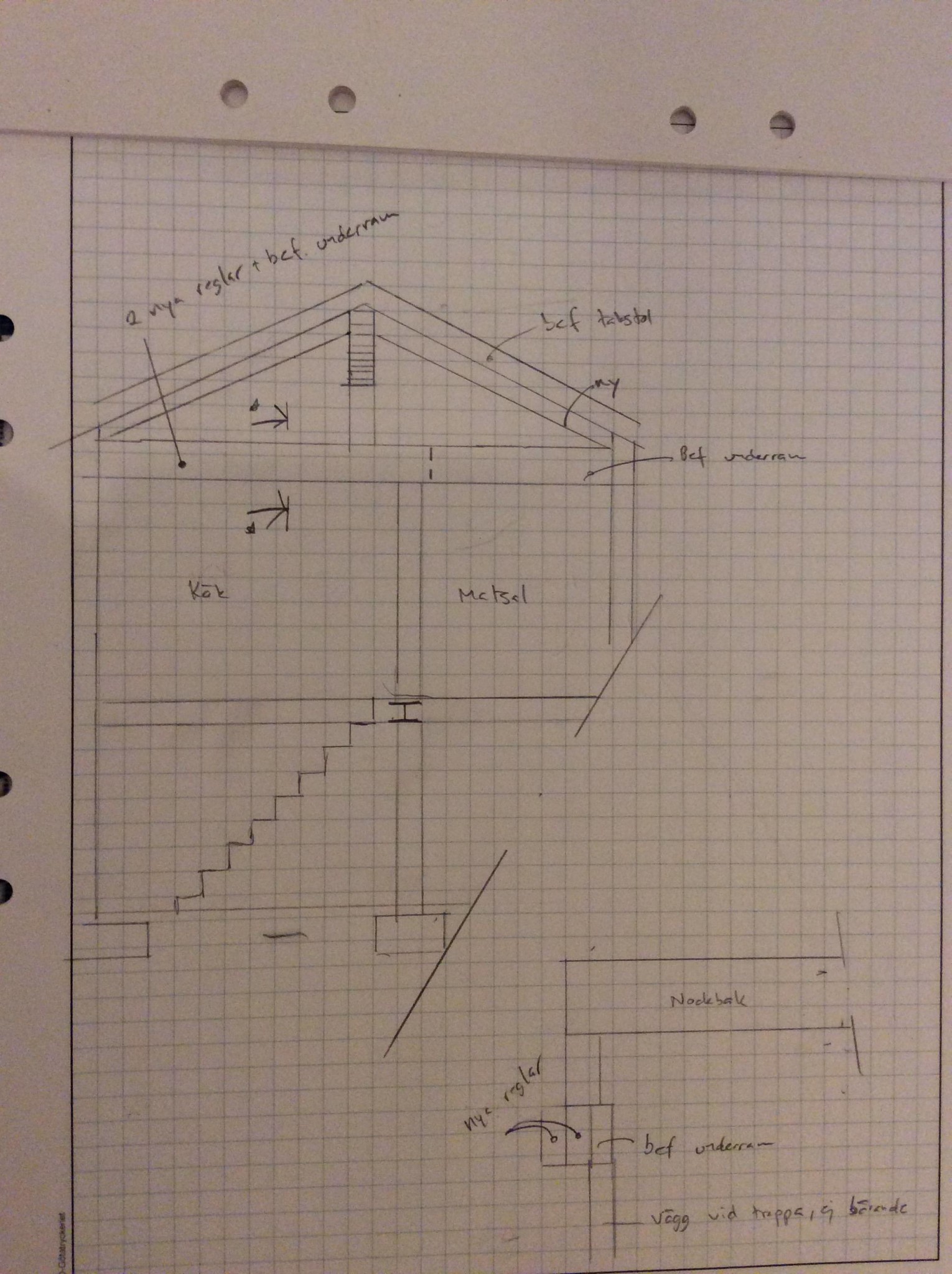
Exciting developments happening, problem-solving at a high level, I like As Justus mentions, it's easier to work with wood. Personally, I would try to remove all visible supports from the room except for the ridge beam if that's the case. Could it be an option to use the wall running parallel to the ridge between the kitchen and dining area as support and transfer the load of the ridge beam between this and the outer wall? I seem to recall that you mentioned the last "whole" truss was located at the stair wall, if so, that could be modified as well. An attempt at a sketch below, hopefully, you can see what's intended (stubborn child was helping and tugged at the pen).
The red text signals that the combination of dimension and load leads to a deflection greater than 1/300 of the span. (With 90x315 the text would turn black)
No. The dimension of the post depends on the total load on the ridge beam and is not affected (other than very marginally) by the weight of the roof joists themselves.
But today our roof trusses are built from 120x45-timber. This calculation then indicates that these are too weak (if 225x42 is highlighted in red). It might be reasonable considering the V's will be removed in the truss framework. Or? But how do you do that? We will saddle on to accommodate increased insulation, but we can't saddle on above the outer wall, so at the point at the T in the dimensioning, it won't be more than 125.
The designer didn't mention anything about this in the drawing.
There may be reasons for us to review your calculations. When I calculated backwards earlier today, I thought you had a rather large roof load. Your current roof trusses are of the truss type, so you can't compare the dimensions. When you modify them, the top chords must be sistered from below. Alternatively, you insert new roof joists in between.
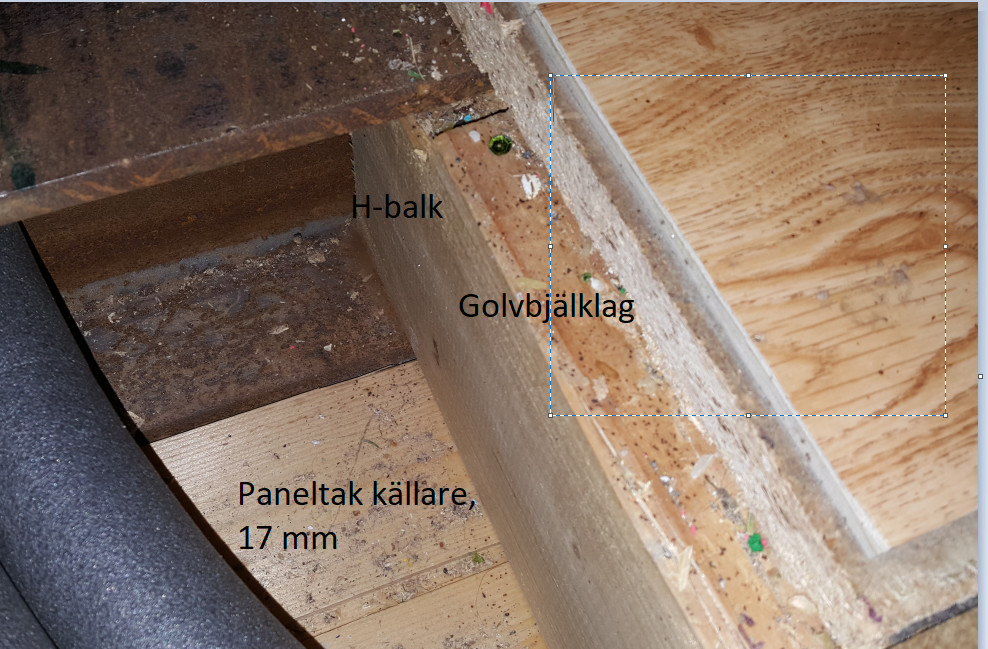
The drawing looked good and not too difficult to build. However, the wall you mean does not stand as load-bearing on top of the basement wall but to the right of it, but maybe it doesn't matter much that it stands on the floor joist when you spread the forces more than at one point, stiletto heel vs. running shoe How wide does a load-bearing wall need to be? 75? 95? (45? )
There may be reasons for us to review your calculations. When I calculated backwards earlier today, I thought you had too large a roof load. Your current trusses are of the truss type, so you can't compare the dimensions. When you modify them, the upper frames must be reinforced from below. Alternatively, you can insert new rafters in between.
Yes, I meant too weak after reconstruction. This was just something we hadn't reflected on as it was never mentioned. Reinforcing from below won't be a problem as we are anyway going to add insulation and an air gap, as well as something to nail the panel to. So 225 is a fairly reasonable measure to achieve. But at the exact point where the truss rests on the outer wall, it will still only be the existing upper frames. Just like in bossespecial's sketch. Would reinforcing with a 120x45 attached with nail plates be sufficient?
There are no principal obstacles for the roof beams to be more slender at the wall supports. What is reasonable should primarily be checked with respect to current shear forces. Determining the best and most practical approach for such a renovation from a distance is difficult. Many times, I believe it's easier to leave the existing structure as is and insert new ones in between.
I find it easier to accept a slightly larger deflection on the roof beams than on the ridge beam. The latter is a primary structure that affects other structures. As long as it is not walked on, it is largely an aesthetic issue that is also related to the chosen roofing material.
Exactly, it is possible to place this wall on the floor joists. However, you need to check the floor structure's support on the basement wall; you might consider making a dimensioned sketch, as you did before, to share. I would have made the wall 70mm with plywood on both sides without calculating it; it is important that the wall is guided horizontally both at the top and bottom.
Hello everyone! Hope you're still around The flu paid a visit here... But it wasn't all bad because we had time to stop and think and measure a bit. We prefer the sketched solution completely without a post. It seems doable as well. I then calculated for a wall with 70 mm and 15 mm construction plywood (the same as for a bathroom wall) with renovation plasterboard on. We don’t want a wall that's too thick since it continues into a corridor that's already narrow, so it can't grow too much to the "right". But with renovation plasterboard, the difference is barely 2 cm.
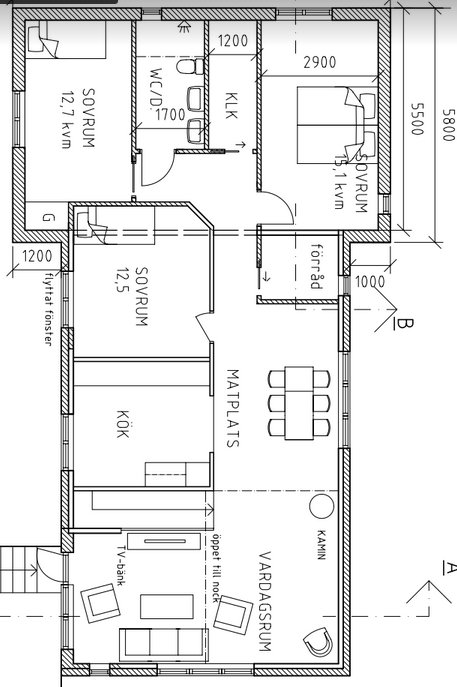
I can make sketches, what specifically would you like to see? We haven't opened up to the kitchen yet and still have a door there. It’s currently 125 cm in from the corner, we were thinking maybe 80 cm for the opening but it’s still flexible how wide the entry to the kitchen becomes, (as long as it’s wider than the current 60 cm) and thus how long the supporting wall piece can be made…
How do you support in the horizontal direction? We have panel ceilings directly nailed to the roof trusses, so upwards there are only roof trusses to attach to. But you can build something between the roof trusses from the attic to screw into, install a beam or so.
The floor joists are a little less than cc 60 and the beams in the floor are 14 cm high.
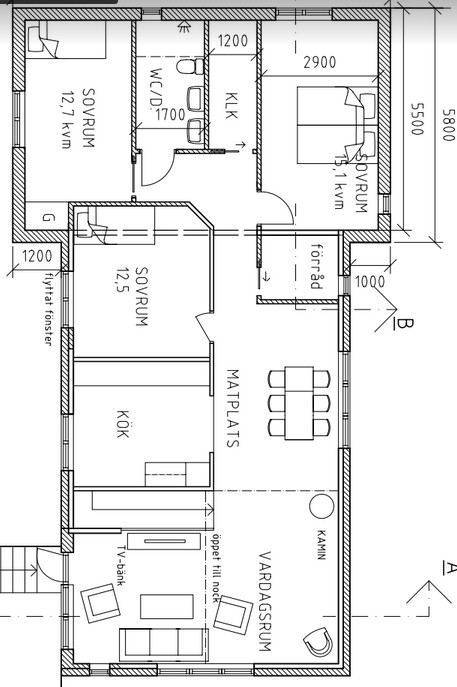
Here's the entire floor plan so you understand with the corridor:


 As Justus mentions, it's easier to work with wood. Personally, I would try to remove all visible supports from the room except for the ridge beam if that's the case. Could it be an option to use the wall running parallel to the ridge between the kitchen and dining area as support and transfer the load of the ridge beam between this and the outer wall? I seem to recall that you mentioned the last "whole" truss was located at the stair wall, if so, that could be modified as well. An attempt at a sketch below, hopefully, you can see what's intended (stubborn child was helping and tugged at the pen).