
1,511 views ·
18 replies
2k views
18 replies
Open up the room - tear down interior wall

Not in connection with the other. But normally yes. Here there was no such wall in that direction otherwise. Sorry I wasn't clear about this.BirgitS said:
To be precise, it also depends on the floor and the construction of the house overall. For example, I have no load-bearing walls on the upper floor, but three transverse load-bearing walls on the ground floor, they have laid the intermediate floor in the longitudinal direction of the house.
The entire lower floor is load-bearing throughout the house with either beams or load-bearing walls.pacman42 said:
Not in connection with the other. But normally yes. There wasn't such a wall otherwise in that direction. Sorry I wasn't clear about this.
To be precise, it also depends on the floor and construction of the house in general. For example, I have no load-bearing walls on the upper floor, but three transverse load-bearing walls on the ground floor, laying the intermediate floor in the length direction of the house.
The upper floor (1.5 stories) has a large open living room in the middle and 2 rooms on each side. One room is smaller and has an inner wall. "Behind" it there is a closet and a small bathroom.
There are attic spaces on both sides, about 1-1.5m wide.
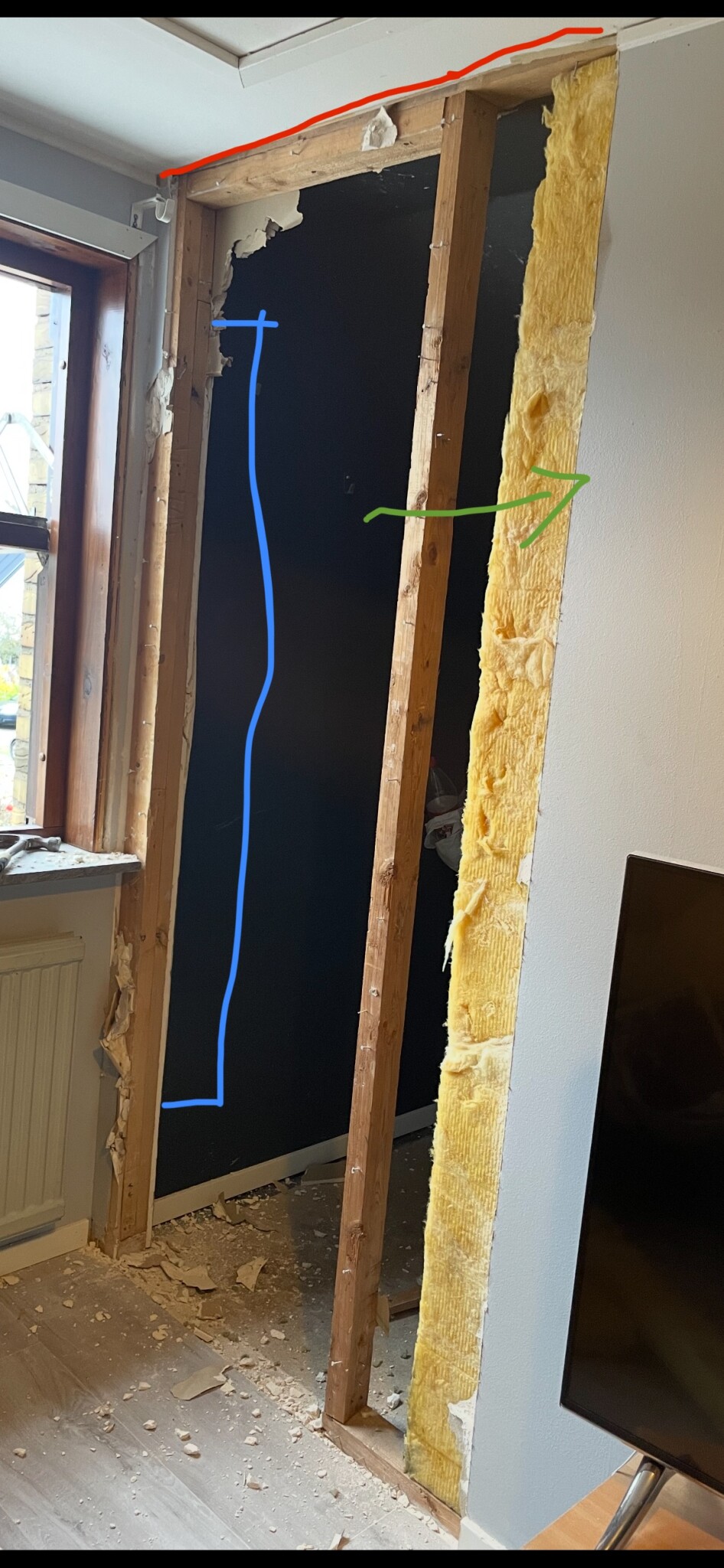
The entire beam in the ceiling is not being removed, only where we want to open up. In other words, the red line.
The beam against the outer wall (blue) we want to remove, and the one on the right marked in green will be moved where the wall ends.
I understand it might not be "easy" to answer whether it's possible or not.
But I think the load-bearing should be in the roof trusses and the "floor." I don't know all the fancy terms so I apologize in advance 🙈

That's true, but one should be aware that the roof trusses' support legs extend down into the knee wall.J Jennie Blomqwist said:
In addition to load-bearing walls, there are stabilizing walls that, for example, prevent the house from tilting or twisting when it's very windy. This is what pacman42 mentions a bit in post 14. The knee walls can have such a function besides "concealing" the support legs.

Mats-S
Construction veteran
· Sollentuna
· 3 637 posts
Mats-S
Construction veteran
- Sollentuna
- 3,637 posts
It completely depends on how it looks above the ceiling. If it's only a thinner beam attached to the ceiling, you can just remove it. If it's part of a beam that goes through the ceiling and the top of the attic, I wouldn't remove it.J Jennie Blomqwist said:
Can you check how the top of the beam ends, is it flush against the underside of the ceiling?
Click here to reply