
13,101 views ·
83 replies
13k views
83 replies
Milling down particleboard in floor joists?

The reason I suggested a high E-modulus for floor particle board in compression is that floor particle board is very stiff for particle board. The particle board itself is not homogeneous in thickness, which complicates the issue somewhat. If I may speculate a bit (I have extensive experience in material development within composite materials), I assume that mineral materials are used to increase the stiffness of floor particle boards. I base that thought on the fact that it would be an effective method and that one often sees signs of mineral materials when machining the material. Sparks are visible and there is extreme tool wear. Under a microscope, the wear appears abrasive. The dominant wear mechanism during machining of pure wood is not abrasion, but high-temperature corrosion (sic!).



Around 3 GPa modulus of elasticity is quite typical for particleboard used in furniture frames. The feeling is that flooring particleboard is stiffer. But when comparing flooring particleboard with "ordinary particleboard," I got approximately the same average density (using product data from some common products in the building trade), about 750 kg/m^3. The modulus of elasticity varies quite linearly with density (at least for the different density layers of furniture particleboard). Mineral fillers can complicate that comparison.
I've been googling around different manufacturers of chipboard flooring. They seem to share the opinion that technical data is not something that needs to be provided.

Homeowner
· Västerbottens län
· 775 posts
But I've thought that they've recessed the chipboards where the bathroom will be so the height difference between bathroom and non-bathroom won't be too high. Because if all the floor is at the same height and you're adding underfloor heating pipes (water) and underfloor heating pipes (electric) self-leveling compound, and then tiles, the floor in the bathroom is quite a bit higher than the floor outside. I don't know how much taller one should expect a bathroom floor to be extra?K Kallebo said:
In any case, we must 1. Solve the height difference in the bathroom and 2. solve the height difference between bathroom and non-bathroom.
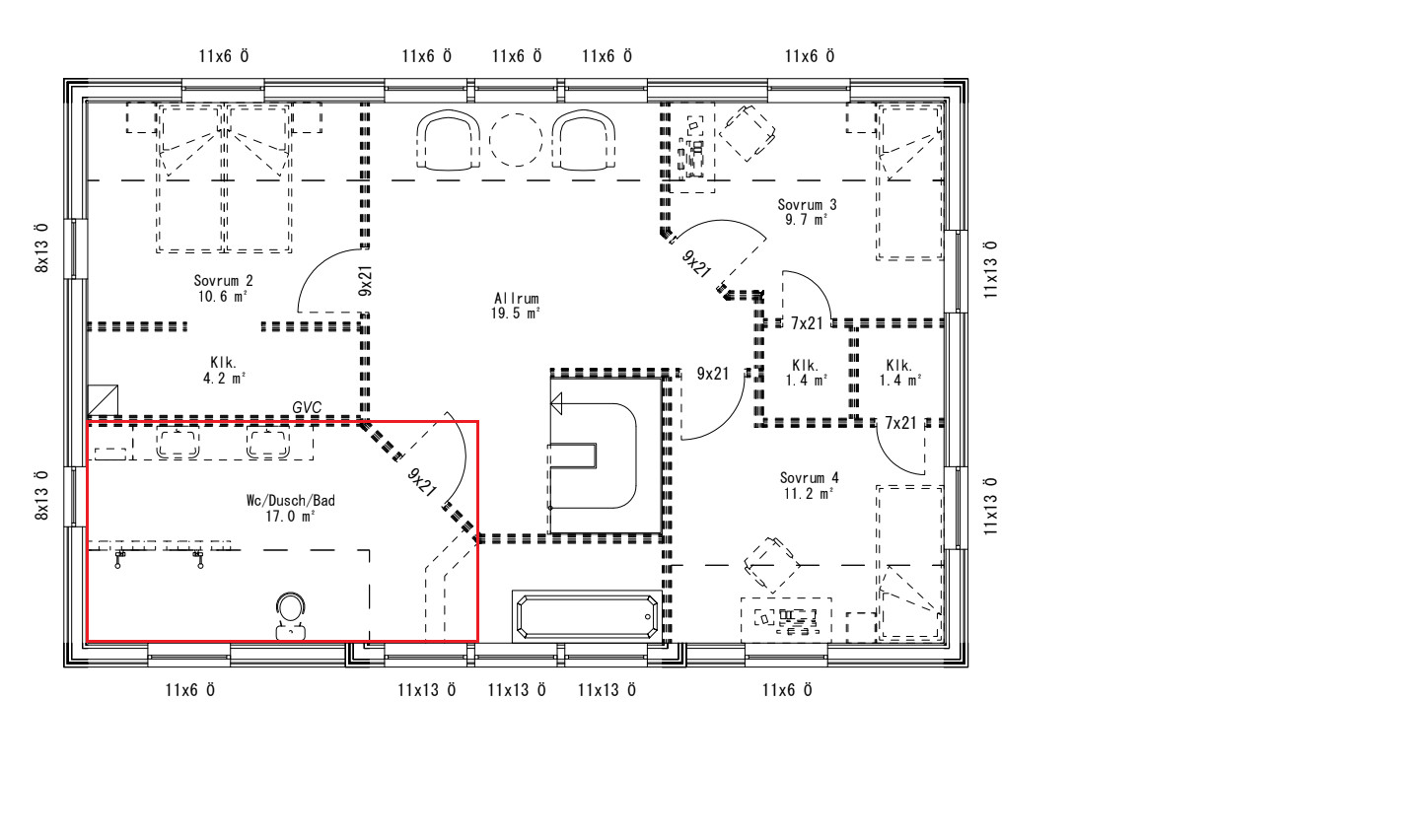
The red marking shows how they have laid the recessed chipboard. As seen, it doesn't follow the bathroom. There are spacing joists everywhere except inside the red marking, which is about 20 mm above the chipboards in height.
Homeowner
· Västerbottens län
· 775 posts
But yes, Kallebo, it might be the case that that's what they have in mind. Since the drawing there suggests a level increase where the bathtub is drawn.
Neither routing the chipboard nor laying battens on top of the rest of the floor joists is acceptable considering the span of the floor structure. A bathroom floor generally does not need to be at a higher level than the other floors. It depends a bit on the choice of waterproofing and floor material. A bathroom not located on the entrance floor can be equipped with thresholds that at least partially conceal minor level differences.
Homeowner
· Västerbottens län
· 775 posts
I have asked the people who designed the house about the construction, so we'll see what they say.J justusandersson said:Neither rebating the particleboard nor laying a batten over the rest of the floor joists is OK considering the span of the floor structure. A bathroom floor generally doesn't need to be at a higher level than the other floors. It depends a bit on the choice of waterproofing and floor material. A bathroom not on the entrance level can be equipped with thresholds that at least partially conceal minor differences in level.
But if we disregard the current level difference and pretend everything was at the same height. First, there would be sheets and underfloor heating pipes, then some kind of board, then electric underfloor heating on top of that, then waterproofing, then self-leveling compound, and finally tiles. What kind of height can I expect from that setup?
Doesn't it become redundant with both floor heating pipes and electric floor heating? The waterproof layer will only be a few mm. Self-leveling compound + tiles and adhesive can be up to 35 mm depending on the placement of floor drains and the desired slope. If you choose a vinyl flooring instead, you can save several mm, besides making the solution more durable.
I look forward to knowing how the house's originators have thought.
I look forward to knowing how the house's originators have thought.
Homeowner
· Västerbottens län
· 775 posts
The water-borne underfloor heating is barely on at all in the summer, and then it's nice to be able to turn on the electric one to dry puddles or just to warm your feet against the otherwise cold floor. We have the same setup on the entrance floor, and it's quite great to crank up the underfloor heating even in the summer.J justusandersson said:Isn't it redundant to have both underfloor heating pipes and electric underfloor heating? The waterproof layer is only a few mm. The leveling compound + tiles and adhesive can be up to 35 mm depending on the placement of floor drains and desired slope. If you choose a wet room mat instead, you can save several mm, besides the solution being more durable.
I look forward to finding out what the house's creators have in mind.
Wet room mats are awful, and it would take a lot for me to install something like that here.
Shouldn't there be some type of board or something to comply with industry standards? That should add another 20 mm. And then extra for the electric underfloor heating. Then we're up to maybe 7 cm?
There are wet room mats of varying quality. They are always warm as well. I shall spare you what I, who probably belong to an older generation, think about this fussing with underfloor heating... Industry standards are industry standards and nothing one needs to worry about. They are created for the industry to sell more tiles. What applies are Boverket's regulations. A prerequisite for making underfloor heating in wooden joists reasonable is that the joist is properly dimensioned from the start. Then the construction height doesn't need to be so large. An addition of 7 cm in height is completely unreasonable.
Homeowner
· Västerbottens län
· 775 posts
Can you build wet rooms on top of open joists? I thought it was chipboard or some other board that was required.J justusandersson said:There are wet room mats of different quality. They are also always warm. I shall spare you what I, who probably belong to an older generation, think about this fuss with underfloor heating... Industry standards are industry standards and nothing you need to care about. They were created for the industry to sell more tiles. What applies is the Swedish National Board of Housing, Building and Planning's regulations. A prerequisite for underfloor heating in wooden beams to be reasonable is that the beams are correctly dimensioned from the start. Then the construction height does not need to be so large. An addition of 7 cm in height is completely unreasonable.
Homeowner
· Västerbottens län
· 775 posts
Is this guy completely out of line installing underfloor heating directly in open joist spacing on an exposed floor structure?
