I have done a quick calculation and concluded that to achieve acceptable values for the floor's deflection, the floor joists need to be 220 mm high and have a glued and screwed chipboard on top. One way to solve this (provided that the recessed chipboard is glued and screwed to the joists) is to glue and screw a sheet of construction plywood on top of the chipboard and the remaining floor beams. Preferably 21 mm thick, but in an emergency, you can go down to 15 mm. Plywood is stiffer than chipboard and distributes point loads better to the surrounding joists. The solution may require you to install noggings between the beams so all joints in the sheets can be screwed. It depends a bit on the measurements.
But the rest of the upper floor doesn't have glued chipboards, instead, there are spaced battens on top of the beams. Is the whole house going to collapse at any moment? It was just a year ago that the house and two identical ones were built here in the village, and neither the municipality nor the building inspector has said there's anything wrong.
And if we're going to have a 21 mm plywood on top of the recessed chipboard, we would be at the same level as the spaced battens, so you might as well lay battens on the existing chipboard, but then the problem remains that we get an unnecessarily large height difference between the wet room and outside...
Sparse battens on top of the particleboard is not an OK solution.
My calculations are based on the span data you provided. I have also assumed that the beams are of strength class C 24. Today, floor structures consisting of 45x220 beams with screw-glued particleboard are considered to handle a maximum span of about 3.5 meters if the construction rules are to be followed. For larger spans, glulam beams are required. What is the maximum floor height you can accept?
It is certainly not good to casually reduce the height of load-bearing beams, but you are referring to deflection, a functional requirement, in your calculation @justusandersson and not the ultimate limit state? So that the original poster's concern is proportional to the problem.
But the rest of the upper floor doesn't have glued particle boards, but has sparsely spaced joists on top of the beams.. Is the whole house going to collapse at any moment?
No, there is no risk of it collapsing.
There is a good margin for load-bearing capacity for reasonably good loads without failure occurring. You can surely roll in a grand piano without the slightest problem in that regard.
The problem you will encounter is with deflection and bounce.
That is, the floor will bend down and tilt noticeably closest to the walls.
And you will notice the bounce through non-constant load, for example, when you walk across the floor, it will cause it to sway slightly.
I myself have an undersized floor structure in the "friggebod" (was aware of this already when I built it but took the risk), and it is noticeable because when you walk in the room, two glasses standing very close together on the table rattle, meaning that the vibrations and bounce in the floor structure become significant enough to manifest as unpleasant effects.
But neither your floor structure nor mine in the "friggebod" will collapse because, as mentioned, the margin to failure is still very large.
Of course, it is the functional requirements I am talking about. There is no risk of crime. TS can sleep peacefully. But at the same time, I think high standards should be set for newly built houses, and I get easily disheartened when I hear about the carpenters' antics.
I must say that it is very strange that they placed sparse paneling directly on the studs in some places. Is there any reason for that? Ö
mattiasp said:
Thought: if the chipboard is screw-glued, it should transfer the compressive stresses to the chipboard, which can handle it quite well. Additionally, I imagine that chipboard has a higher E-modulus, which would mean the chipboard takes a large part of the load. Is this realistic?
Jjustusandersson said:
No mattiasp, chipboard actually has a lower E-modulus. 1.8-2.0 GPa compared to 6.9-8.7 for plywood and 7.0-13.0 for wood (along the grain direction). I found the data at the following address:
[link]
I believe the data is correct, in any case, it is accurate regarding wood.
If the TS can tell us the span of the beams, we can check if it has the potential to work anyway. In that case, a thinner K-plywood sheet can be placed over everything.
Now you looked at the E-modulus for tensile forces, I would also assume that the E-modulus (compression) for chipboard is higher or at least comparable to wood. Plywood, which has fibers in both directions, should have worse compression properties...
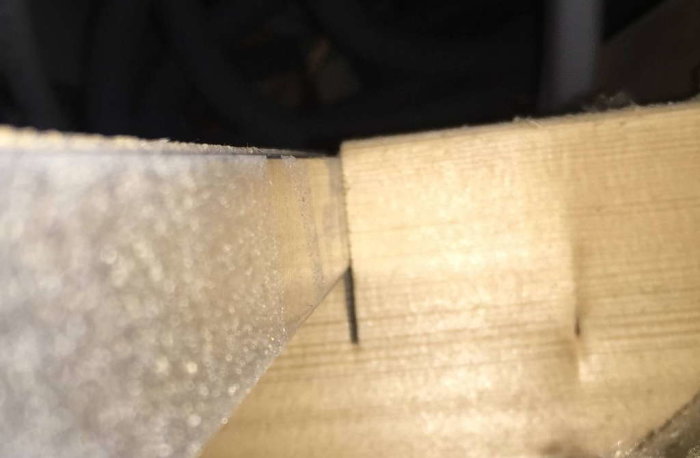
And furthermore, their cutout is poorly made. Not only did they notch it out, but they also sawed almost twice as deep, which probably results in about half of the beam's moment of inertia being lost.
Or something like that, right, Justus. You're way better at this than I am. Sure, the load-bearing capacity increases cubed with the height of the beam?
I must write that it is very strange that they placed sparse paneling directly on the studs in some places. Is there any reason for that? Ö
Now you looked at the E-module for tensile forces, I would also think that the E-module (compression) for chipboard is higher or at least equivalent to wood. Plywood, which has fibers in both directions, should have worse compression properties...
If you google waterborne underfloor heating + sparse joist + open beam layer, it might explain something.
Okay. Then the idea is surely to space out the rest of the floor so that everything comes to the same level? The chipboards are probably there to meet the stability requirements.
Someone must have calculated the whole thing. Moreover, if you built with a major house manufacturer, it should be right in the end...
And moreover, their notch is poorly made.
Not only have they notched it out, but they have also cut almost twice as deep, which probably means that nearly half of the beam's moment of inertia has been lost.
Or something like that, right, justus. You are much more knowledgeable about this than I am. The load-bearing capacity increases cubed with the height of the beam, right?
That's correct. If by load-bearing capacity you mean stiffness, i.e., resistance to deflection. The stress, however, changes quadratically with the height, but in these contexts, as mentioned, it's usually the deflection that's the problem.
However, I think it looks more like they've made a heavy pencil line rather than actually sawing 2 cm too deep. I was also surprised at first when I saw the picture.
The only data I find on compressive strength of particleboard vs. plywood and wood is in my old Bygg band II from the 60s. There, the compressive strength of "particleboard" is stated to be 145 kg/cm2. The corresponding figure for pine plywood is 275 kg/cm2, and for wood (pine parallel to the fiber direction) 470 kg/cm2. The modulus of elasticity for particleboard is stated to be 0.35 kg/cm2 * 10^5 (equivalent to 3.4 GPa), with the note "Values primarily applicable in flat bending."
Vi vill skicka notiser för ämnen du bevakar och händelser som berör dig.




mattiasp said:

Mikael_L said:
And moreover, their notch is poorly made.