We are now in full swing finishing the upper floor and have reached the bathroom... We hired a contractor who did the lower floor and prepared the upper floor.
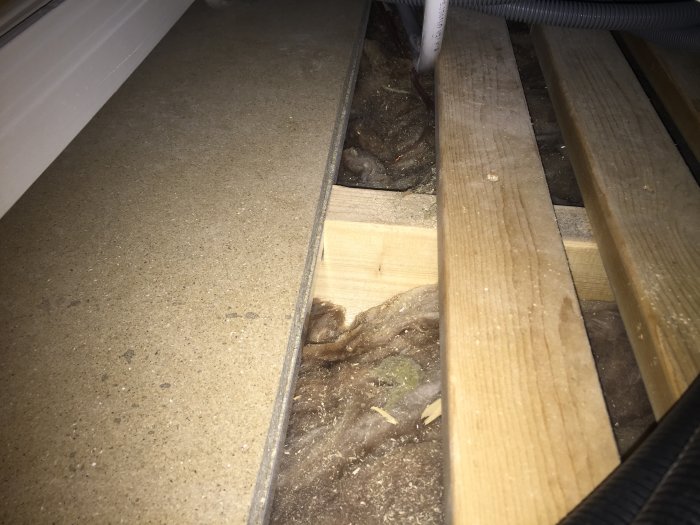
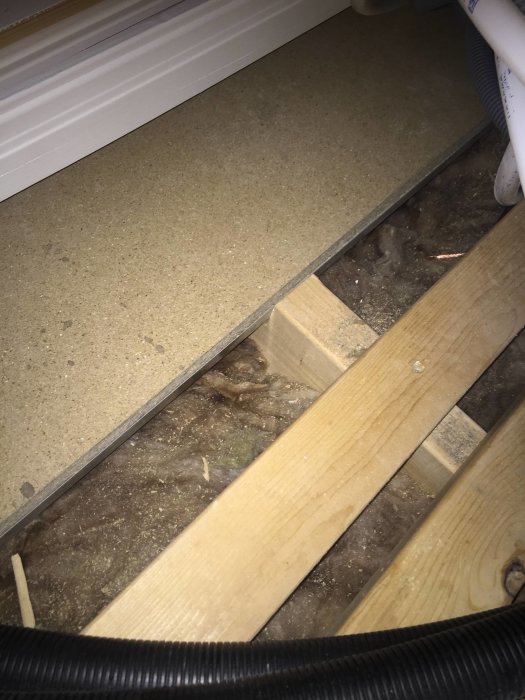
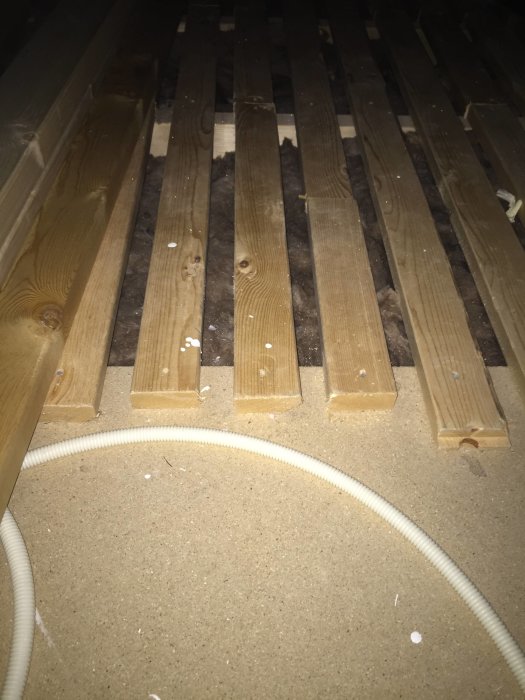
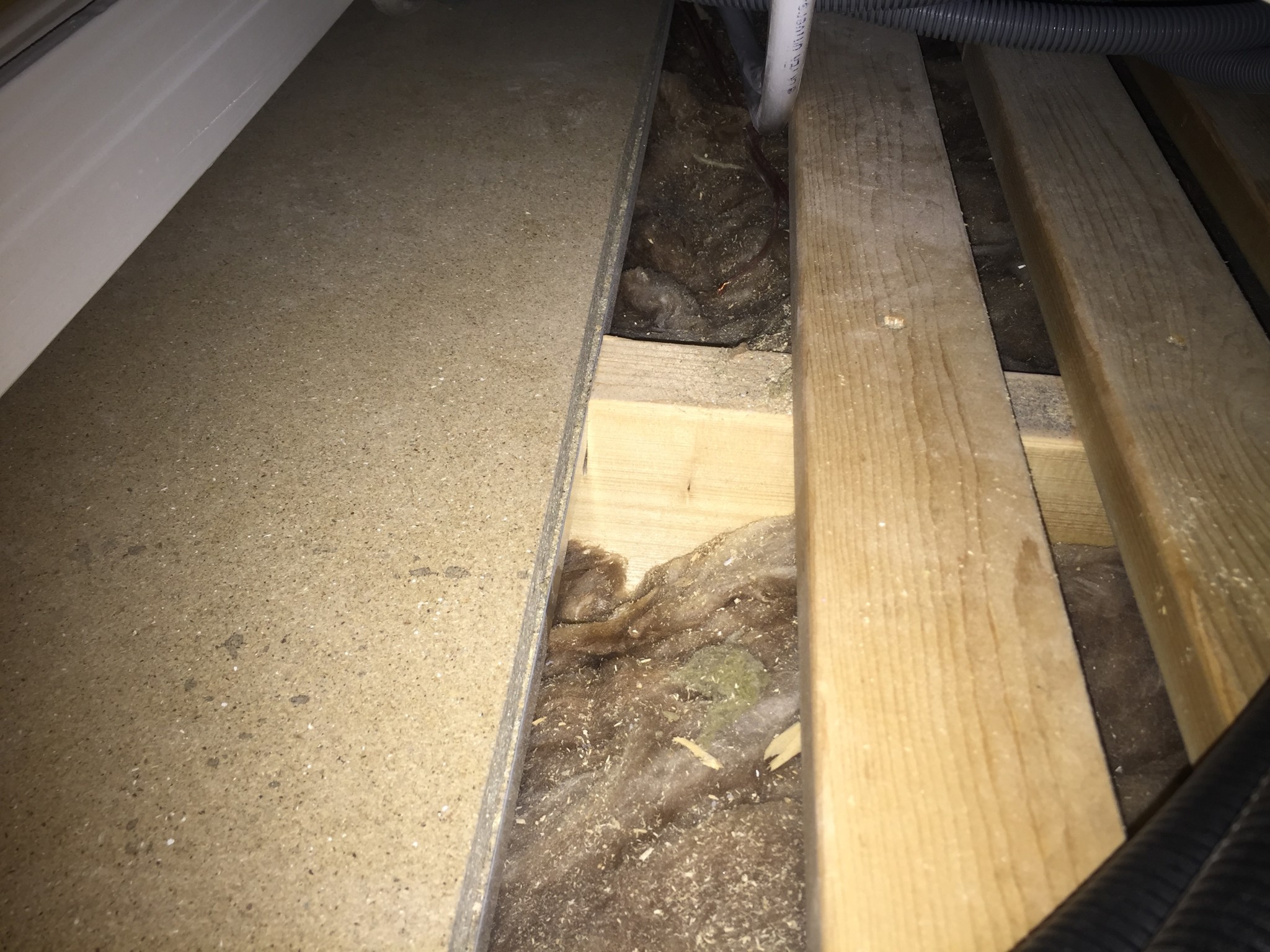
Now to the problem: part of the bathroom floor has chipboard and the rest has sparse joists. So they are at different heights. Apparently, the carpenters found the floor plan difficult to read or it just wasn't their problem, what do I know.
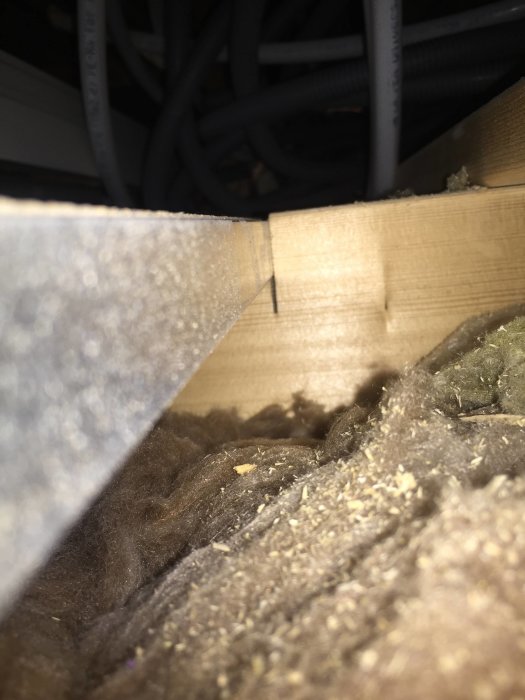
Now we need to get the floor at the same height. If we raise the part where the chipboard is currently so that it levels with the sparse joists, there will be a huge height difference into the bathroom later, after floor heating, leveling compound, etc. But we can see that the carpenters have lowered the chipboards into the joists, and now we thought we could do the same where there is no chipboard now.
So my question: is there any magical tool to easily mill out the thickness of a chipboard from the joists? If not, how can we solve this?
My husband wants to attach joists to the beams and lay chipboard on top of them, but then you would see the beams between the chipboards. Maybe that doesn't matter? I thought it felt odd...
What span and dimension do you have on the joists? There is an obvious risk that you will get a too shaky and bouncy floor if you reduce the height of the joists.
Removing 20mm from a 220x45 joist is a significant weakening, you lose about 20% of the load-bearing capacity.
What span and dimension do you have on the joists? There is an obvious risk that you will get a very shaky and bouncy floor if you reduce the height of the joists. Removing 20mm from a 220x45 floor joist is a significant weakening, you lose about 20% of the load-bearing capacity.
Carpenters typically do not have sufficient knowledge in strength of materials to make that type of assessment. The milling is potentially serious. How large is it and what is the span of the beams (length between the supports)? Are the chipboards glued after the milling?
Thought: if the chipboard is glued with screws, the compressive stresses should be transferred to the chipboard, which it can handle quite well. Moreover, I imagine that the chipboard has a higher E-modulus, which in that case means that the chipboard takes a large part of the load. Is that realistic?
Carpenters usually don't have sufficient knowledge in structural engineering to make that kind of assessment. The milling is potentially serious. How large is it and what is the span of the beams (length between supports)? Are the chipboards glued after the milling?
Oh, I don't know that. We weren't there when it was built.
I'll check the plans to see if it was drawn that way or if it's something the carpenters came up with themselves.
But how do you otherwise build an upper floor so that there isn't too much height difference between the bathroom and the rest of the floor?
Thought: if the chipboard is screwed, it should transfer the compressive stresses to the particle board, which it handles quite well. Additionally, I imagine that the chipboard has a higher E-modulus, which would mean the chipboard takes a large part of the load. Is it realistic?
No mattiasp, particle board actually has a lower E-modulus. 1.8-2.0 GPa compared to 6.9-8.7 for plywood and 7.0-13.0 for wood (along the grain direction). I found the information at the following address: http://wekla.com/wp/wp-content/uploads/2015/02/Referensvärden-150504.pdf
I believe the information is correct, at least it is right concerning wood. If TS can tell us the span of the beams, we can check if it still has the potential to work. In that case, you could lay a thinner K-plywood sheet over everything.
I'm too much of a rookie to be sure what you mean by span, but if it's the width of the house, then it's 7.8 m. In the middle of the length (12 m) runs a load-bearing metal beam.
The span is the length of the beams between the supports. The supports are usually exterior walls and partition walls in the floor below. The span is certainly not 7.8 meters, probably about half that. If you have access to a sectional drawing, post it. The easiest way to mill down a beam is with the help of a router. But don't do that before you have checked the load-bearing capacity of the floor structure. It can be one of the most foolish things you do. The damages can be expensive to repair.
The span is the length of the beams between the supports. The supports are usually the outer walls and the partition walls on the floor below. The span is certainly not 7.8 meters, probably about half. If you have access to a section drawing, post it. The easiest way to cut down a beam is with a hand router. But don't do that until you've checked the load-bearing capacity of the floor. It could be among the dumbest things you do. The damage can be expensive to repair.
Yes, the house's exterior dimensions are 7.8 m and the metal beam goes in the middle, so therefore the span should be 3.9 m.
I don't really understand why the carpenters made such a big deal if it was indeed dangerous; they erect 5 of these houses every year...




Mikael_L said:

mattiasp said: