
1,606 views ·
69 replies
2k views
69 replies
Claystone - insulation value?


Kan själv!
· Trelleborg
· 20 241 posts
Missed that part too, there are plenty of asbestos roofs to take down, about 280+330+250sqm.J jawen said:
Based on how it looks everywhere, the "eternity" of asbestos is about 90-100 years long, and it's time to start considering a replacement.
Kan själv!
· Trelleborg
· 20 241 posts
If renovating, the interior will be essentially completely gutted, the idea is to pour new slabs inside, with underfloor heating. Insulate the roof and replace windows. Also new bathrooms and kitchen. The roof will also need to be considered.J jawen said:
Budgeting is something they do on TV shows 😅
No, but a budget will be made to compare against a new building option.
It is possible to move in and live as it is today, but it is worn and we want to use the house differently. We plan to do most of it ourselves over several years; for now, I think it's fun =)J jawen said:
Yes, I saw they had "provisionally" repaired something up by the ridge, so just below there, action may be needed.
One must be positive when seeing such a beautiful building, & the extra positive thing with such an old fine building is "you get what you see".
If you buy a house from 1950 to 2024, parts of the building can be "as bad as can be", so you can't "see what you're buying".
Damn, that's a lot of roof area 😆, then the asbestos cement could probably last another 100 years.
860 sqm of roofing is definitely not cheap $$$
Kan själv!
· Trelleborg
· 20 241 posts
That’s where a chimney was removed, the old laundry room and bake oven.J jawen said:
Where I'm thinking, the upper frames sag inward, probably due to the lack of tie beams.
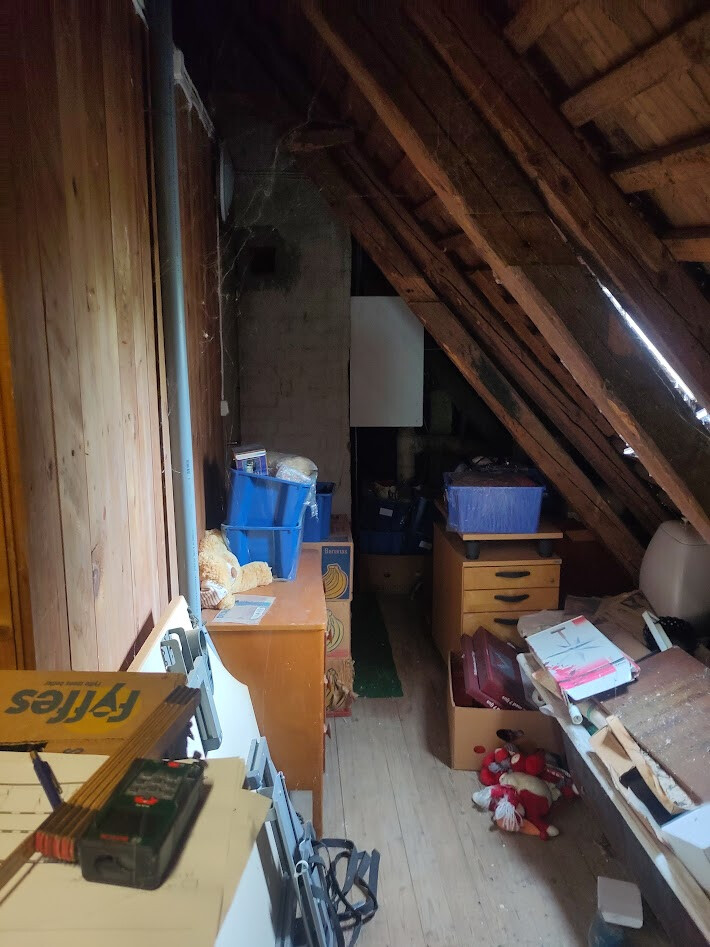
But it's also along the same stretch where we have the collapsing wall.
Wasn't it just you who said that you couldn't know what was inside the walls?J jawen said:

Kan själv!
· Trelleborg
· 20 241 posts
Unfortunately, I'm seeing more and more broken tiles.J jawen said:
But sure, if you replace one of the roofs, you'll have plenty in reserve
I'm a bit fond of the lath roof from 1913, I'm not going to go for the original roof, which was probably thatch. It's evident from the house's roof trusses, as they have been raised. Meanwhile, the utility buildings likely had tar paper roofs from the start.
You misunderstand me.
Your house can't have any flaws such as plastic in the walls combined with a large thermal bridge & other incorrect construction, since your house does not contain this "risk"
So you see what you get.
Then if you have different stones embedded, it does not mean any "disasters"
Fyffes bananas cool!
Kan själv!
· Trelleborg
· 20 241 posts
Then I understand. =)J jawen said:You misunderstand me.
Your house can't have any flaws such as plastic in the walls combined with a large thermal bridge & other incorrect construction, since your house doesn't contain this "risk"
So you see what you get.
Then if you have different stones embedded, it doesn't mean any "disasters"
Fyffes bananas cool!
If you have a beam underneath (in the floor) you can support/unload them from below without changing "too much visually, just make sure of the anchoring in the wall plate first!
Kan själv!
· Trelleborg
· 20 241 posts
Where do you think this beam should support?J jawen said:
Here is some more info about the construction:
https://www.byggahus.se/forum/threads/takstolar-och-kalvande-yttervagg-pa-skanelanga.549857/
If the roof rafters do not have a collar tie between them (where the chimney stack would have been), the rafters with snow loads will want to "bend" inward and at the same time push the wall plate and outer walls outward (since their force is absorbed diagonally downwards and outwards).
But a "dog bone on each side and that you have "locked" the left & right rafter higher up (for example with a 45x145), the load from the roof will also be absorbed through the "dog bone" & the beam underneath, which makes the roof rafters "stop" wanting to push out where the roof meets the wall.
Draw on your sketch from the other thread.
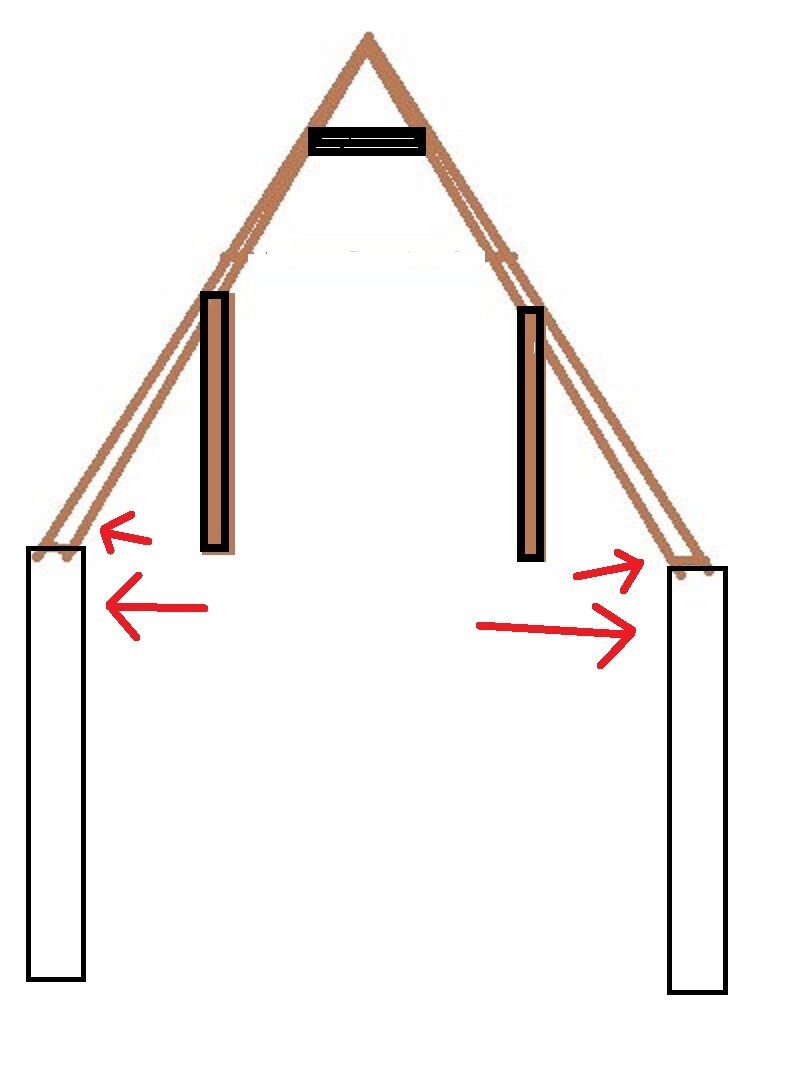
Sometimes in wooden houses, it can be "so bad" that one has to use tension straps to straighten the exterior walls, as the roof rafters are about to push them out so much that the house can collapse "like a house of cards."
So you have to tighten a few cm at a time for several years in a row.
Kan själv!
· Trelleborg
· 20 241 posts
Here, the tie beam has been removed to allow for headroom.J jawen said:If the rafters don't have a beam between them (where the chimney would have gone), the rafters will want to "bend" inward from snow loads & simultaneously push the wall plate and outer walls outward (since their force is directed diagonally down and outward).
But with a "dog leg on each side and you have "locked" the left & right rafter higher up (for example with a 45x145), the load from the roof will also be absorbed through the "dog leg" & the beam below, which means the rafters will "stop" wanting to push out where the roof meets the wall.
Draw it on your sketch from the other thread.
[image]
Sometimes in wooden houses, it can be "so bad" that tie-down straps must be used to straighten the outer walls, because the rafters are about to push them out so much that the house can collapse "like a house of cards."
So you have to tighten it a few centimeters at a time over several years.
The floor joists and top plates unfortunately are not directly above each other here.
However, hopefully, they are connected via the wall plate.
My plan was probably to reinforce the top plates with studs instead.
Wouldn't a short "collar tie" work then?
Reinforcing the top plates (rafters) doesn't solve the issue that the roof load is now being absorbed by the wall plate, which wants to "push out" due to the rafters.

Building conservationist
· 3 573 posts
beautiful farm! The gable is perfectly fine and makes the attic usable. I would leave it! Environmentally, it's foolish to remove functioning solutions solely for aesthetic reasons! However, I would definitely refrain from adding external insulation as it would distort the house's proportions! If you absolutely want to insulate, it can be done internally. For example, building up an inner wall of leca, filling the gap with perlite. Or applying clay plaster in which you plaster a thick tretex board. There are several solutions that work with this type of house. You write that there is a large wall area on a skånelänga, but there are also very many windows! I would think that the biggest heat loss is upwards! I would primarily insulate there. Then there's the issue of windows. Nothing ruins the look of an old house like modern windows! Renovation and energy efficiency of existing windows can go a long way. I see that the windows aren't original. But if the wood is okay, they can be rebuilt with muntins to get closer to the old look.A slightly different look today though:
It was rebuilt in 1937, presumably that's when the gable was added, and the asbestos roof.[image]
There is a risk, but it's not really the feeling I've gotten when I have been there, but we'll see when we get into it.
I've glanced at other farms for sale, and some are built with flint instead.
Last edited: