
1,581 views ·
69 replies
2k views
69 replies
Claystone - insulation value?


Kan själv!
· Trelleborg
· 20 197 posts
Anyone have any idea what thermal conductivity (lambda) to expect for unburnt clay brick?
Trying to determine how good the insulation is in the existing walls on the farm with their 50-60cm thick clay brick walls.
I have found some theses that touch on it superficially, for example this one:
https://www.diva-portal.org/smash/get/diva2:721196/FULLTEXT01.pdf
Where they found references to anything between 0.25 and 1.5W/mK (have not registered to check their references)
This one states ~0.66W/mK for mecklerlera if calculated backwards (Whatever mecklerlera is, I can't find any hits on that search term)
https://lup.lub.lu.se/luur/download?func=downloadFile&recordOId=9168935&fileOId=9168945
And in this one, they refer to a study that says 0.5-0.6W/mK:
https://www.diva-portal.org/smash/get/diva2:5816/FULLTEXT01.pdf
What should I really expect? 🤔
Trying to determine how good the insulation is in the existing walls on the farm with their 50-60cm thick clay brick walls.
I have found some theses that touch on it superficially, for example this one:
https://www.diva-portal.org/smash/get/diva2:721196/FULLTEXT01.pdf
Where they found references to anything between 0.25 and 1.5W/mK (have not registered to check their references)
This one states ~0.66W/mK for mecklerlera if calculated backwards (Whatever mecklerlera is, I can't find any hits on that search term)
https://lup.lub.lu.se/luur/download?func=downloadFile&recordOId=9168935&fileOId=9168945
And in this one, they refer to a study that says 0.5-0.6W/mK:
https://www.diva-portal.org/smash/get/diva2:5816/FULLTEXT01.pdf
What should I really expect? 🤔
Difficult that one, and the execution can vary with potential straw as reinforcement, etc.
I think the lambda for brick (0.6-0.8) is the "closest" comparison if you don't want to get a PhD on the subject.
Kan själv!
· Trelleborg
· 20 197 posts
In my case, I don't think it's reinforced at all, so we can probably go with pure clay, but then it depends on the clay, etc.J jawen said:
Well, then I have a baseline to start from.
A lambda of 0.6 gives a U-value of 1 for "our" wall, which makes a difference in the house's energy consumption. There's a lot of wall in a Skåne house, so with a reasonable amount of insulation in the floor and roof (300mm), the walls account for 70% of the energy consumption.
Yes, these houses/ stables/ barns are not easy to get "energy-okay" unless you change the entire facade.Well, then I have a district to go from.
0.6 Lambda gives a U-value of 1 for "our" wall, it makes a difference to the energy consumption of the house.
A lot of wall on a Skånelänga, so with a reasonable amount of insulation in the floor and ceiling (300mm), the walls account for 70% of the energy consumption.
My stone house has 20 cm of tongue-and-groove styrofoam over Leca, then mesh and 10 mm of integrally colored white noble plaster.
The U-value is then about 0.14, so my house of 256 square meters consumes between 6,600-8,500 kWh per year.
The heating itself is around 1,000-2,400 kWh/year.
Kan själv!
· Trelleborg
· 20 197 posts
Here it is 50-60cm clay brick, so adding 20cm results in really deep window niches. Probably doesn't even have roof overhang for it.J jawen said:Yes, these houses/stables/barns are not easy to make "energy-okay" unless you change the entire facade.
My stone house has 20 cm grooved polystyrene over Leca, then mesh and 10 mm dyed white premium plaster.
The U value is then about 0.14, so my house of 256 sqm consumes between 6,600-8,500 kWh per year.
The heating alone is around 1000-2400 kWh/year
Here the length is ~6x34m on the outside, so it's a lot of wall for little floor.
What type of building is it?
Do you live in it, or is it a stable/barn/garage?
And what are you going to use the building for?
You can extend the eaves 10-20 relatively easily & also bevel the outer insulation at the windows so the light comes in better.
Kan själv!
· Trelleborg
· 20 197 posts
Skånelänga from 1845, residential house.J jawen said:
We plan to move there in the fall.J jawen said:
Residence.J jawen said:
Not much to work with there either unfortunately, especially not without ruining the appearance.J jawen said:
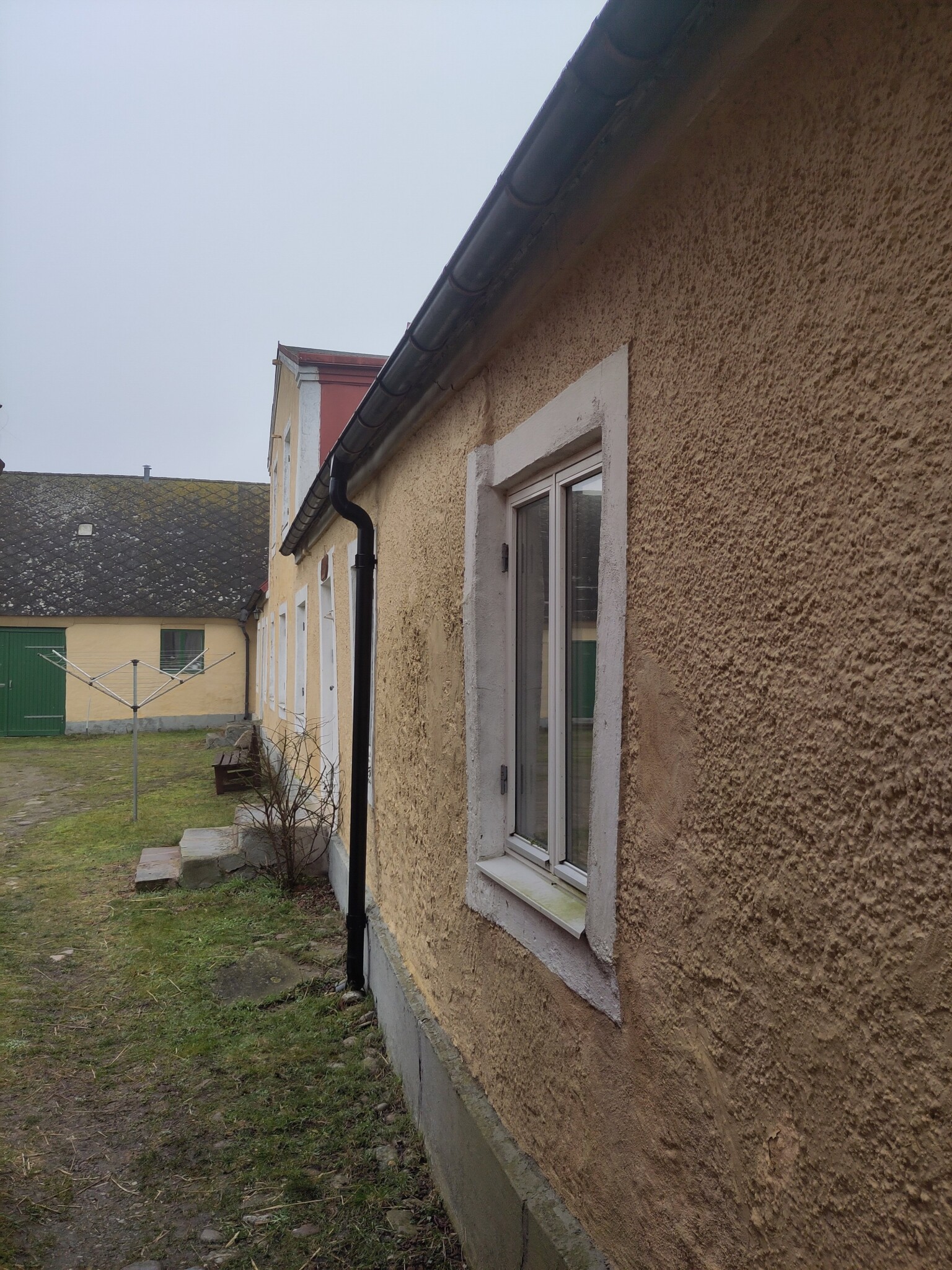
Roof pitch about 50 degrees.
Okay residence.
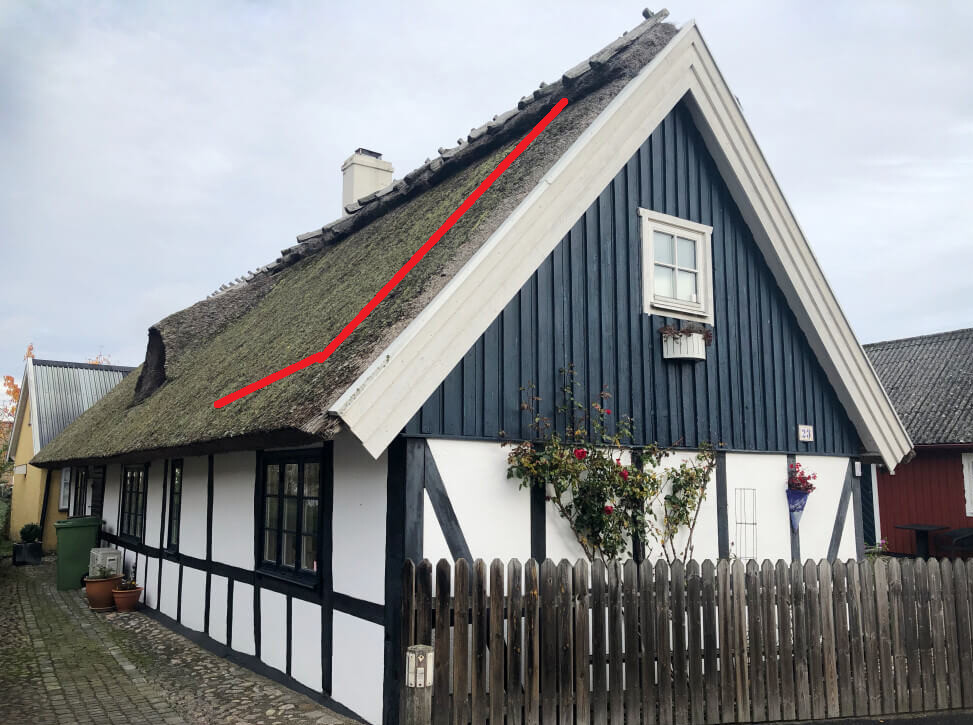
Then you need to tackle this, and it’s not super difficult or needs to be very expensive.
You can extend the eaves by modifying/building a bit up on the roof so it harmonizes with the building but still provides the possibility to insulate from the outside.
That the current roof is about 50 degrees is advantageous in this procedure 👍
You also won't encroach on the sunlight "from above" since the final eaves will come to the same height as they are now. The roof-wall junction will also, after the intervention, be as it is today.
A bit like this (so you understand what I mean)
Kan själv!
· Trelleborg
· 20 197 posts
Just and just, it's an asbestos roof on a shingle roof, so you might as well replace the trusses too.J jawen said:Okay, housing.
Then you have to tackle this, & it's not super difficult or needs to be very expensive.
You can extend the eaves by modifying/ rebuilding a bit up on the roof, so it harmonizes with the building but still provides the condition to insulate externally.
That the current roof is about 50 degrees is advantageous in this intervention 👍
You also won't encroach on the sunlight "from above" since the final eave will be at the same height as now. Also, the roof-wall meeting will, after the measure, be as it is today.
It's a bit like this (so you understand what I mean)
[image]
Kan själv!
· Trelleborg
· 20 197 posts

Kan själv!
· Trelleborg
· 20 197 posts