Ok, let's try a new variant. We can probably agree that Violina took home the prize for the stingiest build, i.e., with only pallets, but practically it's hardly feasible, especially since I can't access this build with a car. It's also difficult on uneven ground. So that variant won't do.
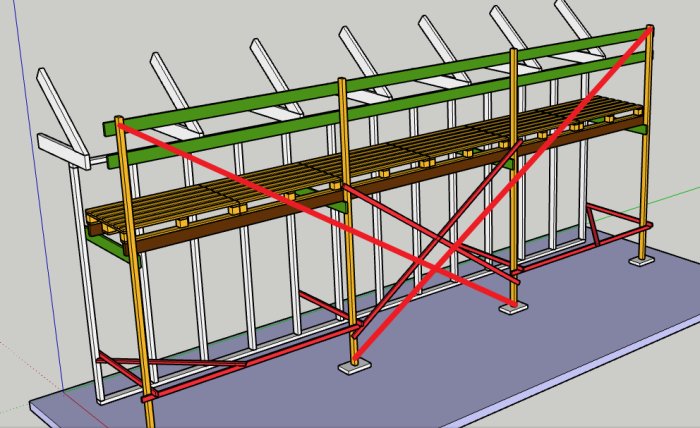
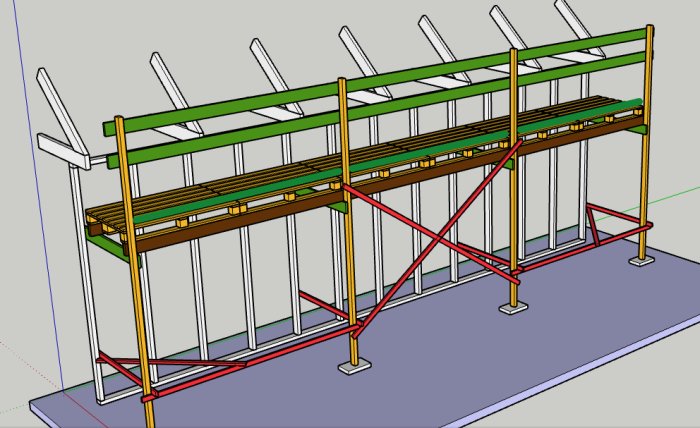
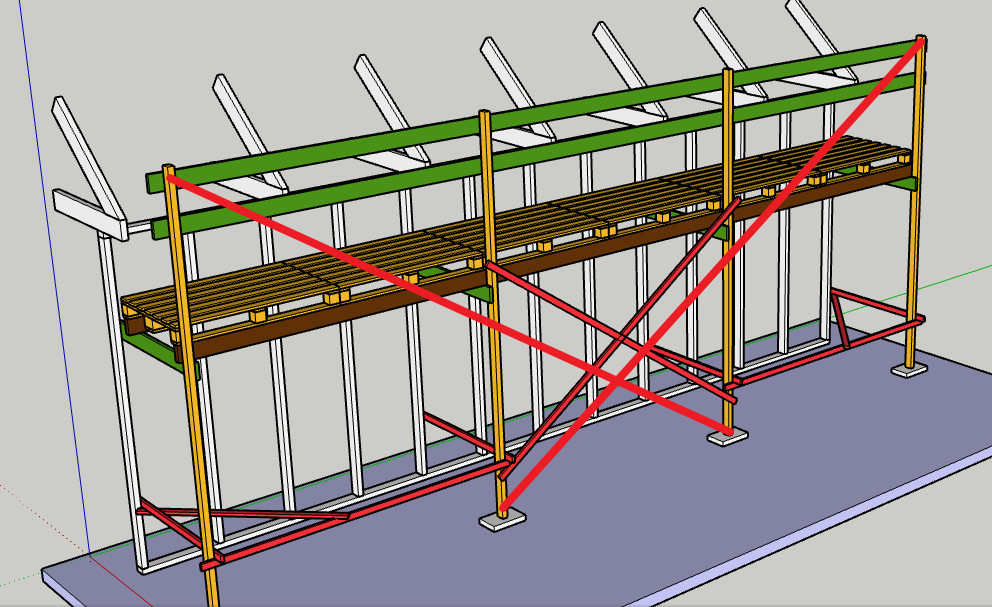
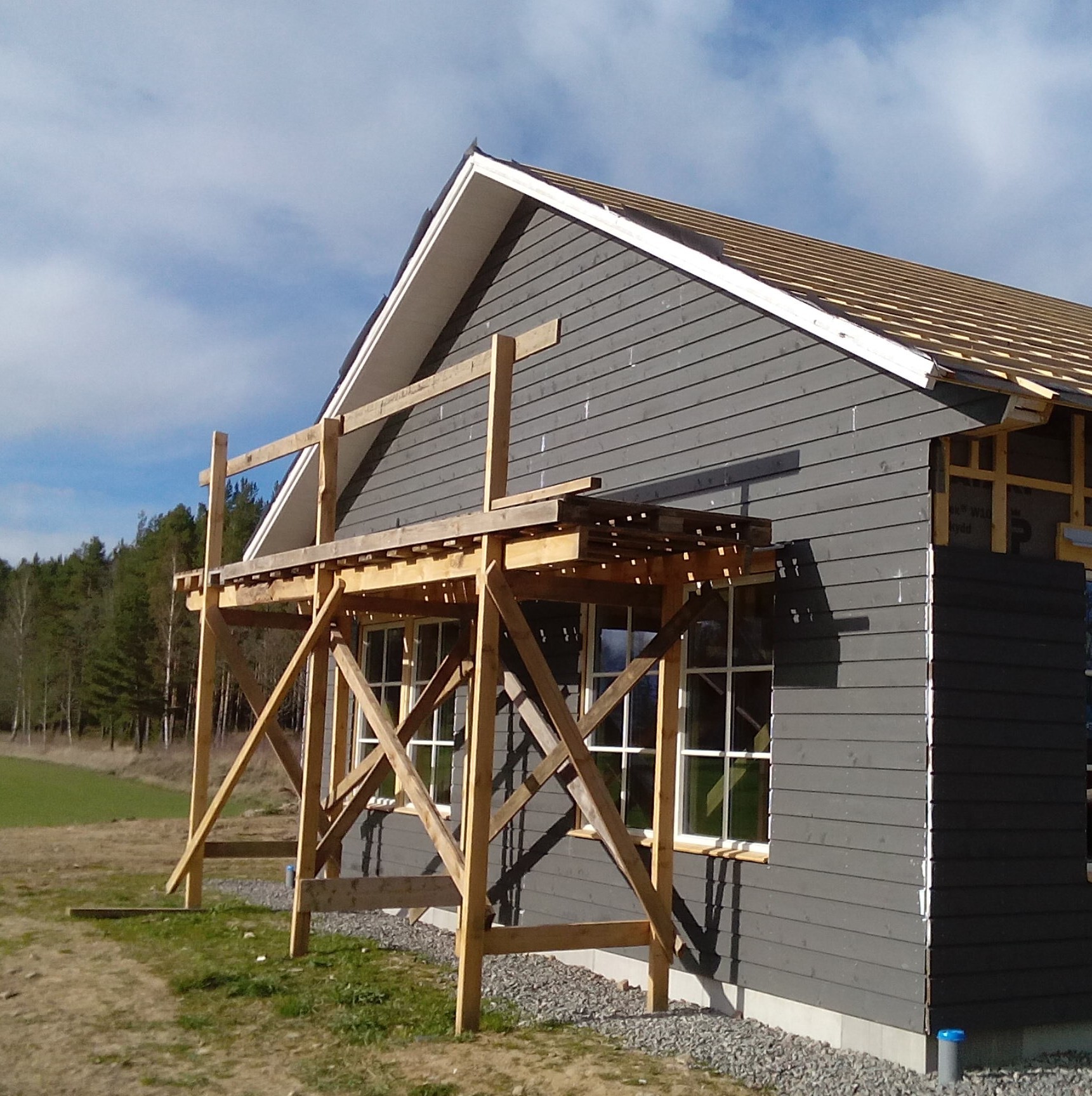
I've taken the criticism and added a cross, and also slightly changed the construction. This is easier to build as it's not dependent on the center-to-center measurement of the wall studs. I think we're getting closer to the best pallet solution considering the factors of stability, economy, and buildability.
Still skeptical?
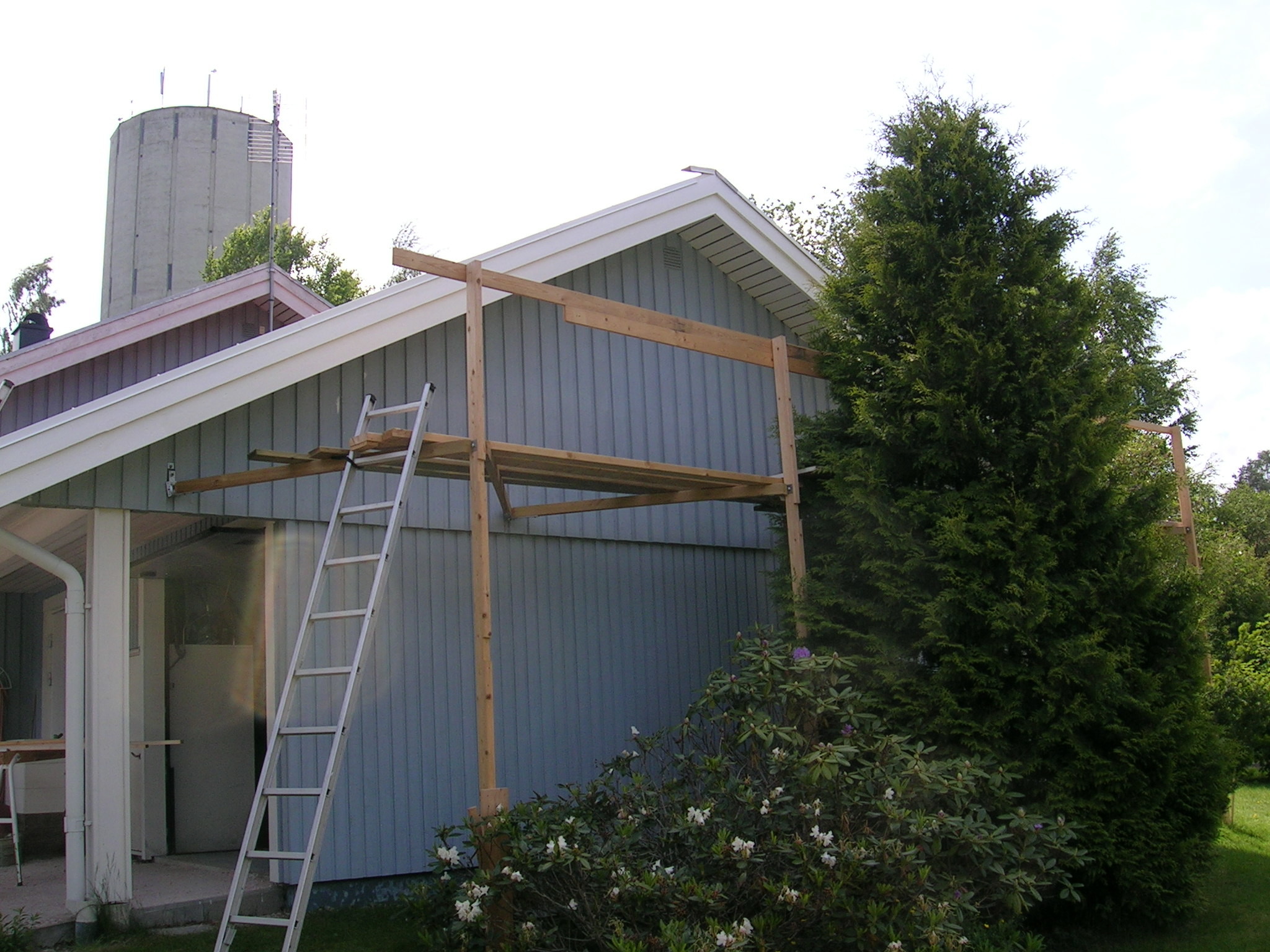
I wouldn't hesitate to go for it, I think this will be incredibly stable, but on the other hand, I've never bothered building a structure before, so this is luxury no matter what . However, I'm not 20 anymore, so the challenge of climbing around like a monkey among rafters and provisionally set steps isn't as appealing as it used to be.
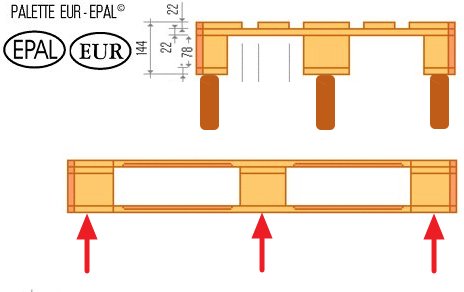
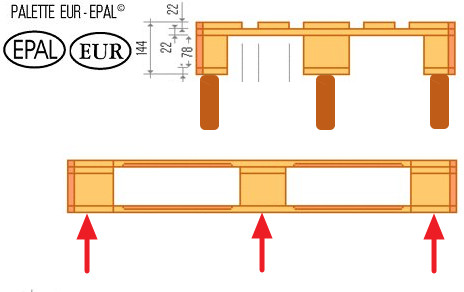
In this construction, the beam layer is in the wrong direction, with only three thin boards in the pallet taking the entire load. You must turn the pallets 90 degrees instead.
In this construction, the boom layer is the wrong way around, only three thin boards in the pallet bear the entire load. You need to turn the pallets 90 degrees instead.
Exactly my thought, it's just a bunch of extra material that doesn't contribute to the construction.
Hello! I think it's great that you're thinking a little outside the box. I'm a bit like you; if it's just for personal use and I can tug and pull on it without it moving, then I'm okay with it. If larger loads, pallets with roof tiles, or similar are going up, or if it's professionals/friends, then I'm considerably more skeptical since you're the one responsible. That's my opinion, but it's nothing that affects the physics behind it all, only that I would feel guilty if something happens.
Now to the fun part of the question. How can it be made more stable!
1. As previously mentioned. As long braces as possible. Based on your case, I think it's difficult to find ones that go all the way, but the further out in the corners you get them, the better.
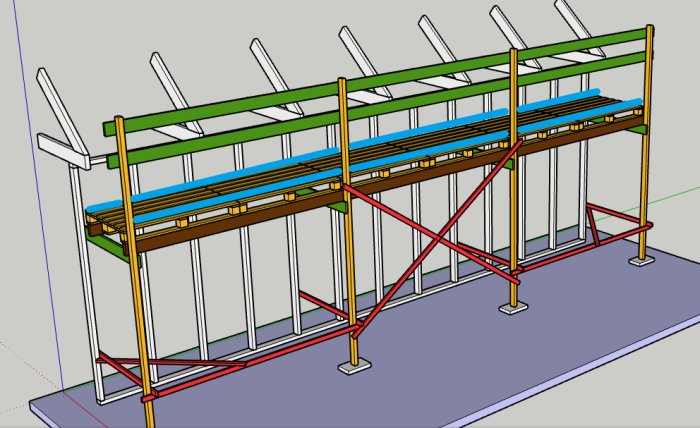
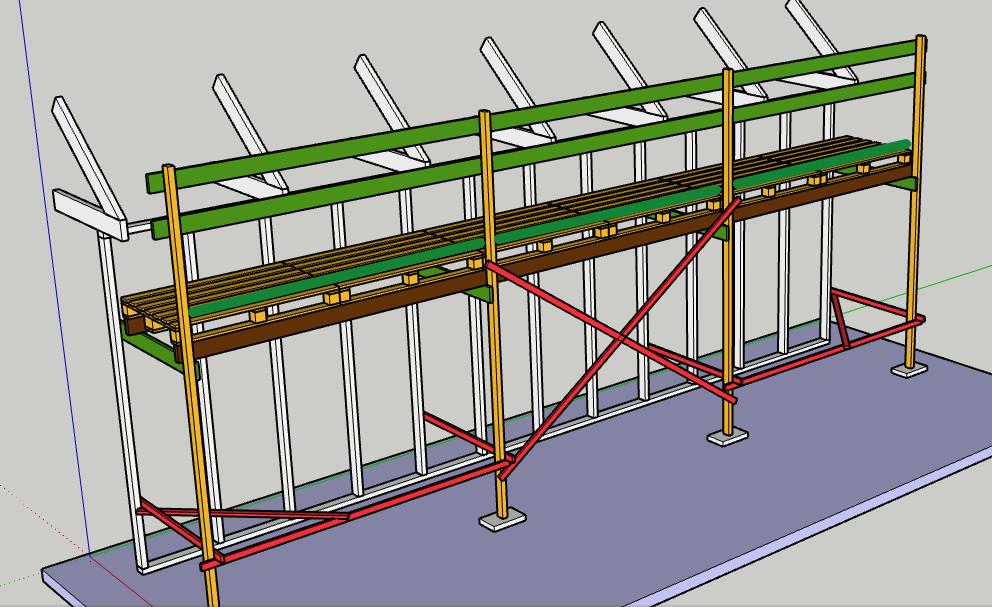
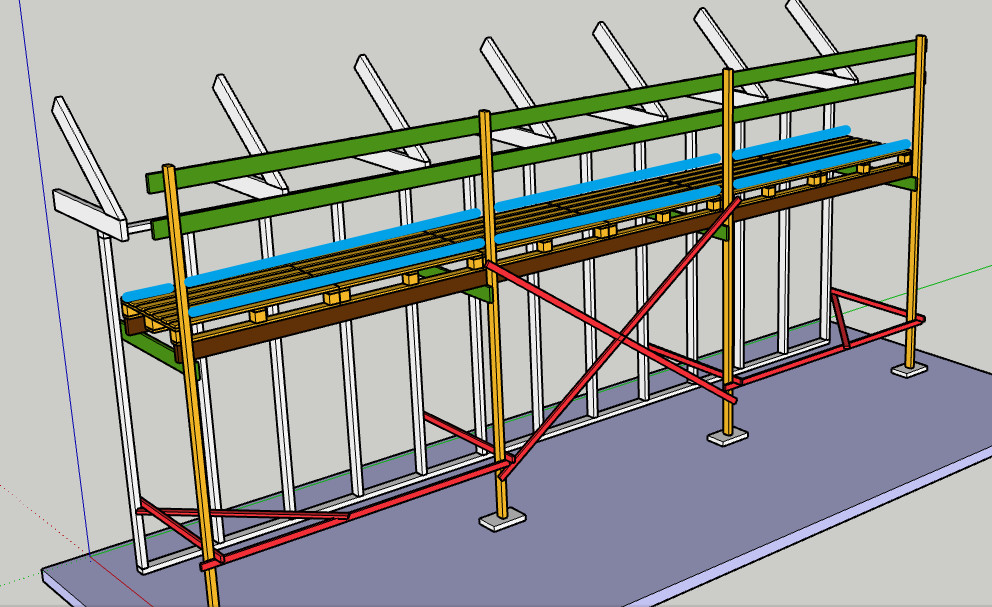
2. As the previous writer mentioned, pallets are strong lengthwise because each "ski" becomes a bit like a beam. To solve this, I would probably have a standing stud in the middle of each pallet and not just on the two outermost skis. The alternative is to make the whole thing a bit deeper and put the pallets in crosswise. This way, you get good strength in the pallet (provided, as you write, that the pallets are of good quality). Also, consider placing the pallets so the force doesn't land on the supporting beams between the "blocks" in the "skis."
3. Protection so you don't slide. My experience is that pallets that get wet can become terribly slippery. It is suggested to place a deck on the inside of the posts that goes all the way. Alternatively, you can screw a stud on both the inside and outside of the top of the pallets so you get slip protection on both sides, which also gives you an additional layer to hold the pallets together in a good way that can be easily unscrewed afterward.
That's what I can come up with early in the morning during breakfast at least. And again, if you have scraps, mount everything you can find on the diagonal, and you'll get a strong, fine frame. Triangles are God's gift for stable constructions.
Don't know, should they? Feels like it shouldn't matter. If one section is torsionally rigid, the entire side should become so.
Preferably a brace across the entire side, alternatively one in each compartment on the long side. As I see it, you have currently built a house of cards.
I wouldn't have been worried about the pallet not being supported in the middle. But on the other hand, it doesn't cost much to put a rule there either.
Smart! It's going to be a crazy amount of pallets to haul there though, but you could stand the pallets on the short side as intermediate storage, that could work =)
If you have a kind neighbor with a loader and pallet forks, it's done in an hour.
I work as a scaffolder and get terrified when I see some of the constructions here. I would recommend renting a real scaffold, it's foolish to skimp on safety. We would have charged about 700 SEK as a base fee and then about 70 SEK/day for the scaffold.
The only thing the original proposal does is replace the planks with pallets and introduce a screwed joint at each post, which is also a bit tricky to achieve in a "quality-assured" way.
I think I'll choose the traditional planks.
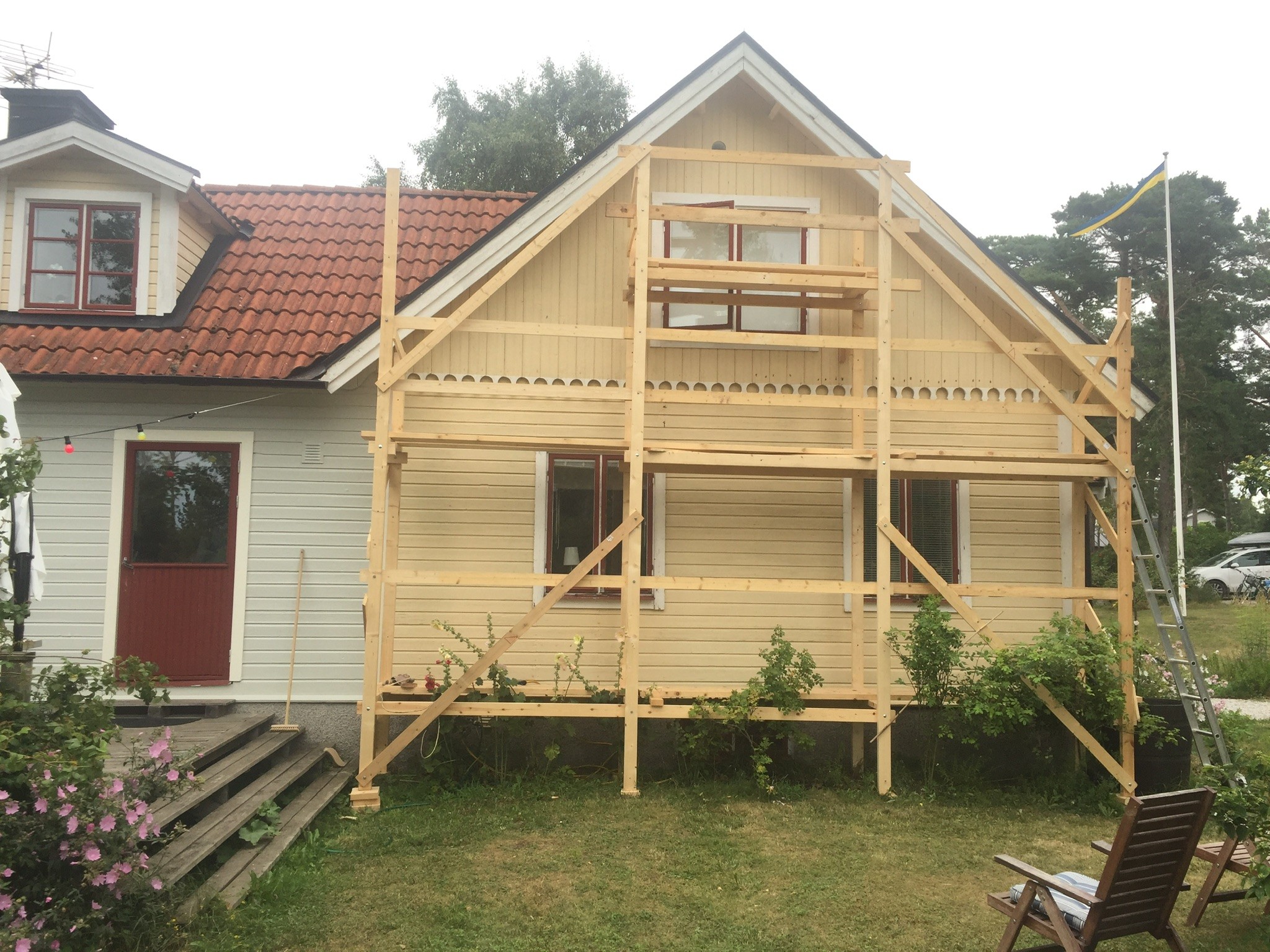
I built with studs and planks.
Standing 45x90, underslag 45x70, walking planks 45x220, then some 22x95 as crosses and railing. Carriage bolt between studs, cross and railing, walking planks screwed. It's not very clear in the picture, but there are braces in all three planes. The longest rule is 5.10 m, highest walking plank at about 4.20. The two middle inner posts are also screwed into the wall.
I drilled holes every meter in the studs and planks, and with 283 cm spacing in the crosses, so it's easy to rebuild the scaffold to another size/height/width and make all parts fit.
I advocate bracing in all planes. It makes the scaffold very stable.
The problem is that not everyone has 100' (if you need a large model) for scaffolding when you are also going to build/renovate. But of course, you can get your "rental" for free by doing so
It doesn't need to cost that much at all. My scaffolding was 170 m2 and cost 17,000:- I sold it for 19,000:- after having it for a year or so.
It is also not entirely simple or risk-free to build a haki-frame or equivalent on your own.
HAKI are easy to build even on your own. I bought a second-hand one cheaply many years ago and sold it for the same amount 2 years ago. There are plenty of them on the market. I used pallets a bit on a project, but it was too cumbersome and took too much time. Then I wanted to be sure when we loaded with bricks and machines. Not an answer to your question, but a tip for getting away cheaply.
Vi vill skicka notiser för ämnen du bevakar och händelser som berör dig.

. However, I'm not 20 anymore, so the challenge of climbing around like a monkey among rafters and provisionally set steps isn't as appealing as it used to be.




nino said:
