
43,643 views ·
117 replies
44k views
117 replies
Challenge - who can build the most economical scaffolding on pallets?
Well, that's your opinion, but this thread isn't about that; it's about how one can use pallets to make a profit. Building a wooden structure without limiting factors isn't particularly difficult. In that case, you could do as suggested in the report HerrP linked to (excellent reading).snuttjulle said:
I mean that the total price will be lower if you get money for excellent pallets and maybe even have some left over for things other than the walking part of the scaffolding. I have tried several times to use free materials to make something cheap, but in the end, it has been more expensive than buying the right thing directly. But if it's just about using pallets, fill it all the way and secure them as you go with what you have available.



I just can't... Do you have to be negative or point fingers to participate in a discussion? It's a sad attitude many have, thinking I'm going to build a rickety house of cards just because I don't want to rent scaffolding. It's actually possible to solve things in ways other than the norm in the construction industry, without getting hurt or dying.
I'm not at all worried that the scaffold won't be stable when I'm done, regardless of how I choose to build it. I'm always thorough and meticulous. I mostly wanted some tips and ideas to further develop the basic concept. If you have nothing to contribute besides concern for my potential sudden demise, you need not bother. Thanks.
I'm not at all worried that the scaffold won't be stable when I'm done, regardless of how I choose to build it. I'm always thorough and meticulous. I mostly wanted some tips and ideas to further develop the basic concept. If you have nothing to contribute besides concern for my potential sudden demise, you need not bother. Thanks.

Garden fixer
· Vischan
· 1 421 posts
Shouldn't the braces be in the outer compartmentsM Markus P said:Ok, then let's try a new variant. We can probably agree that Violina took home the prize for the cheapest build, i.e., with only pallets, but practically speaking, it's hardly feasible, especially since I can't get there by car with this build. Also difficult on uneven ground. So that variant won't do.
I have taken the criticism into account and added a cross, and also changed the construction a bit. This one is easier to build as it is not dependent on the center-to-center measurement of the wall studs. I think we're getting closer to the best pallet solution considering the factors of stability, economy, and buildability.
Still skeptical?
I wouldn't hesitate to go for it; I think this will be incredibly stable, but on the other hand, I've never even bothered to build a scaffold before, so this is a luxury anyway. However, I'm not 20 anymore, so the challenge of climbing around like a monkey among rafters and temporarily set up steps isn't as appealing as it used to be.
I'm not trying to point fingers or be negative, just considering it from another perspective. Personally, I see it as a major disadvantage to have to lift heavy EU pallets to that height and want to offer that thought so you don't start the construction and realize it doesn't work well. My thought when I just read the text was that you would use the pallet in the lower part of the frame as a brace in some direction since they are quite sturdy over the diagonal.
But if you just get annoyed when I'm not purely cheering, then just forget about it.
But if you just get annoyed when I'm not purely cheering, then just forget about it.
I agree with you 100% or almostM Markus P said:I just can't deal with it... Do you have to be negative or bring out the pointing stick to participate in a discussion? It's a sad attitude many have that I'll build a rickety house of cards just because I don't want to rent scaffolding. It IS indeed possible to solve things in other ways than what's standard in the construction industry, even without getting injured or dying.
I'm not worried at all that the scaffolding won't be stable when I'm done, no matter how I choose to build it. I'm always careful and thorough. I mainly wanted some tips and ideas to further develop the basic concept. If you have nothing more to contribute than concern for my potentially sudden demise, then you don't need to bother. Thanks.
Spontaneously, I think that the pallets are heavy and hard to handle at that height, and I would probably focus more on the torsional rigidity and such. A flimsy plank easily holds a person's weight, but I think perhaps the weight of the pallets at height could be a bit much if it gets a little wobbly? It's hard to say until you've tried it.
Doesn't it seem like the upper part of the pallet is actually holding something while the cubes and the lower part don't really contribute anything?
I'd go ahead and add as needed when you notice where it's needed.
This is what it looked like in China when I was there, thought I had a picture of one assembled but unfortunately not.
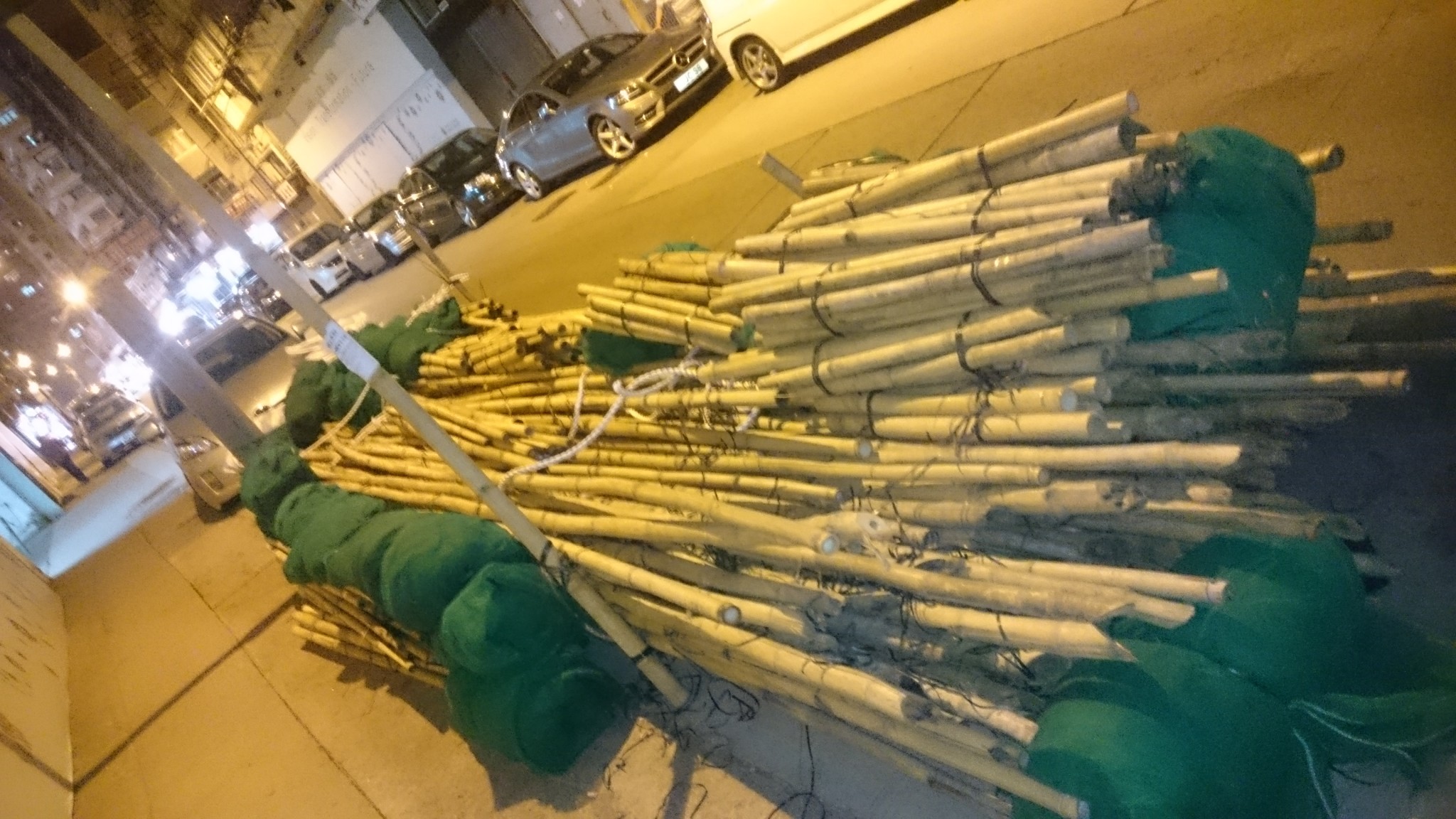
Yes, it's true as you say that the pallet is poorly utilized and much of the wood is unnecessary. At the same time, I have, as I said, tested placing a pallet to check stability, and it felt rock solid. But it might have been better to dismantle the wood in the pallets and use them like planks across the support beams.Forlowt said:
I agree with you 100%, or well almost
Spontaneously, I think that the pallets are heavy and difficult to handle at that height and would have probably focused more on torsional stiffness and such. A flimsy plank easily holds a person's weight, but I might think that the weight of the pallets at the height can become a bit too much if it were to become a little wobbly? Hard to say until you try.
Isn't it that the upper part of the pallet is actually what's holding something and the cubes and lower part don't directly contribute to anything?
I would proceed and add as you notice where it’s needed.
This is how it looked in China when I was there, thought I had a picture of a mounted one but unfortunately
Throwing the pallets onto the structure, however, I'm not too worried about, they aren't that heavy. A couple of weeks ago, my neighbor and I tossed up the glulam beam in the ridge, 115x360x6500, with manual force and without any scaffolding at all. With that experience in hindsight, everything else feels so much easier
you shouldn't limit yourself to making one section stiff. You should take as long a cross brace as possible and stretch it over all three sections if it is to be optimal.M Markus P said:
Another cheap method is to buy a used scaffolding and then sell it when you're done.M Markus P said:Hello friends!
Currently, I'm in the midst of a little house project at home, and now that roofing work looms, it's time to construct scaffolding. The usual route is to rent scaffolding, but with the poor weather recently, I've had time to think it over, and it occurred to me that it should be possible to build one myself. Has anyone tried this?
The advantages of building one myself, as I see it, are as follows:
- The cost might be similar, but all the materials can be reused.
- A good way to use scrap wood from the construction site
- Always fun to build your own! =)
I have virtually unlimited access to pallets, so I thought I would try to use them to reduce the cost a bit. I'm envisioning something like this (see attached image). I've been as frugal with the wood as I dared, the challenge is to make it as cheap as possible! =). The wood in the picture is as follows:
green - deck 28x120
yellow - stud 45x70
red - batten 25x5
If you go by Buildmax prices, the cost is about 1050 SEK if you buy all the wood new. In reality, you use as much scrap wood as you have first. For example, the cross decking can be replaced with the lengthwise wood of a pallet, thus skipping that cost, just by dismantling a few pallets.
Can anyone think of a better solution for the wall section in the example? And perhaps most importantly, would you dare to use this scaffolding?!
I did that and made a few thousand SEK on the deal AND had professional, reliable scaffolding without the time pressure of expensive rent.
