
43,635 views ·
117 replies
44k views
117 replies
Challenge - who can build the most economical scaffolding on pallets?


I'm not entirely comfortable with taking chances with safety. You are never alone when an accident has occurred, often due to one's own "common sense" or the thought "it won't happen to me." But the consequences when something does happen far exceed any economic savings, and then it's too late. However, I can embrace the idea of using materials that you inevitably plan to use. But I can offer a couple of tips in addition to what I've read so far, with some development of the reasoning.
- Place the pallet crosswise. Partly due to stability and not least because of the access to space when, for example, the gutters are in place.
- Raise the pallet so there is a smaller gap between the eaves and the pallet, which makes it easier when you need to get onto the roof.
- Seal the standing studs (1.8 m) considering that the wood is full of knots, which thereby weakens durability if one loses their balance and the wood breaks....
- Extend the scaffolding beyond the gables considering you will also be laying raw wood, which will then protrude beyond the intended scaffolding.
- Add an additional longitudinal plank that lies in an intended fall line so that you don't roll through the lower plank and the pallet.
- And an additional plank that lies directly against the pallet so that nothing small goes through and falls on the person in front of the scaffolding. And see above.
Good luck
- Place the pallet crosswise. Partly due to stability and not least because of the access to space when, for example, the gutters are in place.
- Raise the pallet so there is a smaller gap between the eaves and the pallet, which makes it easier when you need to get onto the roof.
- Seal the standing studs (1.8 m) considering that the wood is full of knots, which thereby weakens durability if one loses their balance and the wood breaks....
- Extend the scaffolding beyond the gables considering you will also be laying raw wood, which will then protrude beyond the intended scaffolding.
- Add an additional longitudinal plank that lies in an intended fall line so that you don't roll through the lower plank and the pallet.
- And an additional plank that lies directly against the pallet so that nothing small goes through and falls on the person in front of the scaffolding. And see above.
Good luck


Wow, many responses now =). I've tried to sift through the posts and take in what I see as relevant to my project. I'll summarize the points below.
Regards
- I will not use diagonals on the short side because the structure is well anchored in the wall studs both at the top and bottom, and therefore does not need additional reinforcement in that direction.
- One diagonal brace per section added. If desired, more can be used for added stability, but I'm satisfied with this (unless the structure feels unstable once built).
- The pallets are rotated 90°. This actually feels obvious and should have been done from the start. Thanks for the input on that.
- Changed from decking timber to construction timber to support the two longitudinal beams.
- I will not be renting a scaffold. I understand that many prefer the extra safety it provides, and if you feel that way, you should definitely rent a proper scaffold. However, I feel differently and will build according to the original plan, slightly modified based on the valuable feedback here in the thread.
Regards


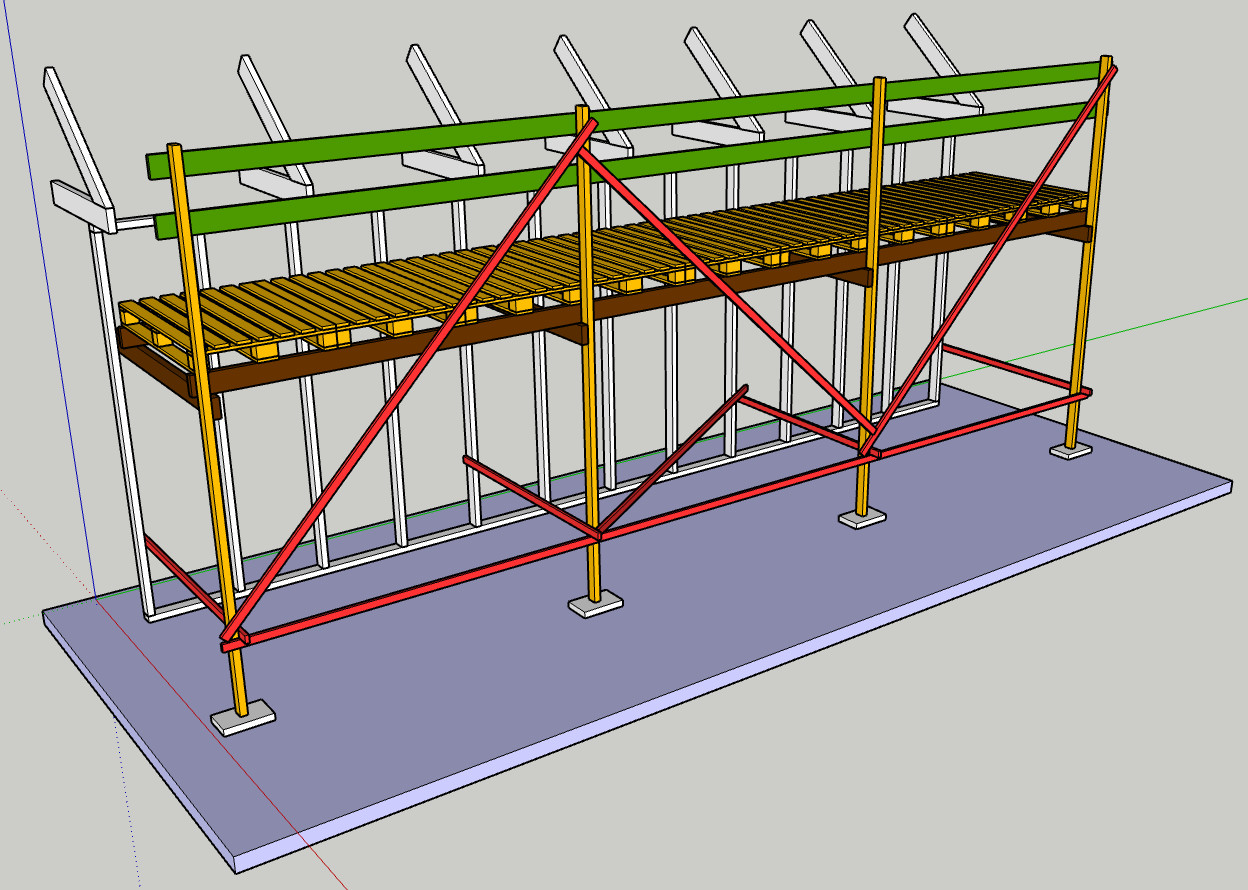
Just this about properly anchoring things and then feeling how stable it is to determine if more diagonal braces are needed, I believe in. Spontaneously, it starts to look a bit overworked. Upright longitudinal properly screwed-in beams that the pallets rest on. It seems easier to let the longitudinal beams lie down and then skip the pallets. But you do get a wider working surface your way.

You're not worried that some druggie might come by and steal the pallet then? As a former truck driver, I remember how important it was to get an empty pallet in return for every pallet of goods I delivered and how shady people drove around and stole pallets to sell.
Haha, no, that's probably the last thing I'm worried aboutK Kirre2 said:
. If someone comes out to us in the countryside, they'll probably find more fun things to steal than pallets. And if it happens against all odds, I can spare those pallets .
Sketchup 8 is also available for free download. A bit older (but better than online in my opinion) software though.M Markus P said:
I also had these thoughts but eventually bought a new haki, 9 meters wide, 3 meters high, 6 meters high in the middle.
16,000:-
It has paid off quite well, and I have also rented it out.
I trust that I will get my money back when I sell it.
16,000:-
It has paid off quite well, and I have also rented it out.
I trust that I will get my money back when I sell it.

Hello
I built a scaffold that reached the height of the eaves during a roof renovation. I constructed it as single-sided sawhorses. The legs were equipped with steps and braces angled up toward the horse's saddle. They became a very sturdy construction. With four of these along the facade, nailed with nail strips to the facade, I then laid iron ladders between the horses. On the ladders, I placed sturdy boards that I could walk on comfortably. The ladders were attached to the horse saddle. Everything felt very stable and secure. They were, however, only used by myself.
I built a scaffold that reached the height of the eaves during a roof renovation. I constructed it as single-sided sawhorses. The legs were equipped with steps and braces angled up toward the horse's saddle. They became a very sturdy construction. With four of these along the facade, nailed with nail strips to the facade, I then laid iron ladders between the horses. On the ladders, I placed sturdy boards that I could walk on comfortably. The ladders were attached to the horse saddle. Everything felt very stable and secure. They were, however, only used by myself.

Mats-S
Construction veteran
· Sollentuna
· 3 617 posts
Mats-S
Construction veteran
- Sollentuna
- 3,617 posts
green - okay but with reservation
yellow - too weak, 45X95 it's supposed to be
red - hellishly too weak, go for at least 20X95
Pallets - high risk of stepping wrong in the large gaps, lay down a board to walk on ... not very fun to fall on this platform.
