
274,345 views ·
85 replies
274k views
85 replies
Building a door that doesn't warp?
You can make a frame in many different ways, from the simplest (a planed plank + a planed strip as a stop) to the slightly more complex (a thicker plank with recesses for stops made by milling or sawing from two sides).halvproffset said:Have read and considered this thorough post and am likely planning to build a door for the shed's storage area with the builder's spec. However, I'm a bit unsure about how to make a proper frame and how to handle the hinges, and how large a gap is necessary between the door and frame for it to open.
There should be three hinges (so they can handle the vertical force = weight of the door leaf) and should be placed with the top one about 20 cm from the top edge of the door leaf, the second about 20-30 cm below that (so that both can handle the moment caused by the door leaf wanting to swing outwards as the center of gravity is at the intersection of its diagonals), and the third about 20 cm from the bottom edge of the door leaf.
To then be able to open and close the door, cut off a bit from the front edge of the door leaf on the inside to account for the swing radius's effect on the arc. This is usually a few millimeters at most. Additionally, the door leaf should be no more than 3mm narrower than the door rebate's inner dimensions.
_____________________
The Builder
Hello
I need to get a sliding door that is approximately 220 cm high and 140 cm wide. It will rarely be closed but is needed to separate the hallway from the living room during cold weather and festive occasions. Unfortunately, I can't change the dimensions. There are no other walls to recess it into.
Considering crafting it myself. I have good access to tools and am handy. Unfortunately (so far), I've only made a flat MDF sliding door that works just fine.
Thinking about building a panel door with 2 sets of panels (due to the width). Considering using an MDF in the middle, across the whole surface, and mounting the framework equally on both sides. I plan to rout the panels in thin MDF and glue them on before the framework is put in place.
I'm worried that the door will warp if I only work with solid wood. Also considering reinforcing with steel along the edges, such as flat iron or T-iron. Beijer has a professional section with 'carpenter dry wood.' Hope it's adequate.
Grateful for tips.
Best regards,
Peter
I need to get a sliding door that is approximately 220 cm high and 140 cm wide. It will rarely be closed but is needed to separate the hallway from the living room during cold weather and festive occasions. Unfortunately, I can't change the dimensions. There are no other walls to recess it into.
Considering crafting it myself. I have good access to tools and am handy. Unfortunately (so far), I've only made a flat MDF sliding door that works just fine.
Thinking about building a panel door with 2 sets of panels (due to the width). Considering using an MDF in the middle, across the whole surface, and mounting the framework equally on both sides. I plan to rout the panels in thin MDF and glue them on before the framework is put in place.
I'm worried that the door will warp if I only work with solid wood. Also considering reinforcing with steel along the edges, such as flat iron or T-iron. Beijer has a professional section with 'carpenter dry wood.' Hope it's adequate.
Grateful for tips.
Best regards,
Peter


Aren't you tempted to carpentry a frame and then two mirrors (not glued but loose) in real wood? Could be a nice project.GSM-Peter said:Hi
I need to get a sliding door that is about 220 high and 140 cm wide. It will rarely be closed but is needed to screen the hall from the living room during cold weather and festive occasions. Unfortunately, I can't change the dimensions. There are no other walls to slide it into.
Thinking about crafting it myself. I have good access to tools and am handy. Unfortunately, I have (so far) only made a smooth MDF sliding door that works just fine.
Thinking about building a paneled door with 2 sets of panels (due to the width). Thinking about using an MDF in the middle, over the entire surface, and assembling the framework equally on both sides. I thought to route the panels in thin MDF and glue them on before the framework is put in place.
I am worried that the door will warp if I only work in solid wood. I am also considering reinforcing with steel along the edges, like flat iron or T-iron. Beijers has a professional section with 'carpenter-dry wood.'
Hope that will suffice.
Grateful for tips.
Regards
Peter
Hi Daniel
Yes, it can be a fun project to build entirely in solid wood.
However, I'm not sure what will be best. I'm worried it may warp, especially since it will be large.
Loose mirrors might work well as I don't need diagonal strength (top-hung sliding door).
We'll see, the door doesn't need to be finished until the summer.
Peter
Yes, it can be a fun project to build entirely in solid wood.
However, I'm not sure what will be best. I'm worried it may warp, especially since it will be large.
Loose mirrors might work well as I don't need diagonal strength (top-hung sliding door).
We'll see, the door doesn't need to be finished until the summer.
Peter

Sorry for a late reply. When I wrote about half and half, I hadn't properly read your description. In my mind, I had split the planks to 21x70, i.e., on the other side. Hence my suggestion about half and half.imported_Byggaren said:I don't quite understand how you mean by shifting a plank width. Can you show with a sketch?
The point of splitting, overturning, and glue-laminating the same plank is that the stresses present in the wood become equal when the parts are taken from the same piece. They do not become equal if you take two different pieces and do the same thing with them, meaning it's not straight in the long run.
______________
Byggaren
Hello
The question was: I don't quite understand what you mean by shifting a rule width. Can you show with a sketch?
Answer: No sketch right now. Hopefully, it will come with time. It was a bit poorly described anyway. I'll try again.
What I mean is that a 135 cm wide door doesn't look nice if I only have three panels. Hence the suggestion to build something that resembles two doors but is joined together.
This results in 6 panels and hopefully looks a bit more beautiful (in fully open, fully closed, or half-closed position. Otherwise, it looks odd).
The idea was first to put a blind center-divider (as if there was an opening in the middle).
My latest idea is to buy 2 standard door leaves and glue them together and reinforce with a rule at the bottom and top.
To achieve harmony, I'll have to cut away a bit in the middle first to give it a sleeker impression.
All ideas are warmly welcome!
Goodnight, for now, I'm off to order new brushes for the washing machine!
Best regards
Peter
The question was: I don't quite understand what you mean by shifting a rule width. Can you show with a sketch?
Answer: No sketch right now. Hopefully, it will come with time. It was a bit poorly described anyway. I'll try again.
What I mean is that a 135 cm wide door doesn't look nice if I only have three panels. Hence the suggestion to build something that resembles two doors but is joined together.
This results in 6 panels and hopefully looks a bit more beautiful (in fully open, fully closed, or half-closed position. Otherwise, it looks odd).
The idea was first to put a blind center-divider (as if there was an opening in the middle).
My latest idea is to buy 2 standard door leaves and glue them together and reinforce with a rule at the bottom and top.
To achieve harmony, I'll have to cut away a bit in the middle first to give it a sleeker impression.
All ideas are warmly welcome!
Goodnight, for now, I'm off to order new brushes for the washing machine!
Best regards
Peter
Raising the thread with a thought: Would it work to cut strips (e.g., 70mm wide) out of 15mm K-plyfa board and glue together, for example, 3 of them to create torsionally rigid studs for a door. Has anyone tried it?

I have now built a door following the instructions in the thread. Extremely stable but incredibly heavy. Had to use the tractor to hang it on the hinges. Used 45*90 studs that were split in half for the frame, 12mm water-resistant plywood for the inside (can't paint on it and I want it to look nice on the outside even if it's just for the barn...), 45*45 studs for the "diagonal bar" and to attach the 22*100 planks on the front. An extra piece of timber as reinforcement where the lock case was placed. Filled the frame with insulation left over from the bathroom renovation and then added reinforced plastic (unnecessary with reinforced but there was a roll here...). Built the frame on site piece by piece from 45*90 studs and 25*25 "sticks" that were also in the barn.
Big thanks to imported_Byggaren for the inspiration and instructions. I probably wouldn't have dared to build a door otherwise. In any case, it certainly wouldn't have been as stable.

Here are some pictures taken during the work and when the door was put in place.
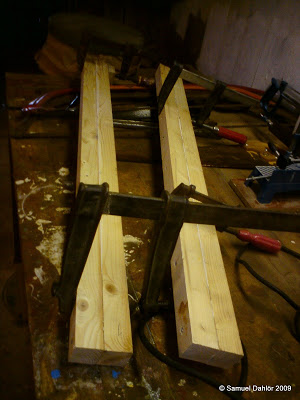
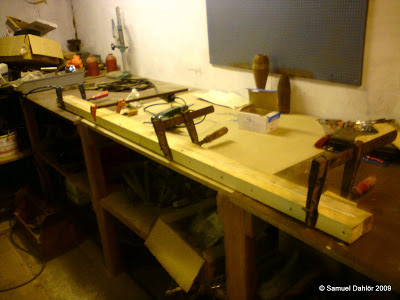
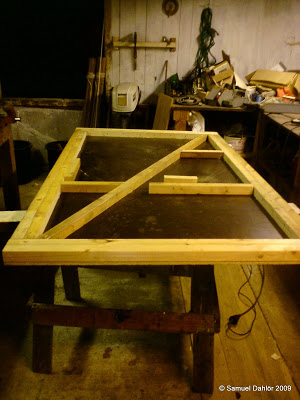
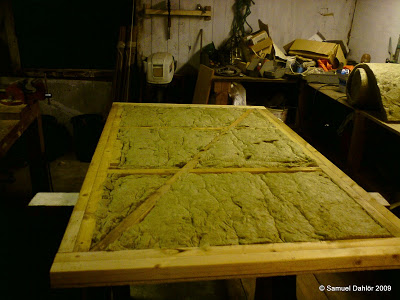
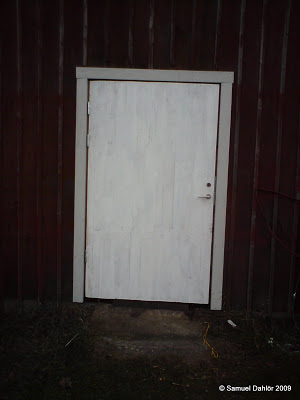
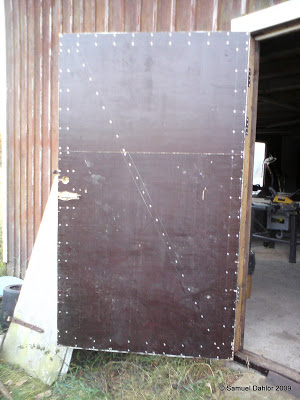
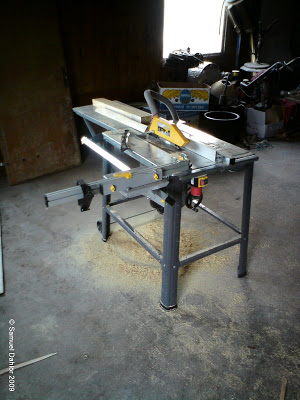
Bonus picture of the "new" (someone who couldn't handle it and thought it was broken...) table saw, maybe not a marvel of quality but it's significantly better than no table saw at all...
Big thanks to imported_Byggaren for the inspiration and instructions. I probably wouldn't have dared to build a door otherwise. In any case, it certainly wouldn't have been as stable.
Here are some pictures taken during the work and when the door was put in place.
Bonus picture of the "new" (someone who couldn't handle it and thought it was broken...) table saw, maybe not a marvel of quality but it's significantly better than no table saw at all...
Last edited:

I would think that it would work just as well to make an interior door with thinner wood and thinner panels, like Masonite. However, I'm not sure because I'm not a builder (I drive a truck when the economy allows...) but I just try things out and think "if you do it this way, it SHOULD work." Then I read a lot here, and that helps a bit...
If you have the time and a decent amount of spare material, you can just give it a try.
/Samuel
If you have the time and a decent amount of spare material, you can just give it a try.
/Samuel


If you want to make noise reduction, it should probably be heavy panels on both sides of the door and as few studs as possible that acoustically connect the sides, then fill with heavy sound-dampened insulation, such as foundation boards.
or, as it usually looks in old movies.. a vinyl/leather stretched over the door and nailed around, with insulation behind it..
or, as it usually looks in old movies.. a vinyl/leather stretched over the door and nailed around, with insulation behind it..
What type of wood is used for the frame of a swing gate for a garage?
Should you glue it in layers to prevent warping?
I've seen somewhere that grooves are cut on the outer side (against the wall).
Can pressure-treated wood be used for the threshold?
I am new to this excellent forum.
Should you glue it in layers to prevent warping?
I've seen somewhere that grooves are cut on the outer side (against the wall).
Can pressure-treated wood be used for the threshold?
I am new to this excellent forum.
Last edited:

Welcome to the forum.intruderbosse said:
You can use standard studs, preferably 45*95. They should be glued in opposite directions.
Grooves on the outside? Not sure what you mean. Not the rebate then?
Pressure-treated wood is probably not recommended, and I don't see any advantage in using it.
It should be painted anyway?
Attached is an image of my doors. Not swing gates, but 14*19.

