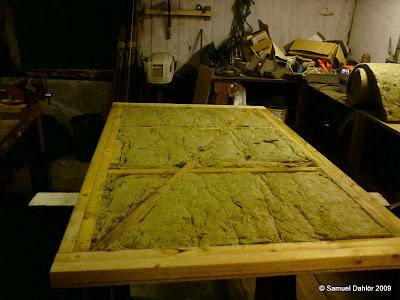
I have used the Builder's advice and built four hinged gates.
Scored plywood on the outside and masonite on the inside. Foam insulation.
By using the plywood as an angle, it was made easier for the gates to become straight and have not shown any tendency to warp.
If I am going to build an interior door and use it as a sliding door, how do I build something solid and soundproof?
The door should only be 40mm thick.
Let's say I use 28x70 framing timber for the frame and then 6mm plywood on each side to make it a completely smooth door.
Regular insulation in the empty space. Will it be a sturdy and good sliding door to use indoors?
Hmm... masonite is not very stable so it doesn't provide very good sound insulation. Now, I don't know how much insulation is needed, but otherwise, it's a common way for how interior doors are usually constructed... It does dampen high frequencies...
The builder is absolutely fantastic with their detailed descriptions! Big thanks to the builder!
I have a question.
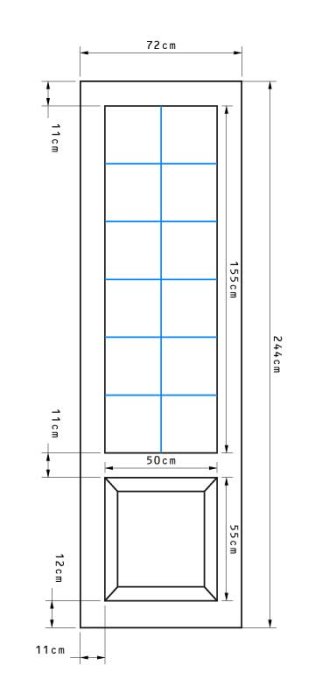
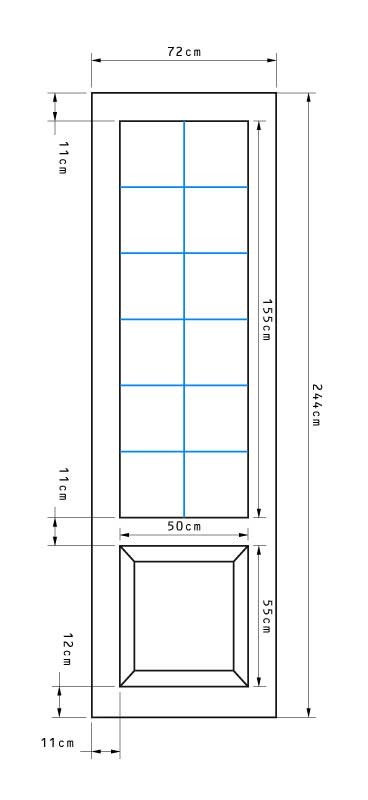
Can you apply exactly the same approach and materials if you are going to build tall door panels with windows and a panel at the bottom? Especially considering that the "hole" where the window will be placed weakens the entire structure. By tall door panels, I mean about 244-245 cm high, and about 72 cm wide. And they are meant to be interior doors, so they shouldn't be too thick. A maximum thickness of 5 cm is allowed. Here's a sketch:
Truly, is there anyone who knows if the technique mentioned above by Byggaren can be applied to large door panels with glass according to the drawing in the previous post?
I thought I’d ask around before I embark on the project so I can avoid failing with an inapplicable technique
Woho! What a great thread thanks to the builder!
I am going to renovate and want new doors. However, it should be two swing doors in an opening that is 250 wide and 270 high.
Sheets that large don't exist, right? (2700mm x 1250mm)
Really no one who knows whether the above-mentioned technique by Byggaren can be applied to large door panels with glass according to the drawing in the previous post?
Thought I would inquire before embarking on the project so I can avoid failing with non-applicable techniques
Hi,
How did the interior door turn out? Interested in the result and if you managed to get it with the glass upper part...
I am planning to make windows for a house we are going to build. Is it appropriate to use the same technique (splitting and turning gluing) when making window frames or is it over-engineering? What moisture content is suitable for window manufacturing?
Why not just use veneer gluing but also rotate the wood across its growth direction, i.e., störtning? I can't figure out why that would be beneficial. Is there an experienced furniture maker who has the answer?
Raising the thread with a thought: Would it work to cut strips (e.g., 70mm wide) from a 15mm K-plywood board and glue together, e.g., 3 of them, to get torsionally rigid studs for a door. Has anyone tried it?
Interesting question. I have built according to the builder's description and am very satisfied. I'm now going to build exterior doors, and it would be nice to be able to use strips of plywood instead, so I am also interested to hear if anyone has tried it.
Another question. I have some glulam beams left over after a small project.
It immediately feels like a good solution to use since it shouldn't warp, one might think.
Does anyone have any opinions on that?
Glulam can definitely warp, especially if you cut or plane it. Additionally, it is usually made from less good quality wood, which might not be ideal for door manufacturing, depending on what type of door it is, of course.
Why don't you just glue in reverse but also rotate the wood across the grain growth direction, i.e., the störtning? I can't figure out why that would be good? Any experienced furniture maker with the answer?
The responses in the thread [link] state that more gluing is better, but I am mostly curious about when störtning might be appropriate.
It possibly reduces tension even in the longitudinal direction, which is a good thing in theory. That being said, you often encounter that half of the piece produces chips during planing, while the other half (which is in the right direction) turns out well.
It is definitely better to use edge-glued shelves in that case, as the pieces used are so narrow that even if you cut them into narrower pieces, there will usually be at least one glue joint left.
For example, if you split a glulam beam that is 90mm wide into 40mm narrow pieces, you'll get entire 90x40 studs from it ...unless you split it so the glue joint is in the middle. But regardless, it sounds cumbersome. As Daniel_N writes, it's probably not a good idea since the pieces used for glulam beams are too large.
Vi vill skicka notiser för ämnen du bevakar och händelser som berör dig.