
Hej,
Hopefully English is OK. I started to write in my bad swedish, but realize my idea is difficult to articulate and likely sounds terrible even in english. Let alone try to 'convince' in Swedish
The short version is i'm trying to source which el patron's would fit in my Albin 500L accumulator tank -- I find ones that 'look' like they should fit (Long and appear to screw in). I simply have no idea if this was a very standardized item and these would fit or if there is a measurement to take. The model of the tank is 870 739 -- I have the original flyer which advertises the use of el patrons' but unfortunately do not find any schematic showing any sort of measurements
I have a local plumber to install into the tank while replacing a few valves, and will hire an electrician to wire them. (Plan is into a shelly or similar to allow remote ability to control them). The problem is finding someone to help locate/order suitable cartridges
The longer 'Why would you ever do such a thing'.
I recently bought a house with an old 80s Albin Combi Panna (720F) with 110L capacity, it originally was ved+olja+el but had exclusively been el for many years. In addition there is a 500L Albin accumlator tank.
The house has 15 radiators, and a tankless water heater. Both tap water and house heating is consumed from the closed loop system from above, solely powered by electricity today.
My day job is a computer geek, and I've gone full home assistant, zigbee2mqtt, devices, etc in the house.
I have smart TRVs on all radiators, and began using the 500L accumulator tank with the elpatron system. -- well all but 3 which have non thermostatic valves. I have a local contractor that will replace these, which will require draining the system. Which --I think-- makes the physical install(not wiring) of el patron's relatively trivial/primarily cost of the cartridge.
We do not have the smart meter installed yet but using the light from the meter, I also have real time consumption data in home assistant allowing me to see when the boiler is active vs not real time and how the automation of radiators affects this.
With home assistant, and tibber i've automated the TRVs based off price. With this, I do achieve periods of the boiler being 'off' . However this is quite limited since the thermostat on the antique boiler is manual and no practical way to automate it. It is more common I sit on the lower step of the el patron(3kw) and prevent the higher consumption from occurring.
Given this 'success', my thought is to take this to the next level.
Install additional elpatron's into the accumulator tank. That either are wired to a more modern thermostat allowing remote setting, or to a shelly breaker type solution allowing me to entirely control the power to these. These additional cartridges would be set to bring the water as high as feasible(90C+?) and only be triggered during the lowest cost periods of electricity,
The existing 'dumb' el patron's in the albin 720F be set to a lower temperature to ensure the overall system never cools too low.
The delta between these two would effectively be a water battery.
Assuming the electric cartridge install + wiring is feasible, the other part be upgrading our main fuse to allow for this madness of electric heating to occur during low cost periods.
I feel I need to do 'something' here regardless as the Albin 720F has 3x cartridges with three thermostats. However testing it is clear only the first cartridge is working. Triage has been done to the point that requires an electrician to go further --. can confirm carrtridge #2 and #3 are not receiving electricity. I will let an electrician remove the cover for proper triage whether it is the thermostat, or timer, or other logic broken -- which we'll have here anyway for a house rewire
Which leds me to my justification.
I'll have a plumber draining the system to replace some older non-thermostatic valves - so why not have a couple additional cartridges installed into the accumulator.
We'll also have an electrician here doing a house rewire(50s house) and installing a modern panel which is on the otherside of the wall as this accumulator tank. So why not triage the existing albin 720F cartridges not receiving electricity + have them wire up additional cartridges into the modern panel, with something like a shelly ?
The one part I am stuck on is can one even buy these cartridges that will fit such an old system? When I google I quickly find el patron's for sale that 'look' like what i'd picture. But I can't find any clear lookup to model numbers, or any measurements in the documentation I have. I suspect this forum if anywhere someone will just 'know'
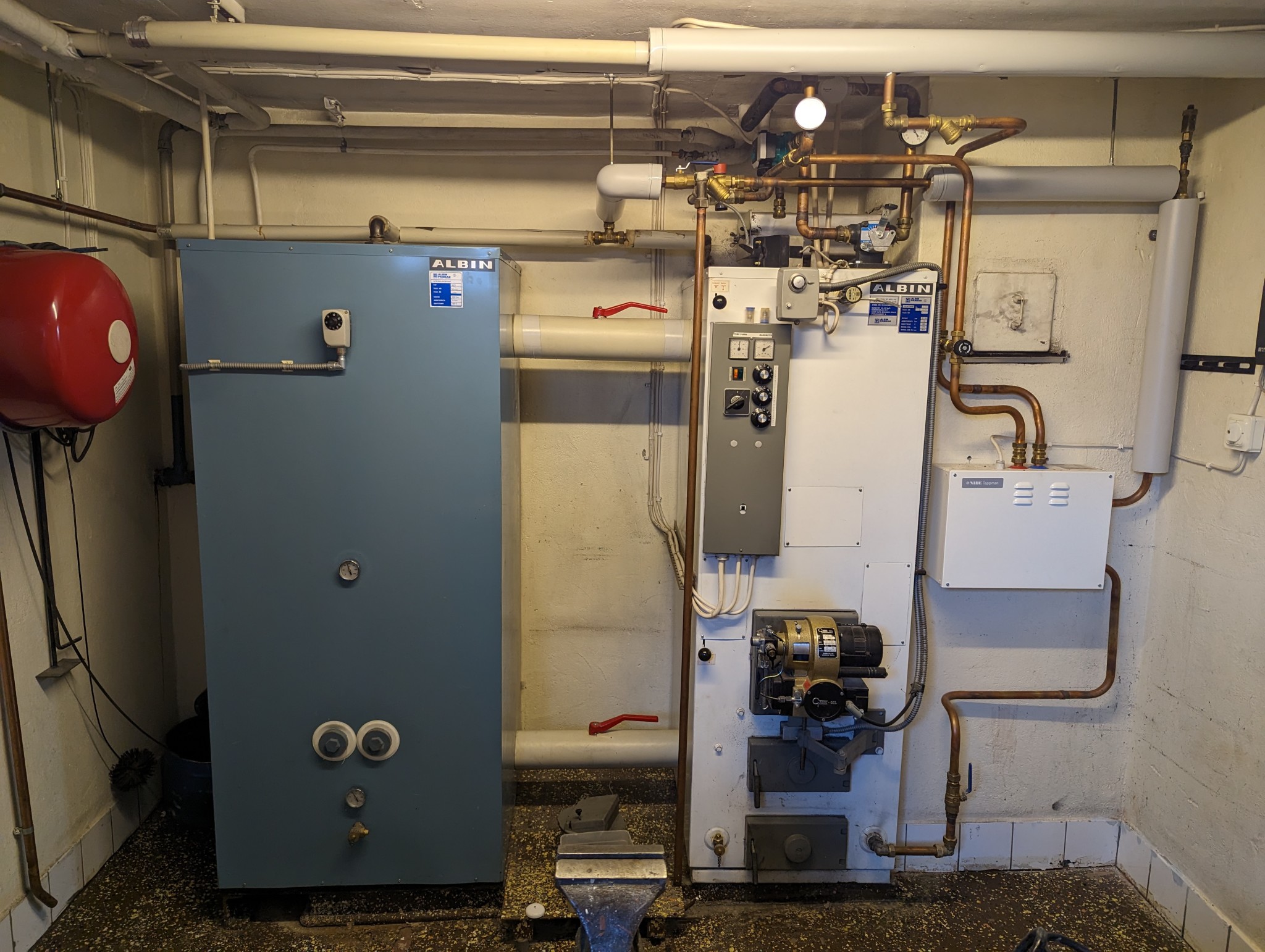
Attached is a photo of the system. If anyone can point me towards cartridges to fit in the accumulator -- i've seen both bare ones and built in thermostat ones. I'd be very grateful
Am I on to a potential 'water battery' or is this the stupidest idea posted here? This is part 'fun' and a challenge to try and automate/generate a heating plan based off tibber's forecast, etc, etc. So I'm ok with the initial cost of the cartridges(within reason), but I also sincerely think if I do this right I can absolutely see a noticeable reduction in electricity cost. The swings of electricity is quite drastic so if one can time consumption and achieve 0 boiler heating during peaks that feels like noticeable savings. .... but as i've told friends. I am either onto something clever, or i'll soon learn why others don't do this and they just install a new system
(If I've violated a rule by posting in English, apologies and I can redo this in bad swedish... just since such a bad idea felt can better defend the insanity in my mother tongue)
Hopefully English is OK. I started to write in my bad swedish, but realize my idea is difficult to articulate and likely sounds terrible even in english. Let alone try to 'convince' in Swedish
The short version is i'm trying to source which el patron's would fit in my Albin 500L accumulator tank -- I find ones that 'look' like they should fit (Long and appear to screw in). I simply have no idea if this was a very standardized item and these would fit or if there is a measurement to take. The model of the tank is 870 739 -- I have the original flyer which advertises the use of el patrons' but unfortunately do not find any schematic showing any sort of measurements
I have a local plumber to install into the tank while replacing a few valves, and will hire an electrician to wire them. (Plan is into a shelly or similar to allow remote ability to control them). The problem is finding someone to help locate/order suitable cartridges
The longer 'Why would you ever do such a thing'.
I recently bought a house with an old 80s Albin Combi Panna (720F) with 110L capacity, it originally was ved+olja+el but had exclusively been el for many years. In addition there is a 500L Albin accumlator tank.
The house has 15 radiators, and a tankless water heater. Both tap water and house heating is consumed from the closed loop system from above, solely powered by electricity today.
My day job is a computer geek, and I've gone full home assistant, zigbee2mqtt, devices, etc in the house.
I have smart TRVs on all radiators, and began using the 500L accumulator tank with the elpatron system. -- well all but 3 which have non thermostatic valves. I have a local contractor that will replace these, which will require draining the system. Which --I think-- makes the physical install(not wiring) of el patron's relatively trivial/primarily cost of the cartridge.
We do not have the smart meter installed yet but using the light from the meter, I also have real time consumption data in home assistant allowing me to see when the boiler is active vs not real time and how the automation of radiators affects this.
With home assistant, and tibber i've automated the TRVs based off price. With this, I do achieve periods of the boiler being 'off' . However this is quite limited since the thermostat on the antique boiler is manual and no practical way to automate it. It is more common I sit on the lower step of the el patron(3kw) and prevent the higher consumption from occurring.
Given this 'success', my thought is to take this to the next level.
Install additional elpatron's into the accumulator tank. That either are wired to a more modern thermostat allowing remote setting, or to a shelly breaker type solution allowing me to entirely control the power to these. These additional cartridges would be set to bring the water as high as feasible(90C+?) and only be triggered during the lowest cost periods of electricity,
The existing 'dumb' el patron's in the albin 720F be set to a lower temperature to ensure the overall system never cools too low.
The delta between these two would effectively be a water battery.
Assuming the electric cartridge install + wiring is feasible, the other part be upgrading our main fuse to allow for this madness of electric heating to occur during low cost periods.
I feel I need to do 'something' here regardless as the Albin 720F has 3x cartridges with three thermostats. However testing it is clear only the first cartridge is working. Triage has been done to the point that requires an electrician to go further --. can confirm carrtridge #2 and #3 are not receiving electricity. I will let an electrician remove the cover for proper triage whether it is the thermostat, or timer, or other logic broken -- which we'll have here anyway for a house rewire
Which leds me to my justification.
I'll have a plumber draining the system to replace some older non-thermostatic valves - so why not have a couple additional cartridges installed into the accumulator.
We'll also have an electrician here doing a house rewire(50s house) and installing a modern panel which is on the otherside of the wall as this accumulator tank. So why not triage the existing albin 720F cartridges not receiving electricity + have them wire up additional cartridges into the modern panel, with something like a shelly ?
The one part I am stuck on is can one even buy these cartridges that will fit such an old system? When I google I quickly find el patron's for sale that 'look' like what i'd picture. But I can't find any clear lookup to model numbers, or any measurements in the documentation I have. I suspect this forum if anywhere someone will just 'know'
Attached is a photo of the system. If anyone can point me towards cartridges to fit in the accumulator -- i've seen both bare ones and built in thermostat ones. I'd be very grateful
Am I on to a potential 'water battery' or is this the stupidest idea posted here? This is part 'fun' and a challenge to try and automate/generate a heating plan based off tibber's forecast, etc, etc. So I'm ok with the initial cost of the cartridges(within reason), but I also sincerely think if I do this right I can absolutely see a noticeable reduction in electricity cost. The swings of electricity is quite drastic so if one can time consumption and achieve 0 boiler heating during peaks that feels like noticeable savings. .... but as i've told friends. I am either onto something clever, or i'll soon learn why others don't do this and they just install a new system
(If I've violated a rule by posting in English, apologies and I can redo this in bad swedish... just since such a bad idea felt can better defend the insanity in my mother tongue
)


I have considered, and that will probably happen at some point.
Am I mistaken that these activities themselves, when done in addition to other work are relatively cheap? I see this part 'for fun', but also believe it can result in savings as well.
If an electrician is already rewiring the house, with a new panel. Wiring an additional set of el patron's that is < 2 meters from the panel is primarily the cost of the el patrons.
If I a replacing non thermostatic valves, which requires draining the system. Installing the el patron's into the tank is primarily the cost of the el patrons.
I am not stating this is a more efficient solution long term than earth heating or water/air system - I fully acknowledge those consume far less electricity as a whole. Apologies if this came across as some sort of long term alternative. See more as a bit of 'fun' interim, because why not?
I do believe if automated can result in a lower cost than i see today and be a fun technical challenge to write the automation itself -- not just reactive on price but creating a heating 'plan' each afternoon, etc.
Or are these wrong assumptions ? The one piece i've been unable to confirm is which el patron's would fit in the system. Happy to link the options i've found if that is allowed. I find two common options of a bare el patron without a thermostat and the other is a more 'all in one unit'. Again just cant' seem to find a clear understanding how to size them(Thread size vs length) or what the options are.
Am I mistaken that these activities themselves, when done in addition to other work are relatively cheap? I see this part 'for fun', but also believe it can result in savings as well.
If an electrician is already rewiring the house, with a new panel. Wiring an additional set of el patron's that is < 2 meters from the panel is primarily the cost of the el patrons.
If I a replacing non thermostatic valves, which requires draining the system. Installing the el patron's into the tank is primarily the cost of the el patrons.
I am not stating this is a more efficient solution long term than earth heating or water/air system - I fully acknowledge those consume far less electricity as a whole. Apologies if this came across as some sort of long term alternative. See more as a bit of 'fun' interim, because why not?
I do believe if automated can result in a lower cost than i see today and be a fun technical challenge to write the automation itself -- not just reactive on price but creating a heating 'plan' each afternoon, etc.
Or are these wrong assumptions ? The one piece i've been unable to confirm is which el patron's would fit in the system. Happy to link the options i've found if that is allowed. I find two common options of a bare el patron without a thermostat and the other is a more 'all in one unit'. Again just cant' seem to find a clear understanding how to size them(Thread size vs length) or what the options are.
Bästa svaret
About a year ago I got the same idea as you. I found out that I would need 3*500 liters tanks to store 90 kWh to be charged at 15 kW during 6 hours from 23:00 to 05:00. At that time the electricity cost was often very low during most nights but only some months later that changed a lot. I would have had to buy all the equipment needed but the total cost was not too bad at 40-50 kSEK.
The thread for heaters (elpatron) is usually 2 inch or R50 as it is usually called. You may need a heater with an inactive part (the outer part of it does not get warm). I don't know Albin, you have to find that information.
Here are a few links to parts and information that I found useful:
https://www.vvsbutiken.nu/category.html/storleks-guide-for-ror-dim-golvvarme-vattenburen (thread sizes)
https://www.relek.se/category/elpatroner-vatten heaters
https://www.rinkabyror.se/artikel/elslinga-rostfri-3-0-kw-lang-inaktiv/ heaters and a lot more
https://www.stromsnaspannan.se/inkopplingsforslag/ manufacturer with good general information about tanks
Note that they will force the electricity network suppliers to introduce "effekttariff" (power fee) latest 2027 that may or may not make this idea good or bad https://ei.se/konsument/el/effekttariffer---vad-innebar-det-for-mig-som-konsument
Because it is really impossible to predict how the energy costs will develop during the coming years I have abandoned the idea to charge tanks during nights. Right now I think a ground heatpump looks more attractive having higher probability to give good economy over >10 years. Total cost will be approx 200kSEK.
The thread for heaters (elpatron) is usually 2 inch or R50 as it is usually called. You may need a heater with an inactive part (the outer part of it does not get warm). I don't know Albin, you have to find that information.
Here are a few links to parts and information that I found useful:
https://www.vvsbutiken.nu/category.html/storleks-guide-for-ror-dim-golvvarme-vattenburen (thread sizes)
https://www.relek.se/category/elpatroner-vatten heaters
https://www.rinkabyror.se/artikel/elslinga-rostfri-3-0-kw-lang-inaktiv/ heaters and a lot more
https://www.stromsnaspannan.se/inkopplingsforslag/ manufacturer with good general information about tanks
Note that they will force the electricity network suppliers to introduce "effekttariff" (power fee) latest 2027 that may or may not make this idea good or bad https://ei.se/konsument/el/effekttariffer---vad-innebar-det-for-mig-som-konsument
Because it is really impossible to predict how the energy costs will develop during the coming years I have abandoned the idea to charge tanks during nights. Right now I think a ground heatpump looks more attractive having higher probability to give good economy over >10 years. Total cost will be approx 200kSEK.
Thank you @TommyC !
Those were the type of elpatroner I found, also from billigtvvs website -- since Relek does not sell to private.
As for whether to have one with an inactive vs active part - ideally i'd find a more detailed document. But the original brochure that was left with the house;
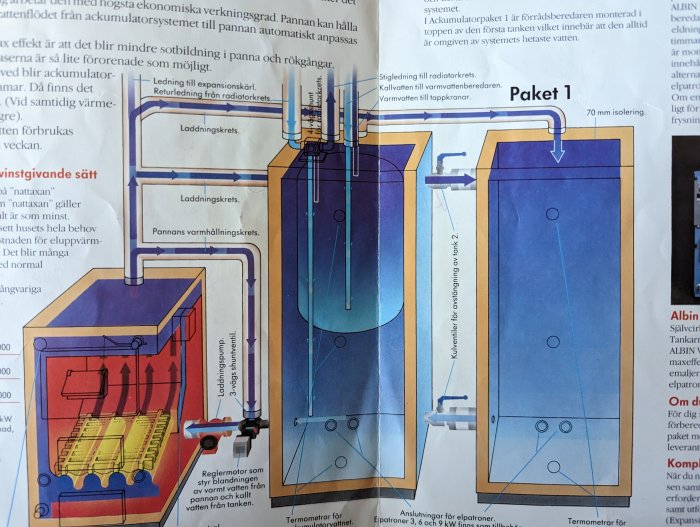
If you look above the right tank, you can see '70mm isolation' - So i think that is what I need to use as guidance?
I think this puts me in the inactive options - Looking at the size the total unit is 740mm wide, + 70x2mm insultion. So 600mm inside, and the non-active elpatrons are 480mm in length.
I wish I had a more 'proper' diagram' but the diagram on the back which shows the measurement implies the tank is using the entire space 'inside' the 70mm thick insulated 'box'.
All my searching cannot find anything with more detail, seems the fact I have these original brochures and manuals is the best info I have
I think I will go with the 1-steg 'all in one' units - specifically this two of these https://www.relek.se/product/relek-elpatron-pp1-ia-6rf-6kw-1-stegs-term-30-85-inaktiv
Did you consider 1 vs 2 vs 3 vs 4 step options? My thinking is since I essentially want these 'on or off' I see no reason to lower the consumption, I either want the full 6kw until 90C or I want the unit off. A mult-step thermostat would lower the power as it approaches target temp, which is the not what I want. --- but curious what your plan was @TommyC
From my calculation it'll be about 2500kr per elpatron - so 5,000kr in parts.
The 'install' unless I am mistaken will be negligible for a plumber whom already has drained the system and replaced numerous valves.
The electrician wiring these I suspect will be it's a little bit, but again they'll be here rewiring the entire house. This will practically be a couple new connections within 1-2meters from the panel (Other side of the wall).
In my head i'll have this all done for under 10-12k SEK parts+labor included (Since already having contractors on site). This may be throwing good money after bad money, but I'd bet i'll earn that back in electricity savings.
--My goal is not to heat enough to last all day(90kw worth), but to generate a heating plan the day before from price forecast and optimize everything. Practically being able to make all el patron's 'off' for just a few hours is what is needed. Yes some days suck all day -- like now. Average price > 220kr, but even still optimizing the consumption during the lower peaks even when high will be lower.
I am sure within a year or two we'll replace the entire system downstairs, but the focus this year has been other activities. We've had the avlopp relined, having electricity rewired, etc. I am not making the argument this is a long term alternative to a modern system that transfers heat instead of creating heat. See this as a fun geek project first that I think will lower the cost for the existing system too.
Thanks again Tommy !!
Those were the type of elpatroner I found, also from billigtvvs website -- since Relek does not sell to private.
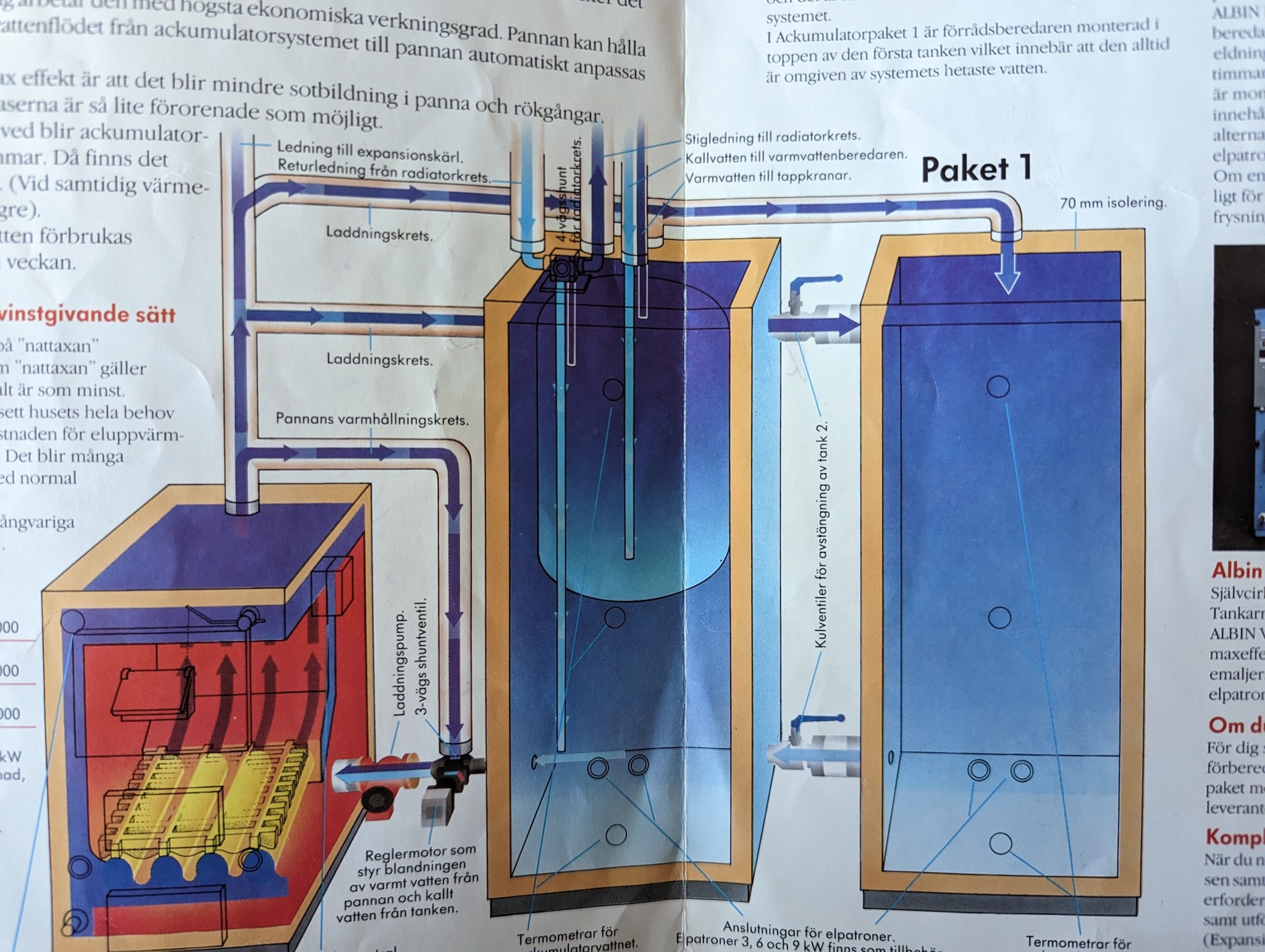
As for whether to have one with an inactive vs active part - ideally i'd find a more detailed document. But the original brochure that was left with the house;
Inloggade ser högupplösta bilder
Logga in
Skapa konto
Gratis och tar endast 30 sekunder
If you look above the right tank, you can see '70mm isolation' - So i think that is what I need to use as guidance?
I think this puts me in the inactive options - Looking at the size the total unit is 740mm wide, + 70x2mm insultion. So 600mm inside, and the non-active elpatrons are 480mm in length.
I wish I had a more 'proper' diagram' but the diagram on the back which shows the measurement implies the tank is using the entire space 'inside' the 70mm thick insulated 'box'.
All my searching cannot find anything with more detail, seems the fact I have these original brochures and manuals is the best info I have
I think I will go with the 1-steg 'all in one' units - specifically this two of these https://www.relek.se/product/relek-elpatron-pp1-ia-6rf-6kw-1-stegs-term-30-85-inaktiv
Did you consider 1 vs 2 vs 3 vs 4 step options? My thinking is since I essentially want these 'on or off' I see no reason to lower the consumption, I either want the full 6kw until 90C or I want the unit off. A mult-step thermostat would lower the power as it approaches target temp, which is the not what I want. --- but curious what your plan was @TommyC
From my calculation it'll be about 2500kr per elpatron - so 5,000kr in parts.
The 'install' unless I am mistaken will be negligible for a plumber whom already has drained the system and replaced numerous valves.
The electrician wiring these I suspect will be it's a little bit, but again they'll be here rewiring the entire house. This will practically be a couple new connections within 1-2meters from the panel (Other side of the wall).
In my head i'll have this all done for under 10-12k SEK parts+labor included (Since already having contractors on site). This may be throwing good money after bad money, but I'd bet i'll earn that back in electricity savings.
--My goal is not to heat enough to last all day(90kw worth), but to generate a heating plan the day before from price forecast and optimize everything. Practically being able to make all el patron's 'off' for just a few hours is what is needed. Yes some days suck all day -- like now. Average price > 220kr, but even still optimizing the consumption during the lower peaks even when high will be lower.
I am sure within a year or two we'll replace the entire system downstairs, but the focus this year has been other activities. We've had the avlopp relined, having electricity rewired, etc. I am not making the argument this is a long term alternative to a modern system that transfers heat instead of creating heat. See this as a fun geek project first that I think will lower the cost for the existing system too.
Thanks again Tommy !!
I was planning for two heaters (elpatron) at 9kW and 6kW to give 15kW total and 90kWh in 6 hours. Only one step per heater was needed. I would control (on/off) them with some seconds delay between them. I was mainly interested in the Relek version with built in relays and thermostat. Mainly to make the installation simpler and to be able to adjust the temperature closer to 100 degrees C to achieve a total temperature difference of a little more than 50 degrees to reach the 90kWh with ’only’ 1500 liters of water. I need 45 degrees C water to the radiator system at -18 degress C outside. Here -18 C is the DUT, the coldest temperature to design the heating system for.
https://www.boverket.se/sv/om-bover...ionerande-vinterutetemperatur-dvut-1981-2010/
You may need a separate connection box with contactors (3-phase relay) to control power to your heaters.
The tanks from Strömnäspannan I had chosen has 75mm insulation so 70mm is probably good enough. They specified 100W heat loss but I never found out at what conditions. It is rather simple to calculate the loss depending on temperature but I have not done that.
You can try to calculate your potential saving by looking at the Nordpool hourly electricity prices. That is difficult due to the rather extreme variations but if you can avoid the most expensive hours with your 500 liters that may be good.
Hopefully someone here can give you more information about you Albin tank!
https://www.boverket.se/sv/om-bover...ionerande-vinterutetemperatur-dvut-1981-2010/
You may need a separate connection box with contactors (3-phase relay) to control power to your heaters.
The tanks from Strömnäspannan I had chosen has 75mm insulation so 70mm is probably good enough. They specified 100W heat loss but I never found out at what conditions. It is rather simple to calculate the loss depending on temperature but I have not done that.
You can try to calculate your potential saving by looking at the Nordpool hourly electricity prices. That is difficult due to the rather extreme variations but if you can avoid the most expensive hours with your 500 liters that may be good.
Hopefully someone here can give you more information about you Albin tank!
Hi, Just an update for any future curious folks.
I've ordered the following:
1x 4.5kw Relek 'Inactive' Single stage elpatron
1x 6kw Relek 'Inactive' Single stage elpatron
1x Shelly Pro 4
2x Hager 400v 4-pol contactors
The heaters will be inserted into the accumulator tomorrow while the system is emptied to do other work aorund the system (A few old cast iron radiators with non thermostatic valves).
Monday we will begin the full rewire + new panel of the house. My hope is to have the bits and pieces here to work out an install by the electrician during the rewire.
I *think* the best solution will be to mount a small box on the accumulator tank which contains the shelly + contactors with a new 3phase run to this box (Or use the existing for the boiler). For the 230v coil voltage can either tap the existing line in the area, or I (think?) Line to neutral is 230 if Neutral is ran with the 3 phase run? The electrician knows of this plan, but trying to source the likely needed bits before Monday without bothering them. Worst case come monday we'll just have to make a plan when to do this wiring (or I go and buy missing bits during day -- like if an isolation switch is needed at the accumulator, etc).
We also had the värmepump fixed Friday (Sourced a local company - they were amazing. Hope to recoup the cost from polarpumpin via the ARN/Consumer rights..). With it working, this makes me feel even more confident to find savings. The boiler often wants to 'idle' at 3kw with it's dumb thermostat. Even ability to heat a few degrees above will ensure the boiler is 'off' majority of the day. As well for hot water, preheating during low periods.
Happy to update this thread as this progresses for good or bad. I have my consumption data since shortly after gaining access to the house.
I've ordered the following:
1x 4.5kw Relek 'Inactive' Single stage elpatron
1x 6kw Relek 'Inactive' Single stage elpatron
1x Shelly Pro 4
2x Hager 400v 4-pol contactors
The heaters will be inserted into the accumulator tomorrow while the system is emptied to do other work aorund the system (A few old cast iron radiators with non thermostatic valves).
Monday we will begin the full rewire + new panel of the house. My hope is to have the bits and pieces here to work out an install by the electrician during the rewire.
I *think* the best solution will be to mount a small box on the accumulator tank which contains the shelly + contactors with a new 3phase run to this box (Or use the existing for the boiler). For the 230v coil voltage can either tap the existing line in the area, or I (think?) Line to neutral is 230 if Neutral is ran with the 3 phase run? The electrician knows of this plan, but trying to source the likely needed bits before Monday without bothering them. Worst case come monday we'll just have to make a plan when to do this wiring (or I go and buy missing bits during day -- like if an isolation switch is needed at the accumulator, etc).
We also had the värmepump fixed Friday (Sourced a local company - they were amazing. Hope to recoup the cost from polarpumpin via the ARN/Consumer rights..). With it working, this makes me feel even more confident to find savings. The boiler often wants to 'idle' at 3kw with it's dumb thermostat. Even ability to heat a few degrees above will ensure the boiler is 'off' majority of the day. As well for hot water, preheating during low periods.
Happy to update this thread as this progresses for good or bad. I have my consumption data since shortly after gaining access to the house.
Hi,
Just keeping this up to date for future insane people.
So after some planning, and perhaps paranoia. Worked out a plan with the electrician during the rewire, that ended up with a second panel more full than the main panel just for this 'experiment'
A new 6mm2 was ran into the room, into a main breaker. Then 3x 16A 3 Phase breakers. One going to the original 'dumb' boiler/elpatron. The other other two individually going to a 40A 3 phase contactor, then on to the new 4.5KW and 6KW elpatron's respectively.
The shelly is behind a single phase 16A breaker to control coil voltage across the contactors.
I have the boiler's dumb thermostat set extremely low. So in practice it has yet to turn on.
In addition i've placed a half dozen DS810 temp sensors all over the room into an ESP32. I have outlet/inlet flows for the radiators, tankless hot water, accumulator pump, top of tank, etc.
I am still improving my code/logic but so far seeing positive results. Basically I generate a 'heating plan' based off future electrical price data, the current accumulator tank temp, etc. The goal to heat when the cheapest over a time period. I've created the concept of a 'Water Battery %' based off the observed peak temps, and the lowest 'usable' temps (can still take a shower), and build my automation/plan generation from this.
The individual radiators and upstairs heat pump also behave differently in conjunction with current battery level, heat plan.
Before this, it was normaly to see my boiler idling at 3kw (Very short periods of 0 heating), and if one took a shower atleast an hour or two at 6kw when the second stage kicked in. This meant, my floor was around 75+kwh/day consumption (3kwhx24hours). Most of my plans so far are around 4-6hours of heating per 24 hour period.
As the spring comes, I could see as little as 3-4 hours per day heating (To cover showers/hot water) -- We are just two adults no teenagers taking crazy showers yet
I am tracking my actual average cost vs tibber stated average. So far I am around 80% of the average cost -- but also about 30% less consumption.
But.............
One issue I do have tho, that may prove this all to be waste! I am not able to maintain constant pressure in the system Previously i'd keep the system around 1.2-1.5bar, and only the dumb thermostat.
Now, I saw I was losing pressure. I will end up with .5 or bar after a few days if left fully automated with around 30C swings in temperature.
I began checking every radiator, and afraid during the change of valves perhaps a pipe broke. Have not found any water.
Yesterday I placed a cup underneath the expansion tank's safety exit, and by afternoon it was overflowing. I believe this indicates the expansion tank is the cause of pressure loss -- not a leak? A leak would not cause the safety valve to trip right?
Pressing the valve only air came out. Checking the pressure I saw the same number as I saw on my manometer at that time (.8bar). I reliefed pressure in the system until no more water/pressure to 0. Then closed the safety valve, added .5bar and refilled the system to just over 1 bar.
This morning again had some water in the cup. (The system of went from 60 to 80C overnight since electricity was 13öre). This morning the pressure was around 1.2bar and 70C.
--Is this likely something I forgot to calculate for? That my expansion tank(or system in general) is not going to tolerate 30-35C temp swings on a daily basis? Or is it likely I have an issue somewhere as it should tolerate this?
This weekend I will put the system back to 'dumb' - Turn off the new elpatrons entirely, return to local/dumb thermostat to confirm I hold pressure if the temp is 'stable'. But welcome any comments meanwhile..
Just keeping this up to date for future insane people.
So after some planning, and perhaps paranoia. Worked out a plan with the electrician during the rewire, that ended up with a second panel more full than the main panel just for this 'experiment'
A new 6mm2 was ran into the room, into a main breaker. Then 3x 16A 3 Phase breakers. One going to the original 'dumb' boiler/elpatron. The other other two individually going to a 40A 3 phase contactor, then on to the new 4.5KW and 6KW elpatron's respectively.
The shelly is behind a single phase 16A breaker to control coil voltage across the contactors.
I have the boiler's dumb thermostat set extremely low. So in practice it has yet to turn on.
In addition i've placed a half dozen DS810 temp sensors all over the room into an ESP32. I have outlet/inlet flows for the radiators, tankless hot water, accumulator pump, top of tank, etc.
I am still improving my code/logic but so far seeing positive results. Basically I generate a 'heating plan' based off future electrical price data, the current accumulator tank temp, etc. The goal to heat when the cheapest over a time period. I've created the concept of a 'Water Battery %' based off the observed peak temps, and the lowest 'usable' temps (can still take a shower), and build my automation/plan generation from this.
The individual radiators and upstairs heat pump also behave differently in conjunction with current battery level, heat plan.
Before this, it was normaly to see my boiler idling at 3kw (Very short periods of 0 heating), and if one took a shower atleast an hour or two at 6kw when the second stage kicked in. This meant, my floor was around 75+kwh/day consumption (3kwhx24hours). Most of my plans so far are around 4-6hours of heating per 24 hour period.
As the spring comes, I could see as little as 3-4 hours per day heating (To cover showers/hot water) -- We are just two adults no teenagers taking crazy showers yet
I am tracking my actual average cost vs tibber stated average. So far I am around 80% of the average cost -- but also about 30% less consumption.
But.............
One issue I do have tho, that may prove this all to be waste! I am not able to maintain constant pressure in the system
Previously i'd keep the system around 1.2-1.5bar, and only the dumb thermostat. Now, I saw I was losing pressure. I will end up with .5 or bar after a few days if left fully automated with around 30C swings in temperature.
I began checking every radiator, and afraid during the change of valves perhaps a pipe broke. Have not found any water.
Yesterday I placed a cup underneath the expansion tank's safety exit, and by afternoon it was overflowing. I believe this indicates the expansion tank is the cause of pressure loss -- not a leak? A leak would not cause the safety valve to trip right?
Pressing the valve only air came out. Checking the pressure I saw the same number as I saw on my manometer at that time (.8bar). I reliefed pressure in the system until no more water/pressure to 0. Then closed the safety valve, added .5bar and refilled the system to just over 1 bar.
This morning again had some water in the cup. (The system of went from 60 to 80C overnight since electricity was 13öre). This morning the pressure was around 1.2bar and 70C.
--Is this likely something I forgot to calculate for? That my expansion tank(or system in general) is not going to tolerate 30-35C temp swings on a daily basis? Or is it likely I have an issue somewhere as it should tolerate this?
This weekend I will put the system back to 'dumb' - Turn off the new elpatrons entirely, return to local/dumb thermostat to confirm I hold pressure if the temp is 'stable'. But welcome any comments meanwhile..
Klicka här för att svara