
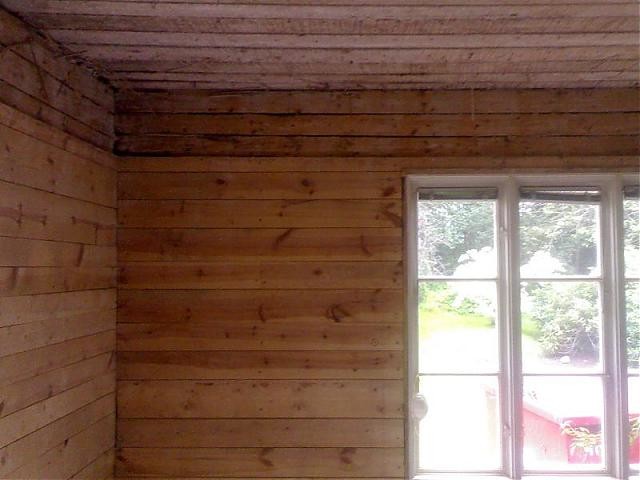
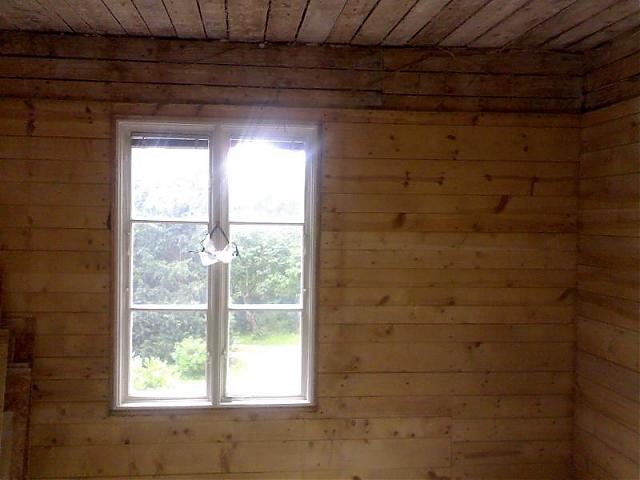
I have torn down wallpaper and plywood sheets on my walls as well as plaster that was in the ceiling and about 30-40cm down the wall. I was planning to use part of the "compartment" on the wall where the plaster was to run new electrical conduits, etc., and make connections down to switches and outlets. I will fill the upper part of the "compartment" with boards of appropriate thickness to make it even with the rest of the wall so it will be straight and nice when I gypsum.
I have inspected the wall and as it stands now, from the inside, it looks like this:
30mm raw wood -> 30-40mm air gap -> asphalt board -> facade panel.
Since I will be replacing the exterior panel in the near future, I was thinking of extending my studs and insulating from the outside.
Should I, with these conditions, cover my exterior walls from the inside with a vapor barrier before I gypsum?
To then tackle my very uneven ceiling, I was thinking of leveling it and building a framework that I anchor to the wall and point-fix to the ceiling with angles. Does anyone have experience with the Nivell system for ceilings?
Grateful for any feedback.
I have inspected the wall and as it stands now, from the inside, it looks like this:
30mm raw wood -> 30-40mm air gap -> asphalt board -> facade panel.
Since I will be replacing the exterior panel in the near future, I was thinking of extending my studs and insulating from the outside.
Should I, with these conditions, cover my exterior walls from the inside with a vapor barrier before I gypsum?
To then tackle my very uneven ceiling, I was thinking of leveling it and building a framework that I anchor to the wall and point-fix to the ceiling with angles. Does anyone have experience with the Nivell system for ceilings?
Grateful for any feedback.

It is likely that a diffspärr (vapor barrier) won't be of much use here, not only will you probably have problems sealing it completely throughout the house, but you will also have to deal with creating functional ventilation. The house breathes today, but with a diffspärr, you change that condition.
/Kent
/Kent

Self-builder
· Stockholm
· 8 594 posts
If you have an older house without a vapor barrier, it is extremely risky to install this now! You are practically asking for mold and moisture problems if it is not done correctly, and there are really no benefits to a vapor barrier - but it is a necessity if you have very effective insulation, as in modern houses, to prevent moisture from condensing inside the insulation and compromising its effectiveness, potentially creating moisture problems there.
In older and more leaky houses, or if you are going to keep the house unheated, you should not use a vapor barrier.
How much additional insulation are you planning to add?
/K
In older and more leaky houses, or if you are going to keep the house unheated, you should not use a vapor barrier.
How much additional insulation are you planning to add?
/K
Today, I have no insulation at all. I was thinking of building out the studs so that I can fit 70 or 95 mm of insulation between them. Then I was considering adding some insulating boards on top of that and then putting on new exterior cladding. The boards come in varying thicknesses, but maybe 70-95 there as well.
Jumping into this thread.
I have applied a moisture barrier on the exterior walls of a house from 65 when I renovated, which it didn't have before. I have 140 insulation (if I remember correctly). I will probably add additional insulation from the outside in the future. I've heard mixed opinions about using plastic on older houses. How do you check if any damage has occurred, i.e., if there's moisture in the walls? Can you measure it with a moisture meter?
I have applied a moisture barrier on the exterior walls of a house from 65 when I renovated, which it didn't have before. I have 140 insulation (if I remember correctly). I will probably add additional insulation from the outside in the future. I've heard mixed opinions about using plastic on older houses. How do you check if any damage has occurred, i.e., if there's moisture in the walls? Can you measure it with a moisture meter?
Open up the facade and take a look at the insulation and the frame, the attic usually shows any problems quite quickly. Moisture meters can be a bit deceiving, so make sure it really measures on wood and take several measurements in multiple places.
/Kent
/Kent
Impossible to answer because it depends on how the ventilation is designed.
/Kent
/Kent
Self-builder
· Stockholm
· 8 594 posts
It can take anywhere between 1-20 yearsDregen said:
But I would think that after a couple of years (say 2-5) you could try to see if it's damp, even if you might have to check several times over a year, or if there are traces of old moisture. Even if it hasn't yet developed into a real moisture damage.
Then it's not certain that everything is ok just because of that, it might go so slowly that you don't see anything until after 10 years, but IF you see something early you have confirmed that there's something going on - and can address it in time...
/K
Click here to reply