
Hello,
I have renovation plans for the upper floor today. Currently, I have sawdust and wood shavings in the attic for insulation (15cm). The only thing preventing the shavings from falling into the rooms is the ceiling panel, which is nailed directly onto the rafters (no paper between the panel and the rafters). (The house is from 1923, brick house)
On the sloping walls, there is tongue-and-groove wood nailed up to the sub-roof. I have been up in the attic and looked at the tongue-and-groove wood for the outer roof and there is no sign of mold whatsoever. I also scraped away the sawdust/wood shavings down to the panel (sub-roof) and found no issues at all. I can also say that I stopped burning pellets in the chimney three years ago as we switched to air/water for heating. My plans are as follows:
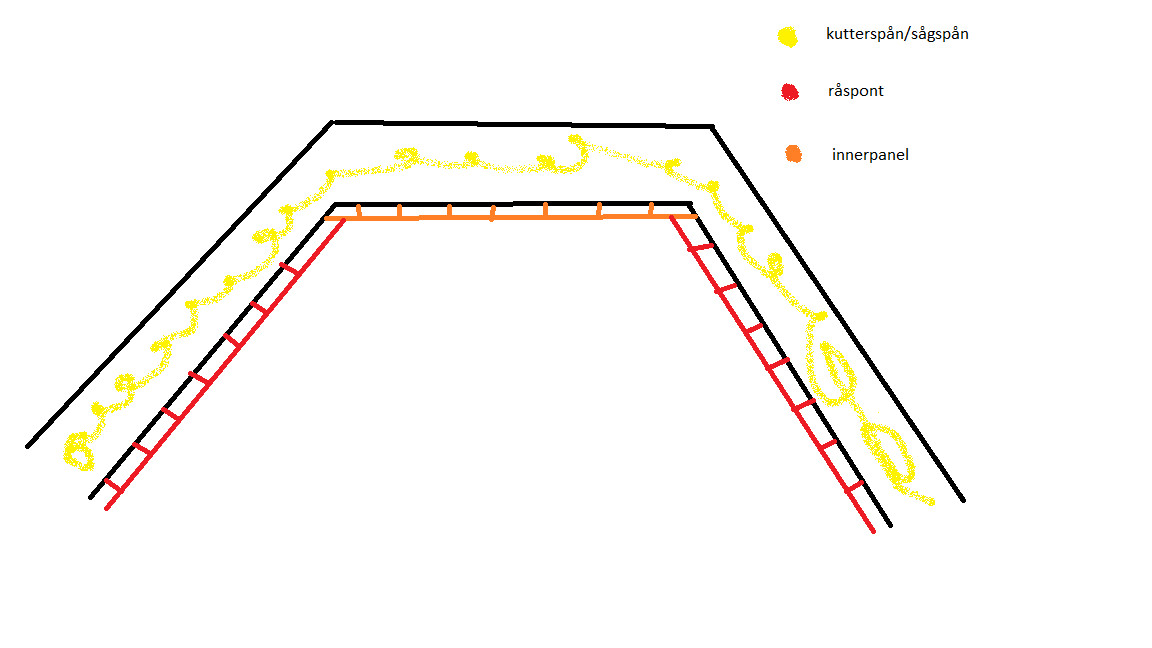
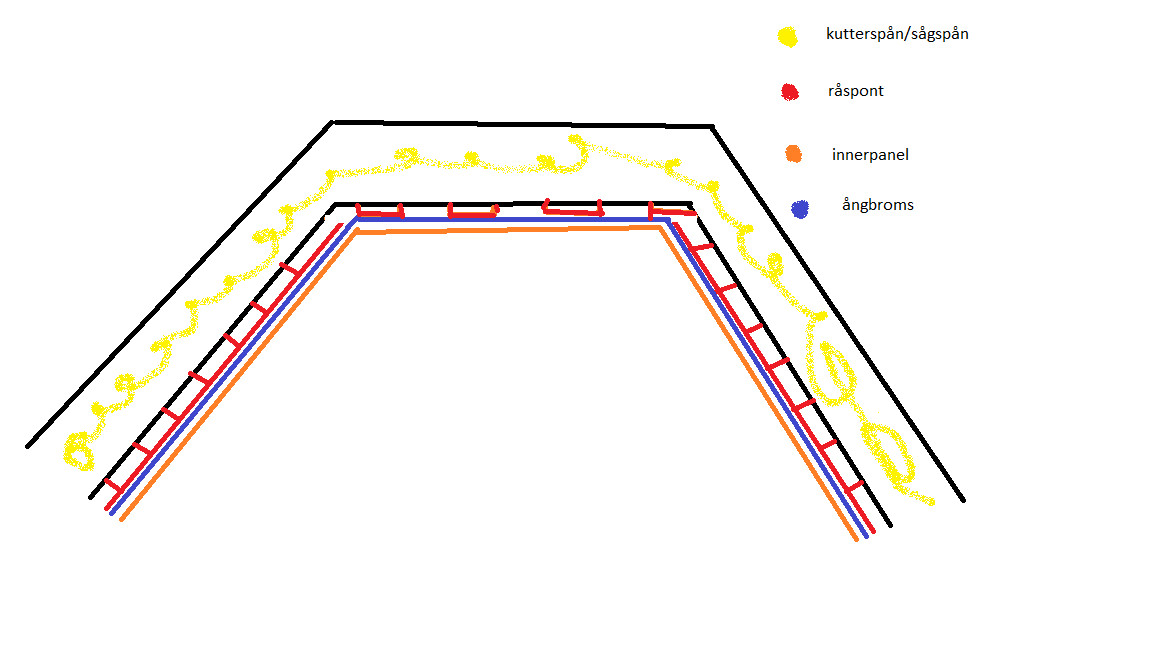
1. Rake away the shavings lying against the sub-roof and remove the panel.
2. Install a vapor barrier.
3. Nail new battens.
4. Put up a new interior panel.
5. Rake back the wood shavings/sawdust again.
It feels like our house breathes well and has done so for almost a hundred years. The reason I choose a vapor barrier is that I want the house to continue to breathe.
Another thought is to put up a new panel or plasterboard directly on the old panel and skip the vapor barrier, as it seems to work well today (the lazy side of me speaking here...)
My questions are as follows:
1. If I go with the vapor barrier option, which vapor barrier can you recommend? Bison, T-packaging, Mataki Halotex, or another good brand.
2. I have read that some do not recommend installing a vapor barrier against a cold attic, why is that? Isn't it better to install a vapor barrier compared to how it is today?
I hope there are knowledgeable people who can help me with my inquiries, thank you in advance.
I have renovation plans for the upper floor today. Currently, I have sawdust and wood shavings in the attic for insulation (15cm). The only thing preventing the shavings from falling into the rooms is the ceiling panel, which is nailed directly onto the rafters (no paper between the panel and the rafters). (The house is from 1923, brick house)
On the sloping walls, there is tongue-and-groove wood nailed up to the sub-roof. I have been up in the attic and looked at the tongue-and-groove wood for the outer roof and there is no sign of mold whatsoever. I also scraped away the sawdust/wood shavings down to the panel (sub-roof) and found no issues at all. I can also say that I stopped burning pellets in the chimney three years ago as we switched to air/water for heating. My plans are as follows:
1. Rake away the shavings lying against the sub-roof and remove the panel.
2. Install a vapor barrier.
3. Nail new battens.
4. Put up a new interior panel.
5. Rake back the wood shavings/sawdust again.
It feels like our house breathes well and has done so for almost a hundred years. The reason I choose a vapor barrier is that I want the house to continue to breathe.
Another thought is to put up a new panel or plasterboard directly on the old panel and skip the vapor barrier, as it seems to work well today (the lazy side of me speaking here...)
My questions are as follows:
1. If I go with the vapor barrier option, which vapor barrier can you recommend? Bison, T-packaging, Mataki Halotex, or another good brand.
2. I have read that some do not recommend installing a vapor barrier against a cold attic, why is that? Isn't it better to install a vapor barrier compared to how it is today?
I hope there are knowledgeable people who can help me with my inquiries, thank you in advance.

The reason it's worked so well is because I have an insulation material today that can absorb moisture and release it, albeit on a small scale. So the warm humid air we exhale today doesn't seem to affect my attic at least. The reason I might want to install a vapor barrier is because an "expert" thought it could prevent warm humid air from rising to the attic, even though I explained that the attic looked fine. There must be thousands of houses out there with wood shavings/sawdust as insulation, what have you done?Jonatan79 said:
One reason why this type of problem is difficult to assess is that there are many variables. The sawdust insulation in the sloped roof and between the collar beams works well because it is both hygroscopic and has a poor U-value, allowing a lot of heat to pass through, reducing the risk of condensation. You can increase the efficiency of the current insulation by ensuring it is enclosed between two airtight layers, with the inner layer having a vapor-retarding effect. As long as you do not change the type of insulation or increase its amount, you can continue as you are. If you want to replace the sawdust with cellulose fibers, which is also a hygroscopic material but with twice the insulating capacity, I suggest you choose a vapor barrier according to the insulation manufacturer's recommendation.
I don't want to say what's right, but you're asking what others have done.
We have removed all the sawdust (when we finally checked it, it was mixed with peat, fabric strips, and various debris which insulates quite poorly against heat) and ordered wood fiber boards from Feelingwood. For that, we will have a vapor barrier on the side facing the room.
I think you should ask yourself why you're considering this at all. Is it just because someone said so or are you cold? Do you want to reduce heating costs? Does sawdust fall down between the boards (as it does in our temporary residence)? If none of these reasons apply and you're very comfortable, it's warm and cozy, and you don't want to insulate or dampen sound levels, there might be no reason to make an intervention in a construction that works and has worked for a long time.
We have removed all the sawdust (when we finally checked it, it was mixed with peat, fabric strips, and various debris which insulates quite poorly against heat) and ordered wood fiber boards from Feelingwood. For that, we will have a vapor barrier on the side facing the room.
I think you should ask yourself why you're considering this at all. Is it just because someone said so or are you cold? Do you want to reduce heating costs? Does sawdust fall down between the boards (as it does in our temporary residence)? If none of these reasons apply and you're very comfortable, it's warm and cozy, and you don't want to insulate or dampen sound levels, there might be no reason to make an intervention in a construction that works and has worked for a long time.
MmeMim said:
I don't want to say what is right, but you are asking what others have done. We have removed all the sawdust (when we finally looked at it, it was mixed with peat, fabric strips, and various debris, which insulates rather poorly against heat) and ordered wood fiber boards from Feelingwood. To that, we will add a vapor retarder on the side facing the room.
I think you should ask yourself why you are considering this at all. Is it just because someone said so, or are you cold? Do you want to reduce heating costs? Is sawdust falling down between the boards (as it does in our temporary residence)? If none of these reasons apply, and you are very comfortable, warm, and you don't want to insulate for heat or reduce noise levels, then perhaps there is no reason to make an intervention in a construction that works and has worked for a long time.
Thank you for your answer!
The reason for my question is because I want to do it "right" when I renovate the entire upper floor, I don't want to tear it down and start over.
I've probably googled my computer to death about what is "right" or "wrong" to do. Vapor barrier, vapor retarder and neither are right, as well as wrong depending on whether the house is old, new, insulation material, as well as what kind of heating, etc. I called the homeowners association and consulted a "technically knowledgeable" person on what he thought. He thought that it was good to put up a vapor retarder (he said it won't hurt), precisely because it is vapor permeable. From that answer from the homeowners association, this question came to all of you happy DIYers, experienced carpenters, etc.
Is he right? All those who sell vapor barriers cannot be called because they just want to sell their product.
The house is warm and no sawdust falls on our heads, and spending a few bucks on something unnecessary isn't a problem.
What I wonder about is, if I now put up a vapor retarder, will it become colder in the attic then?
I might even be creating a mold problem up in the attic?
Thank you for your response!J justusandersson said:One reason why this type of problem is difficult to assess is that there are many variables. The sawdust insulation in the sloped roof and between the ceiling joists works well because it is partly hygroscopic and partly has a poor U-value allowing a lot of heat through, reducing the risk of condensation. You can increase the efficiency of the current insulation by ensuring it is enclosed between two airtight layers, where the inner one has a vapor-retarding effect. As long as you don't change the type of insulation or increase its amount, you can continue as now. If you want to replace the sawdust with cellulose fibers, which is also a hygroscopic material but with double the insulating capacity, I suggest you choose a vapor retarder according to the insulation manufacturer's recommendation.
You write that I can increase the efficiency of the current insulation by ensuring it is enclosed between two airtight layers, where the inner one has a vapor-retarding effect, what do you mean by that?
Two airtight layers, do you mean vapor retarder plus inner panel with two layers?
Will the attic become colder with a vapor retarder, along with maintained insulation?
I forgot to mention, of course, there is no air gap in the sloped roof, instead, it's sawdust all the way down to the start of the rafters.
Member
· Etelä Pohjanmaa
· 2 465 posts
Sounds like a lot of work for no benefit. Why remove the wood shavings and the old paneling when you plan to put the wood shavings back again? Leave it in place, i.e., skip steps one, two, and five. Your old paneling probably works just as well for the purpose as any vapor barrier. A vapor barrier is ordinary paper that has been given a very high price. It makes no difference either way.
You either follow the principle of building airtight and mechanically ventilating the air out, or you go with diffusion-open. A vapor barrier is something in between.
You either follow the principle of building airtight and mechanically ventilating the air out, or you go with diffusion-open. A vapor barrier is something in between.
Click here to reply