I have a house from the 60s that I'm renovating. I've reached the point where I need to decide what to do before insulating the attic. Half of the house is renovated, and there I've put drywall directly on the sheathing. In the attic, there's very little insulation and only a bit of wind paper. The question is what happens if I spray 300-400mm of loose-fill insulation up there. I had a structural engineer visit who suggested not to alter the structure too much on a functioning house. But with more insulation, there's obviously a risk of moisture. He thought it would be a lot of work to put plastic in the truss bays before insulating and his suggestion was to staple forhydringspapp on the sheathing before the drywall. This provides some protection, which, though not as airtight as plastic, does offer some benefit.
If you plaster the drywall joints in the ceiling, you'll get an airtight interior ceiling, which should go a long way. However, be sure to seal at the interior walls/ceiling transitions. The most important thing is airtightness; diffusion-tight is good but not equally important...
Yes, the gypsum boards are all 2400x1200, and they are jointed with tape that is also glued with waterproof adhesive. The walls are OSB and gypsum connecting up to the gypsum on the ceiling. The joint is sealed with latex. So it seems like it will be quite tight.
One thought was to do in the kitchen as in the bathroom. Prime with waterproof primer and then paint two layers of ceiling paint. It feels like these are the most critical areas.
It feels like an okay solution, just check the ventilation too, make sure you have negative pressure in the house. Then it should be okay. The solution in the wall/ceiling angle should work, are you planning to have crown moldings?
-If crown moldings, you can wait with one molding for a year or two to see if the latex sealant doesn't crack. (But the thing with the last molding might come naturally anyway, isn't there always one missing?
I completely agree with hakaner in everything h*n writes.
In any case, you will likely fail to make the old house diffusion-tight, so instead focus on making it as "airtight" as possible, i.e., that warm moist indoor air cannot rise up (blow up) to the cold attic or other cold areas, such as into the exterior walls.
Airtight + controlled ventilation that ensures a slight negative pressure in the house.
I will not have crown moldings. As you mentioned, there's always a risk of cracks in the soft sealant. In larger gaps against the ceiling, I have first primed and filled to then apply a nice sealant. Everything is painted 5-6 times (walls and ceilings together).
The ventilation noticeably worsened already after I slammed OSB and plasterboard in all bedrooms. The air was completely still. So I installed window vents as a short-term solution, which gives us an okay indoor climate. I will change windows and the house's heating. As part of this, we will look at which solution we should use. Wall vents, window vents, FTX system, or another solution.
What I want to achieve is to reduce the risk of mold in the attic. Now there is 50-100 mm insulation at best. In several places, there are newspapers or old wood. I can add that, with the electric cassette, our electricity bills have been high this winter. So the measures are to insulate the attic, change windows, and review the heating. We tackle the attic first, and since I am working on the interior finish, I now want to include any measures like paper/plastic between the wood sheathing and gypsum.
Many say you shouldn't start changing too much in a functioning construction if you don't have problems today. But the fact remains that I want more insulation both for heat loss and sound leakage. If I apply 300-400mm of loose fill, I want to prevent mold growth to the greatest extent possible. The constructor I had at home suggested I don't have plastic in the areas I've already renovated (bedrooms, hallway, and bathroom) and that wrapping plastic from above is cumbersome. So his suggestion was a breathable sheathing paper. I can imagine he is aiming for just airtight as you mention. This will be in the kitchen (10m2) and living room (35m2).
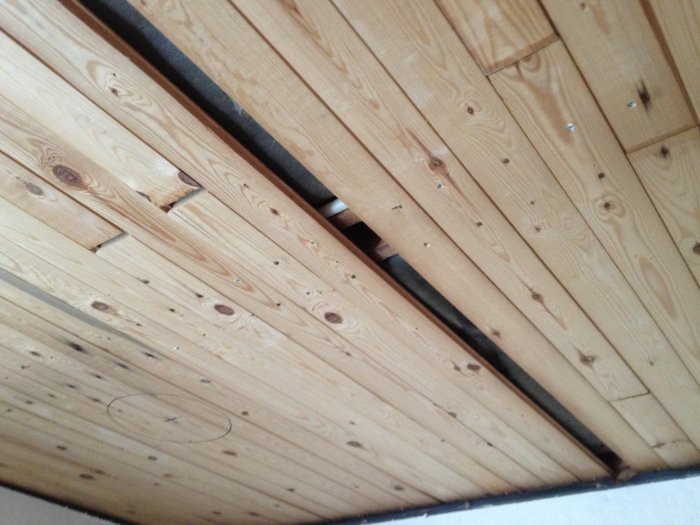
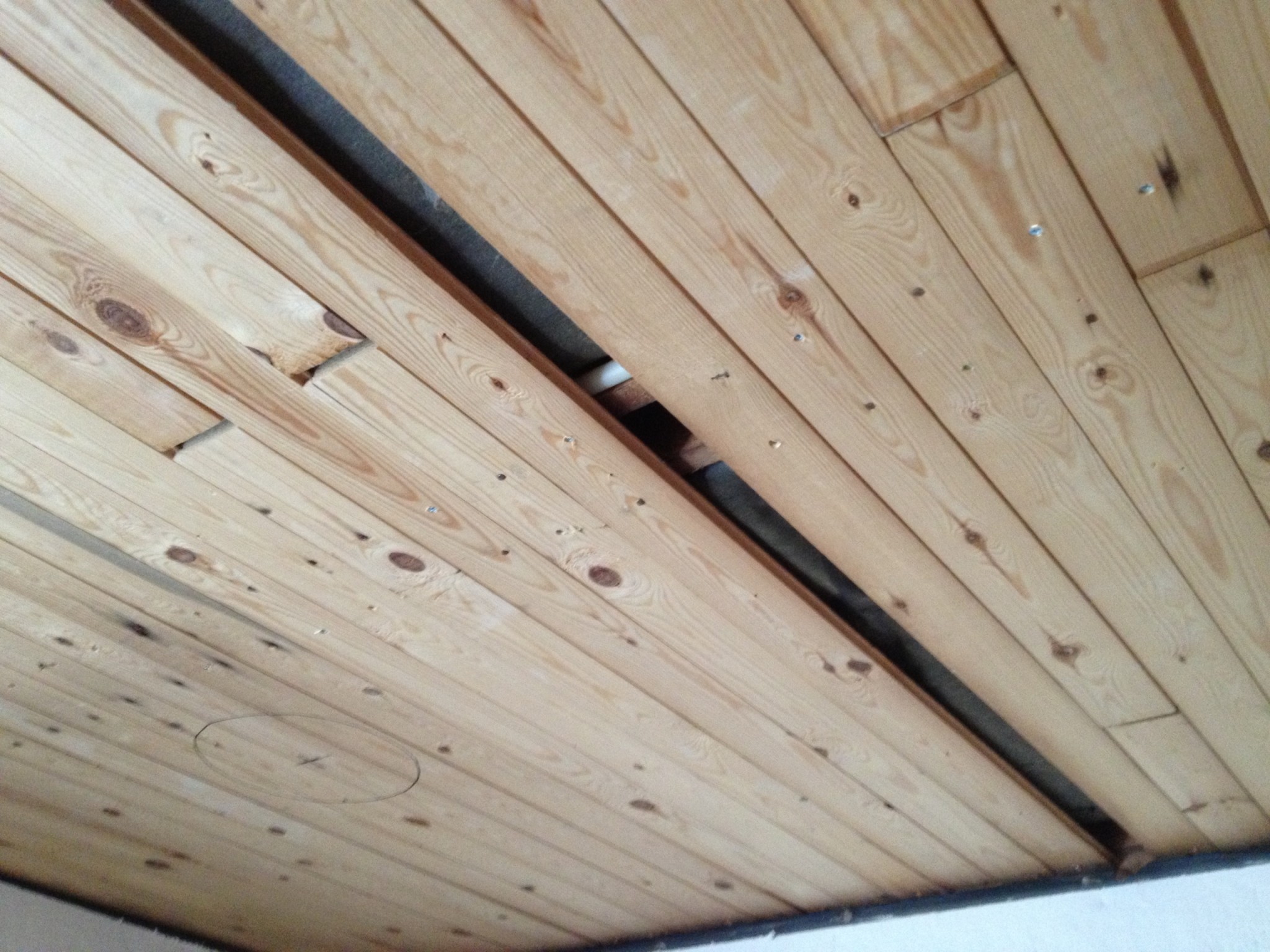
It's time for the living room and once again the question is whether I should use plastic or not. Some say it doesn't hurt while others suggest I should skip it. The ceiling has been cleared and the paneling is now reinforced with screws. 2400x1200x13 gypsum will hang from the ceiling.
Now it looks like the picture, and you can see that above the paneling there is a kind of asphalt felt or something similar. I assume its function is to act as a vapor barrier. However, it’s only between the rafters and not tight. But it’s probably not good to have both plastic below and that felt above as there's a risk that moisture will remain at the paneling. Or is this felt not tight?
I didn’t use plastic in the bedroom or hallway before I plastered there because I thought I'd take care of it from above. But it does make it easier to do plastic before the plaster. There was a constructor who thought that the living room, bathroom, and kitchen are the most important. What should I do, plastic or not?
Click here to reply
Vi vill skicka notiser för ämnen du bevakar och händelser som berör dig.