
71,914 views ·
105 replies
72k views
105 replies
TV on OSB



I can add that I have hung my 47" TV on an extending arm that is mounted with 2 anchor points on the wall, with a 10 cm center-to-center distance between the holes vertically. It's on single-layer drywall with a metal stud behind it, and there's not the slightest indication that it's going to come down!
I'm supposed to have an amplifier of about 20kg and a receiver of 10kg in one of the cabinets. But it feels like a lot, but it's really not.
By the way, I wonder if there's a thread that deals with the mythical and mysterious aspects of suspension. It seems to be an area that is associated with some prejudices, convictions, and belief in the supernatural. Kind of.
By the way, I wonder if there's a thread that deals with the mythical and mysterious aspects of suspension. It seems to be an area that is associated with some prejudices, convictions, and belief in the supernatural. Kind of.
Yes, there are a couple of threads where the plywood evangelists get a slap on the wrist with test results from the state testing institute showing exactly how much tensile and shear load a 6mm screw can withstand in plywood, OSB, and particle board. The load case is of the "kitchen cabinet" type.
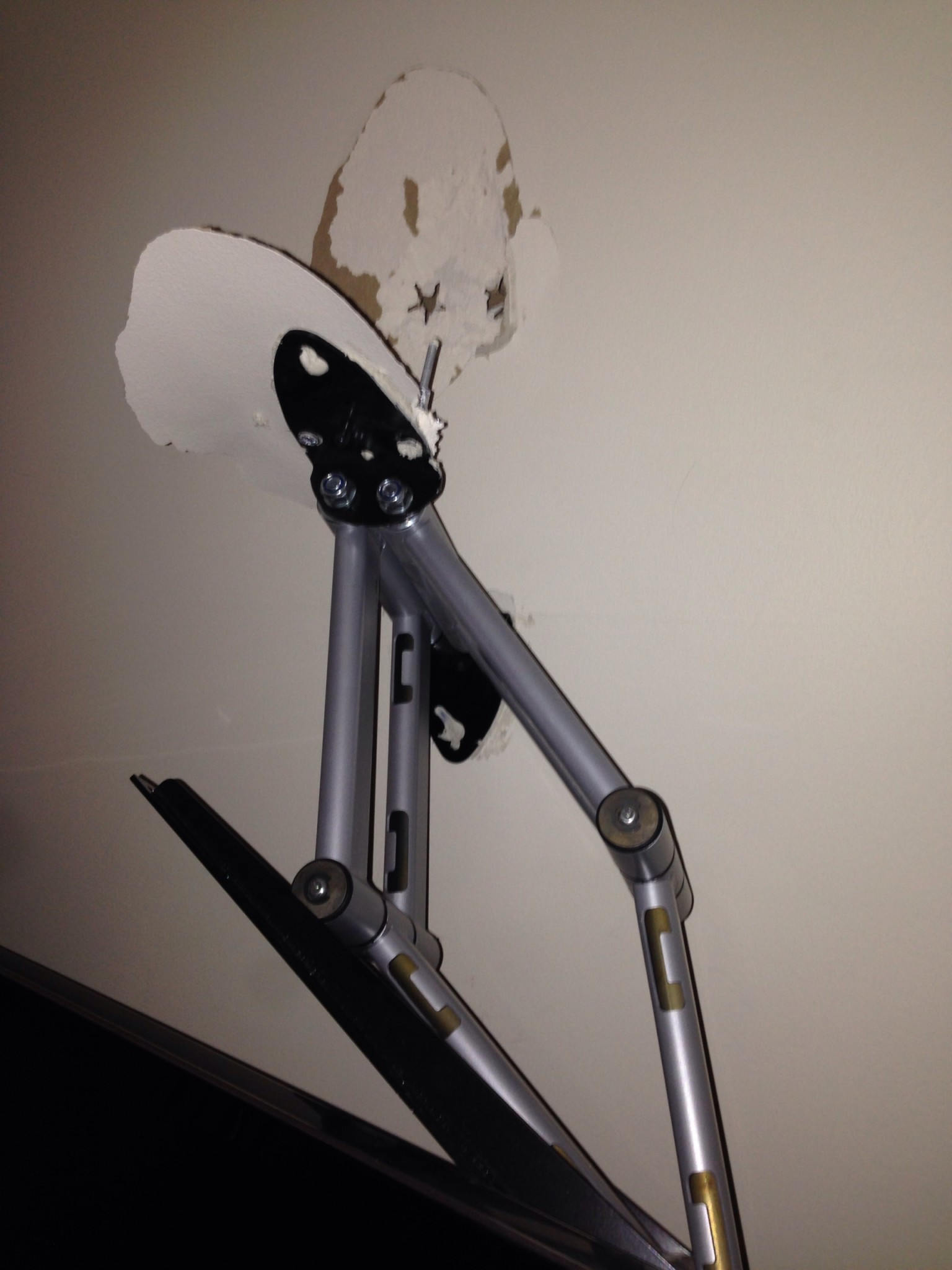

It's not the weight of the TV that's the problem, it's more that you can angle the TV in all directions. When you have the arm fully extended, it becomes a real lever. Such a mount sits much better in plywood/OSB.Marive said:

Of course, the lever-effect is a factor, but I would argue that the weight is a crucial factor? ;-) Naturally, it should be mounted on a plate; this is one of the rooms at work and usually all mounts are installed on plates to avoid "expensive" accidents. Why this mount was installed with adhesive and molly I don't know, but a new mount will soon be in place with plyfa behind...
If one is so "stupid" to use Molly plugs when there are proper things, then to some extent, it's their own fault. And using adhesive on a paper surface, what are they thinking ??? the adhesive holds several times more than the paper.
Now let's not be like that.... There's nothing wrong with the Mollyplug, it just needs to not be overloaded or improperly mounted.
In the picture case, it looks like the Molly is in single drywall with an arm that creates significant leverage. It's doubtful if "your" super plug would have worked there either....
In the picture case, it looks like the Molly is in single drywall with an arm that creates significant leverage. It's doubtful if "your" super plug would have worked there either....
It wouldn’t have crawled out through the plaster anyway, it would have taken the entire sheet piece with it. So there, it would be the sheet that sets the limit on load and NOT the plug.
Ps
The only advantage of Mollyn is that it is relatively cheap and quite easy to install.
Ps
The only advantage of Mollyn is that it is relatively cheap and quite easy to install.