
72,191 views ·
105 replies
72k views
105 replies
TV on OSB
Picking up this thread a little.
I just bought a http://www.netonnet.se/art/tv-och-bild/mobler_och_fasten/tv-upphangning/andersson-wma30/167098.3157/ and included with it are 4 French screws with plugs.
I have OSB and drywall in the walls. My question is if you think I should use the French screws with plugs or something else. If so, what?
My TV weighs about 25 kg and the mount probably at least 10 kg.
Grateful for answers!
I just bought a http://www.netonnet.se/art/tv-och-bild/mobler_och_fasten/tv-upphangning/andersson-wma30/167098.3157/ and included with it are 4 French screws with plugs.
I have OSB and drywall in the walls. My question is if you think I should use the French screws with plugs or something else. If so, what?
My TV weighs about 25 kg and the mount probably at least 10 kg.
Grateful for answers!

With OSB, you don't need to use plugs, at least not if the threads are placed in the OSB. Buy regular 6mm wood screws and drive them into the OSB otherwise.
Self-builder
· Stockholm
· 10 526 posts
Just right.Raka said:

About 40mm protruding from the attachment and checked so that there is threading where the OSB is. That is, so there isn't a smooth section where it should hold. For example, some fully threaded 6x40-50 might be just right.
They can handle about 20-25kg/screw when they're in OSB.
The screw should just pass through the OSB board and nothing more. The protrusion behind the OSB board does not contribute to the strength, so it is entirely unnecessary. So in your example, I would have chosen a screw that is about 30mm plus the thickness of what you want to screw up.
Just to be clear, a wood screw in OSB+gypsum holds close to 300kg and not 20-25 as mentioned above. It's so strong that it seems unreasonable.
Just to be clear, a wood screw in OSB+gypsum holds close to 300kg and not 20-25 as mentioned above. It's so strong that it seems unreasonable.
You might both be right, depending on whether you mean load vertically or horizontally? That is, that it can carry a load downward of 300 and that a load of 20 kilos constitutes a moment equivalent to 300!?Janus82 said:
The screw should just go through the OSB board and nothing more. The projection behind the OSB board doesn't contribute to the strength so it is completely unnecessary. So, in your example, I would have chosen a screw that is about 30mm plus the thickness of what you want to screw.
Just to be clear, a wood screw in OSB+gypsum holds for nearly 300kg and not 20-25 as mentioned above. It's so strong that it seems unreasonable.


Self-builder
· Stockholm
· 10 526 posts
Interesting values they've obtained.MathiasS said:
Esse states, for example, 50kg in extraction for a 5x60 driven into C14 timber.
Now, Essve has had issues with screws breaking, but one would assume that their data applies to an intact screw.
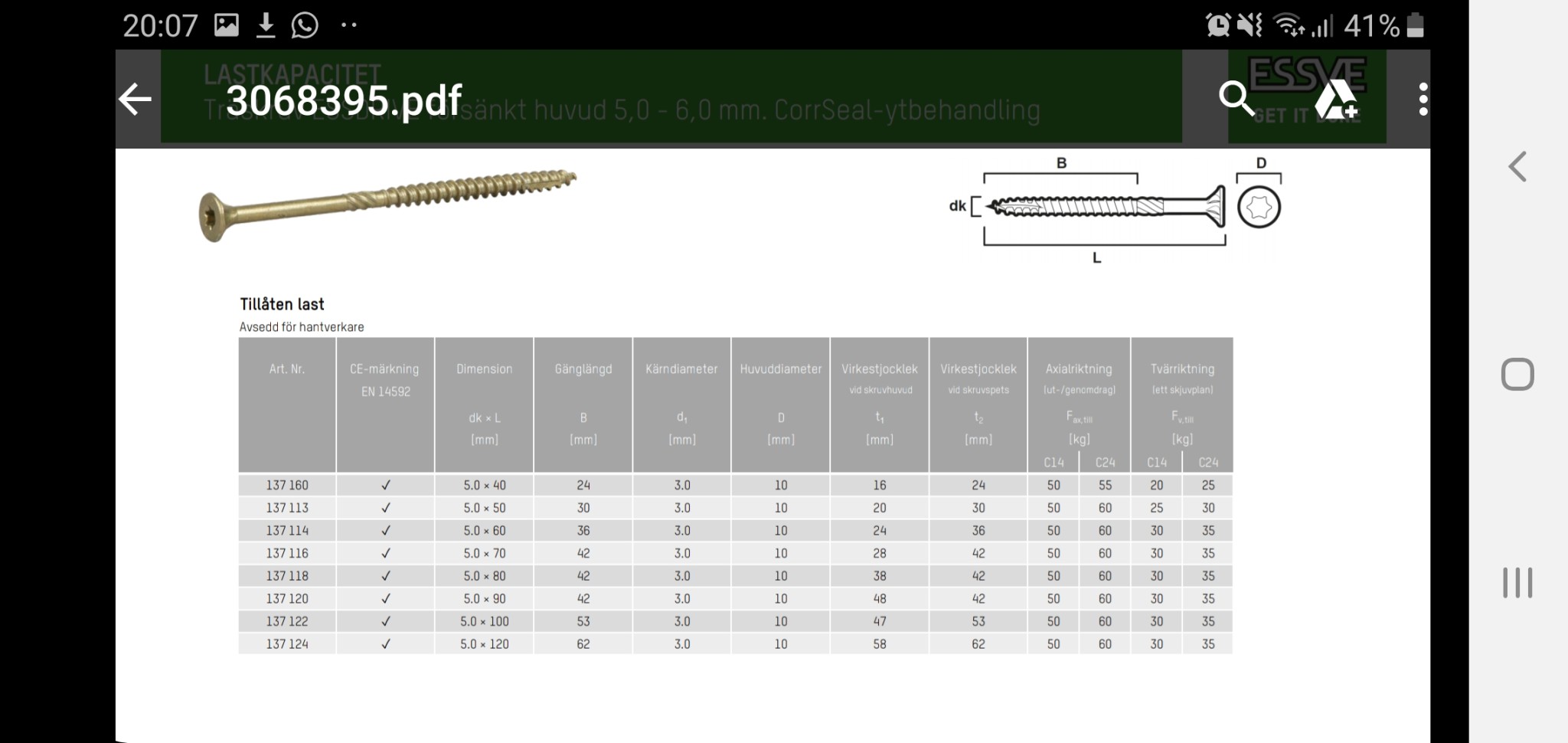
Yes, but consider the possibility that the tensile tests have been conducted in slightly different ways. SP has mounted a metal box on the wall and filled it with scrap until it falls down (freely described), and Essve has probably conducted regular tensile tests on a single screw. In one case, the system is a screw and a cabinet; in the other case, the system being tested is a screw. I'm just guessing, but the measurement method could explain the difference. SP's test is relevant in that it often resembles what we want to do with screws; the practical load case is relevant.R Robert-san01 said:
Essve's figures are the maximum "allowed load." They have naturally included a safety margin in these figures. After all, there is a very big difference in the stresses if you carefully increase the load as SP has done in their tests or if you somewhat carelessly drop a heavy paint can or toolbox on a shelf.
When it's called "permitted load," there should be a safety margin included, I think.
And it's probably quite large too, at least double.
In some contexts, safety margins of 8 times or even more are used.
I wouldn't load it so the extension force was exactly 169 kg (according to SP test) and then sleep well.
And it's probably quite large too, at least double.
In some contexts, safety margins of 8 times or even more are used.
I wouldn't load it so the extension force was exactly 169 kg (according to SP test) and then sleep well.
Certainly not. Imagine if a mosquito needs to stop and rest its wings for a while. Then the shelf is doomed.Mikael_L said:
Yes, when it's called "allowed load," there should be a built-in safety margin, I think. And it's probably quite large too, at least double. In some contexts, safety margins are 8 times, or even more.
I also wouldn't load so that the extraction strength was exactly 169 kg (according to SP test) and then sleep well.