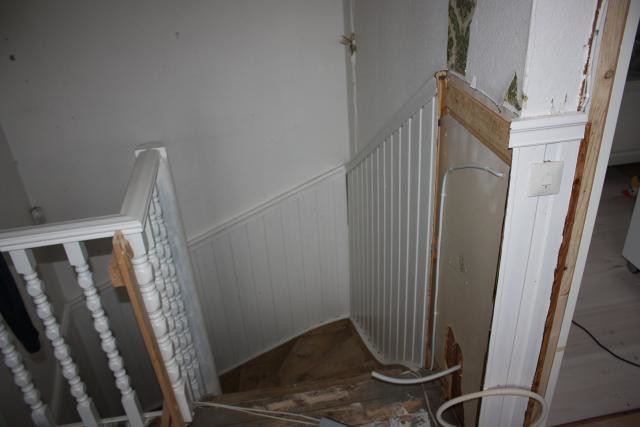
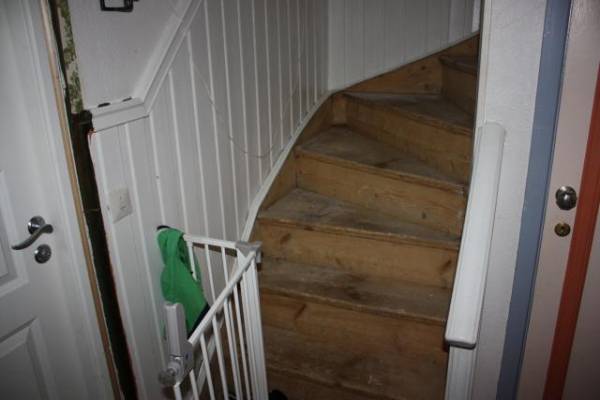
Hello! I would like some tips, suggestions on how I can renovate our staircase in a stylish way! I should mention that I will probably have white beadboard on the wall from top to bottom... And the railings will be replaced with straight flat ones instead of round turned ones...
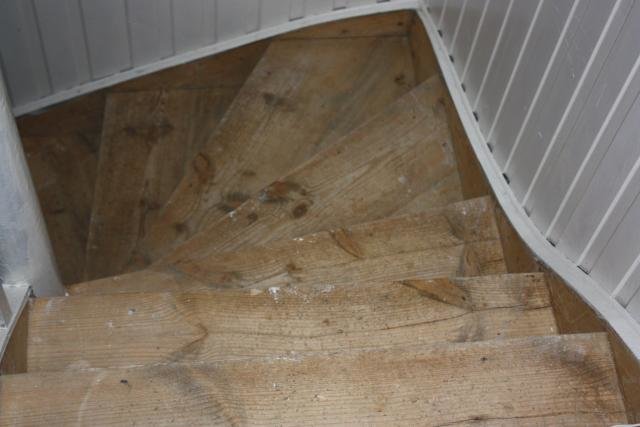
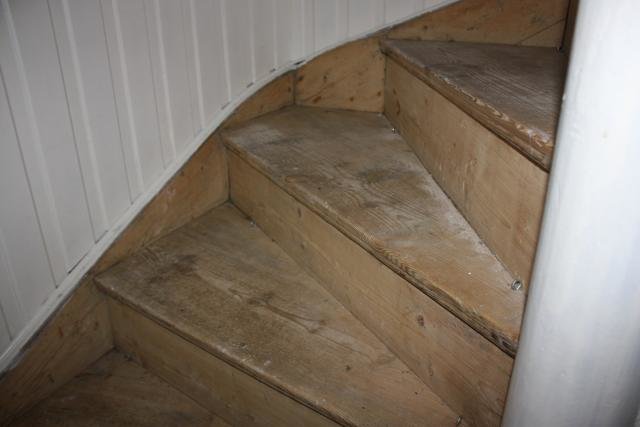
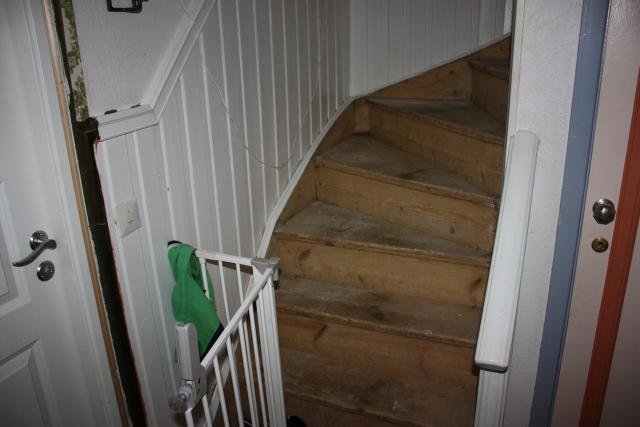
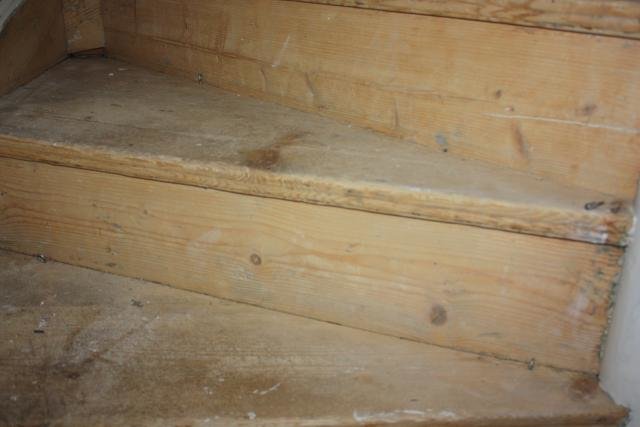
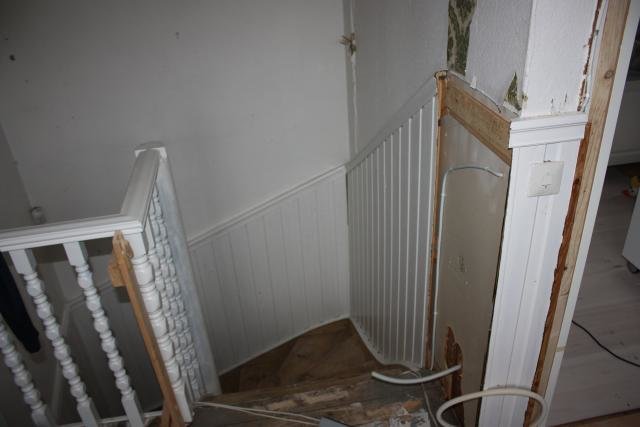
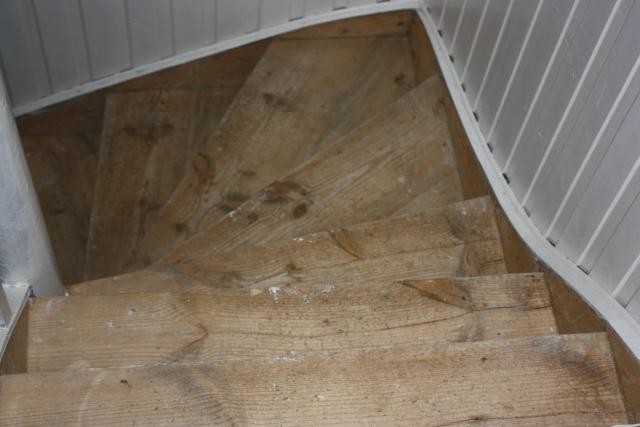
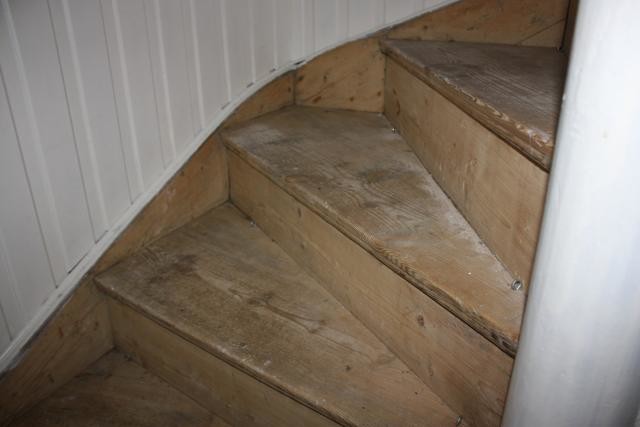
Attaching some pictures so you can see the appearance + shape of the staircase!
When was the house built and do you want to strive for a period-specific appearance?
As I see it, you have three options regardless of this. One is to go over it with a sander to get the surface reasonably even. Then a light floor paint on the stairs. If you use beadboard, it works perfectly fine with patina on the stairs, so you don't need excessive filling to get it perfectly even. A variation of this is to use oil if you manage to remove most of the paint. A third option is to do as above, but place, for example, a wooden surface with stair nosings on each step. Personally, I think a wet-painted or alternatively oiled staircase is the nicest in combination with beadboard.
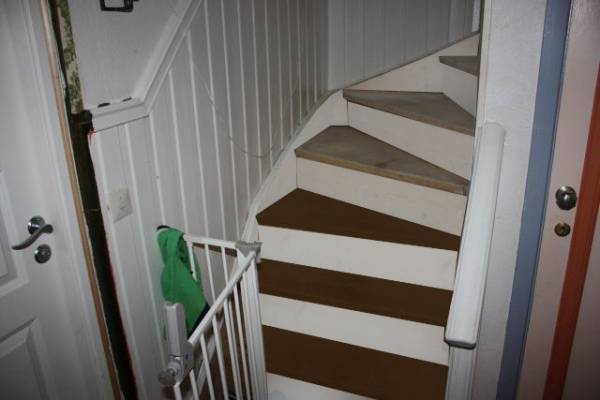
There are no blueprints of the house, but we estimate it to be around 100 years old. Renovating all the rooms upstairs, as you can see in the bottom picture, I'm installing white-oiled Dalafloda flooring up there...
If I go with white paint on the stairs as you suggest, how will it be to walk on? I mean, will it be slippery and is it easy to keep clean?
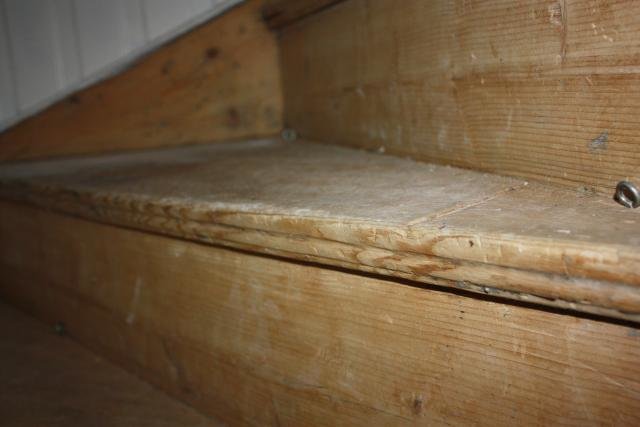
You mention adding, for example, a wood surface with stair noses. Can you take regular parquet, like oak, and cut and glue it on? How do you make nice-looking stair noses, as you can see it's a bit worn at the noses... Should the noses be in the same material, or should one aim to cut out something and paint just the nose white, do you think?
You can rent a lacquer and wood planer, like the Metabo LF724S, and run it over the stairs. I have done it myself with very good results. You can set the planing depth between 0 - 0.3 mm. The surface becomes bare wood. Then it's just a matter of treating it according to your preference. It should be emphasized that you plane both axially and radially.
If you have children, pets, or anything else, for heaven's sake, don't paint the staircase white! My brother's wife managed to get her wish for a white-painted staircase, and now she swears over it every day as absolutely everything is visible, and there's a lot of debris, dust, hair, and other things with three children and two cats.
There are no blueprints for the house, but we estimate that it is about 100 years old. Renovating all the rooms upstairs, as you can see in the bottom picture, I'm installing white-oiled Dalafloda flooring up there...
If I go with a white color on the stairs as you suggest, how will that be to walk on? I mean, will it be slippery and is it easy to keep clean?
You mention putting, for example, a wooden surface with stair noses. Can one take regular parquet like oak, cut it out, and glue it on? How do you make nice stair noses, as you can see it's a bit worn at the noses... Should the noses be in the same material or should one aim to cut out something and paint just the nose white, do you think?
I personally have no problems with painted stairs but, of course, they can be perceived as slippery. If you want to reduce slipperiness, you can have sand or something similar in the paint, but it will show as small dots. Floor paint is quite easy to keep clean, but it is of course a question of how well the color you choose hides dirt and how much you bring in yourself.
When it comes to installing new treads, there are 3-4 companies selling renovation kits in the form of treads with and without stair noses. They cost a few hundred per tread, but they are often solid wood, which over time gives a nice impression. Then, of course, you can also use parquet and stair noses. Kährs has, among other things, stair noses that click together with their 15mm flooring. Many say they are very expensive, but the price I got was 340 SEK for a 2400mm stair nose, which I thought was not too extreme. You just have to be lucky with the width of the stairs so you don't get half waste.
We are renovating our staircase, it was built in '86. Needle felt carpet, open at the front & back edge. We are currently sanding off the varnish from the pine wood and will spray paint it white, then lay 14 mm oak parquet on each step. Screwed from underneath, aluminum strips on the front & back edges, and soft sealant on the sides. We will leave the needle felt carpet in place and use it, along with underlay foam, for soundproofing.
Sounds great, feel free to post a picture when you have it finished so I can see the end result Where do you buy the alu-strips?
Yeah, good question, as of now I've been buying strips here and there, Beijer, Bauhaus, Hornbach, etc. The reason is that there are so many different types, so right now we're trying different options. Picture will come with the end result. I'm currently on the final sanding, then it's going to be painted. But then comes the next challenge, convincing my dear wife that we really need a paint sprayer (Bosch)....
Hello,
Paint everything white except for the steps, which you should oil or soap instead so they don't get slippery. And no aluminum strips!!!! They're really ugly!!! Especially on such a beautiful old staircase... Personally, I would also prefer old-fashioned round nice handrails instead of those horrible flat wide ones... It's an old house, let it show!
I would give my right arm for such a beautiful staircase as you have (almost).
I have a couple of friends where the old worn staircase partly determined their house purchase.. It is extremely charming with an old staircase where the steps have been shaped by the feet that have walked up and down the stairs for a hundred years!!
don't remove it! especially not with modern parquet.
Taste is, as we know, like a derrière but I think it's almost sacrilege.
I agree with njitnjau, take it easy with the staircase. The stair nose is profiled and intended to be visible. There has obviously been a runner on it before, so why not go with that? White-painted staircase with a runner is both traditional and slip-proof.

 I should mention that I will probably have white beadboard on the wall from top to bottom... And the railings will be replaced with straight flat ones instead of round turned ones...