
2,726 views ·
9 replies
3k views
9 replies
Thinning out existing concrete block wall most efficiently?
My garage is hysterically cramped (2.8m between the walls). While waiting for a potential extension, I'm considering creating some space by taking down the most critical wall. It's about a 1.1m long concrete hollow block wall (ceiling height 2.2m) that I would like to reduce by about 10cm. It might sound minor, but it would provide a bit more room to open the car door and walk past.
The wall is built with 20cm blocks and, with plaster on both sides, measures 23cm. On the other side of the wall is the laundry room, where there are also tiles. Once the desired thickness is achieved, I plan to plaster the wall smooth again.
How to proceed?
My best idea is to run the angle grinder (approximately 8cm deep with 230 stone disc) at regular intervals vertically and then gently chip away the material from the side. Since I want to avoid creating cracks on the other side, I'm hesitant to use a hammer drill or demolition hammer. To avoid a lot of dust, perhaps renting a water-cooled cut-off saw is advisable?
Will it hold?
The wall is not load-bearing, but as I said, I don't want it to crack. The roof trusses probably rest a bit on the wall, so there is some stability from above.
The wall is built with 20cm blocks and, with plaster on both sides, measures 23cm. On the other side of the wall is the laundry room, where there are also tiles. Once the desired thickness is achieved, I plan to plaster the wall smooth again.
How to proceed?
My best idea is to run the angle grinder (approximately 8cm deep with 230 stone disc) at regular intervals vertically and then gently chip away the material from the side. Since I want to avoid creating cracks on the other side, I'm hesitant to use a hammer drill or demolition hammer. To avoid a lot of dust, perhaps renting a water-cooled cut-off saw is advisable?
Will it hold?
The wall is not load-bearing, but as I said, I don't want it to crack. The roof trusses probably rest a bit on the wall, so there is some stability from above.
It's probably not a good idea to thin out the wall, as it will become somewhat unstable during processing, and it may crack straight through, causing the tiles on the other side to crack in the joints and possibly come loose. It's probably better to wait until you plan to do more remodeling or extensions.
The problem is that I'm not getting along with the building office, so it's not even certain that there will be any more construction.
It concerns the wall marked in the picture. The laundry room has been renovated and if I had done it again, I would have taken down the wall and replaced it with a thin stud wall instead, but it's a bit late now.
As the picture shows, it's just a wall stump and it has support on both ends (perpendicular wall and door).
A crack in the joints is not so bad, I can re-grout it. There is a moisture barrier on the wall, but I will probably never install a shower there.
It concerns the wall marked in the picture. The laundry room has been renovated and if I had done it again, I would have taken down the wall and replaced it with a thin stud wall instead, but it's a bit late now.
As the picture shows, it's just a wall stump and it has support on both ends (perpendicular wall and door).
A crack in the joints is not so bad, I can re-grout it. There is a moisture barrier on the wall, but I will probably never install a shower there.
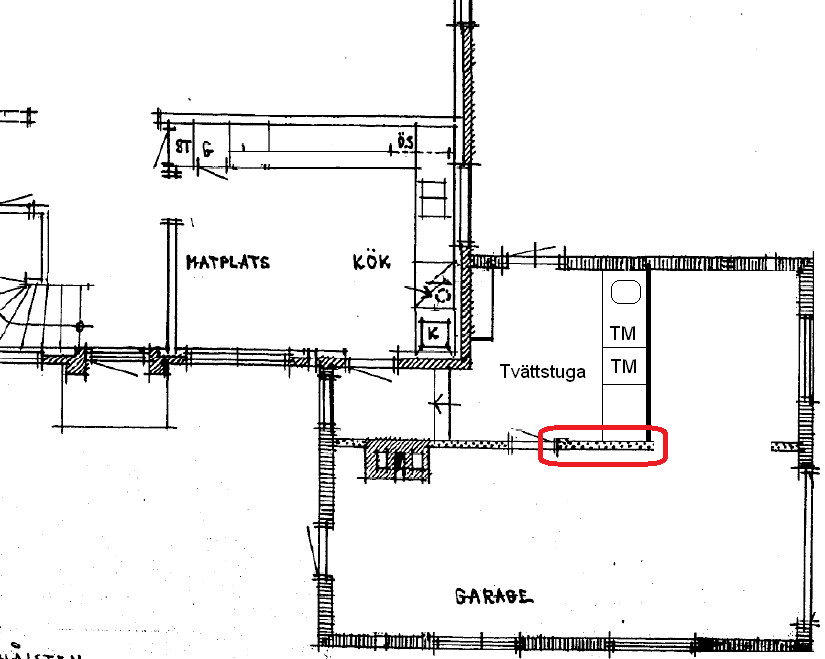
Correct, the rafters lie vertically in the image. The wall is not load-bearing until further to the left (near the chimney), meaning the wall is not included in the cross-section of the rafter on the construction drawing. I've already taken down 170cm of the wall (to the right) and the top layer of concrete hollow blocks was only hanging in the support joint, so there's not much weight on the wall.S skutten11 said:
Seems to be as they say
I would support the roof with a couple of beams, against a beam in the roof to be on the safe side before starting to hack into the wall, then it is secured if there is pressure on it
The wall will become quite hacky; are you going to plaster it again or just put up a board?
I would support the roof with a couple of beams, against a beam in the roof to be on the safe side before starting to hack into the wall, then it is secured if there is pressure on it
The wall will become quite hacky; are you going to plaster it again or just put up a board?
That might be a good idea. There is a truss at each end of the wall.
I've started hacking at it a bit now, using a sledgehammer and chisel, and it's not too difficult to peel away the 2 "layers" of stone I've planned. This means I'm removing 9cm, and there are 3 "layers" of stone left.
Unfortunately, I have to hit quite hard, especially to get through the driving side of a new stone, so it feels like there's an obvious risk of cracks. I’ll probably need to tape up some plastic to help with the angle grinder. (Sigh, still dusting off things in the garage since the last time I had to use the angle grinder about ~4 years ago).
Besides cracks, the biggest concern right now is how the wall is standing on the floor. There are a couple of rows of bricks, and then the wall is placed half on the bricks and half on the floor in the laundry room. When I chipped away the floor in the laundry room, I inserted and fastened solid blocks as best as I could from underneath, but I'm afraid these don't support fully. So now as I thin out the wall, most of the top brick will also go, meaning there's only 5cm for the wall to stand on . But oh well, no cracks so far
I've started hacking at it a bit now, using a sledgehammer and chisel, and it's not too difficult to peel away the 2 "layers" of stone I've planned. This means I'm removing 9cm, and there are 3 "layers" of stone left.
Unfortunately, I have to hit quite hard, especially to get through the driving side of a new stone, so it feels like there's an obvious risk of cracks. I’ll probably need to tape up some plastic to help with the angle grinder. (Sigh, still dusting off things in the garage since the last time I had to use the angle grinder about ~4 years ago).
Besides cracks, the biggest concern right now is how the wall is standing on the floor. There are a couple of rows of bricks, and then the wall is placed half on the bricks and half on the floor in the laundry room. When I chipped away the floor in the laundry room, I inserted and fastened solid blocks as best as I could from underneath, but I'm afraid these don't support fully. So now as I thin out the wall, most of the top brick will also go, meaning there's only 5cm for the wall to stand on
. But oh well, no cracks so far 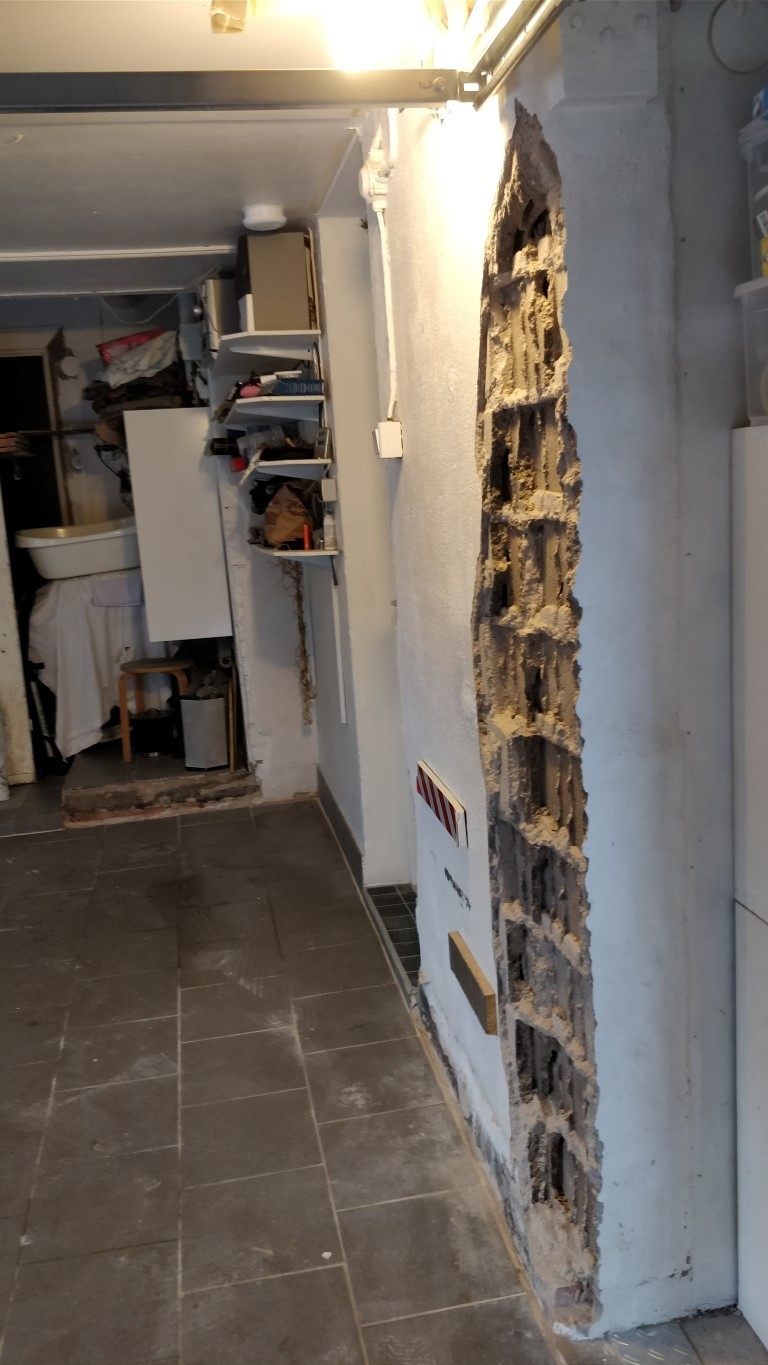
Dig out a little extra at the bottom before supporting it, then it's probably a weight and support from the ceiling that holds the wall a bit, and cast a ledge with concrete up a bit. If it's a concrete floor, set some iron pegs into it as lateral support. Then regarding the sides, drill some holes in a row first, making it easier to break out pieces, then just a bit of touch-up with a machine is needed.
The floor is probably just a thin unreinforced slab on crushed stone, so there's not much to reinforce. Additionally, I hope to find time to break out and lower the floor by 10-20cm sometime in the future. So it will probably be to keep the top brick and hope it holds.
I tested with a drill and a 10mm bit. Unfortunately, I didn't find it much easier to split off pieces even though I drilled at 3cm intervals. I'm considering whether to get some stone splitting wedges to work with instead.
I tested with a drill and a 10mm bit. Unfortunately, I didn't find it much easier to split off pieces even though I drilled at 3cm intervals. I'm considering whether to get some stone splitting wedges to work with instead.
The fact that it's a thin slice of concrete doesn't matter, it's supposed to support sideways, place them just inside the finished wall, the idea of drilling and cracking was just an idea if it worked
You might hit the seam between the holes in the stone, where it's harder
But good luck
You might hit the seam between the holes in the stone, where it's harder
But good luck
Click here to reply