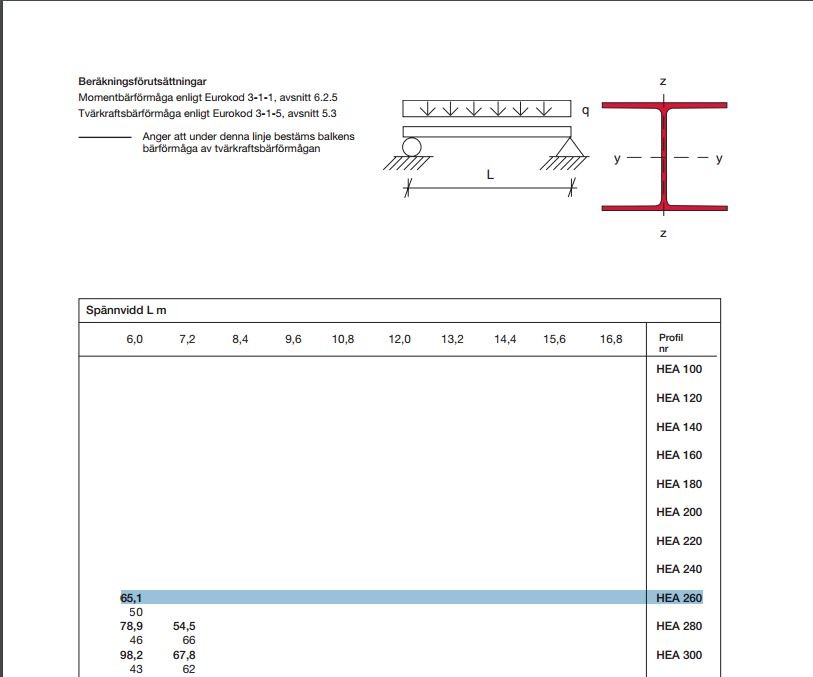
I'm pondering a bit about the deflection between steel and glulam beams. Looking at Tibnor's construction table, I can deduce that I need a HEA 260 to support 6m and that "approved" deflection is 50mm. Have I interpreted that correctly? It feels like quite a lot of deflection, but the beam itself weighs quite a bit too.
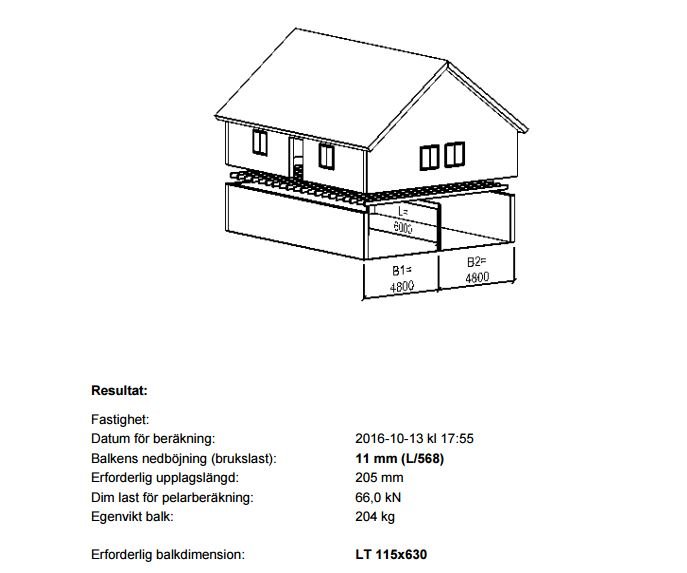
If I enter my measurements into the "glulam program," it recommends a much heftier wooden beam, which naturally has much less deflection.
The thicker the steel beam I choose, the less deflection I get in some respects, but my whole idea with the steel beam instead of glulam was that I thought I would get away with a smaller beam while also getting a more stable one. But maybe I'm fooling myself when I think a steel beam would be more stable/sturdier/better than a glulam beam.
I understand that I can't compare the load calculations straight across since they have different conditions, but my question remains whether a steel beam might possibly give more deflection or if it's just that they have accounted for a higher load which could result in the maximum deflection...?
In Tibnor's construction table, the load is specified as 65.1kN/m, which means a deflection of 50mm is achieved with a load of 65.1kN x 6m (390.6kN).
I interpret the load case in the glulam calculation as 132kN (column load 66kN x 2).
With a load of 132kN, you get a deflection of 17mm (1/352) for an HEA260.
If you insert a HEB260, the deflection is approximately at the same level as the glulam beam above (12mm).
Thanks for the response! 132kN is roughly about 13 tons, right? And the steel beam's 390kN almost 40 tons?
Both should handle my upper floor and potential snow load (living in Östergötland).
Can it be simply said that they roughly give the same amount of deflection at the load 132kN, but when the wooden beam breaks, the steel beam allows even more deflection?
Steel is chosen when you want to avoid doing the limbo through openings, i.e., you can have "smaller/lower" profiles with steel as it has a higher modulus of elasticity.
The recommendation for flooring is 1/400 (length through deflection) and then, based on the given load case, an HEB260 is preferable.
A glulam beam also requires larger supports if I understand it correctly. 200mm in my example above. How about the steel beam? It doesn't seem to have the same support requirements..?
Click here to reply
Vi vill skicka notiser för ämnen du bevakar och händelser som berör dig.