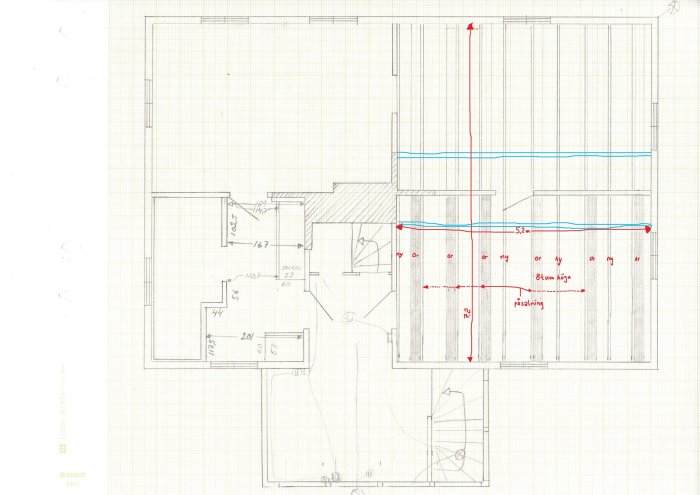
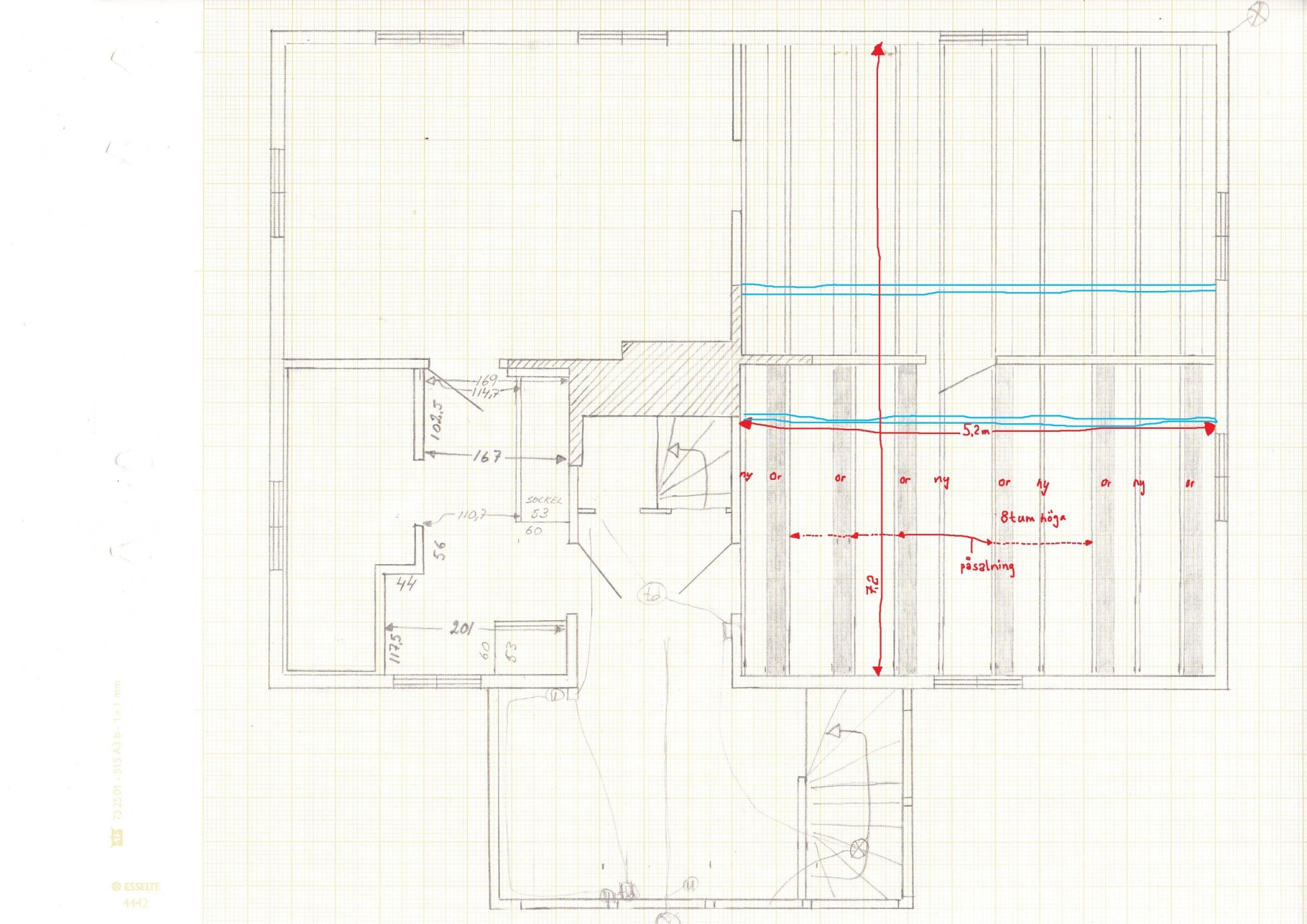
I have a log house with two floors + attic, moved & set up in 1865. Orientation is north-south, chimney slightly shifted towards the north. South of the chimney, there are two rooms on both floors facing east & west. Until 1936, there was a room on each floor measuring north-south 5.2m & east-west 7.2m. They probably needed more rooms and possibly to reduce the floor bounce. The floor structure then had 6 beams 8 inches high at c/c 70 - 110cm, after rearranging the floor on the second floor, there are now 3 8x2 inch beams where the beams were sparse. All now crossed in 6 lines & the old ones have been reinforced because they were not quite level or straight in any direction. The space is filled with ground insulation underneath (for impact sound reduction) & regular stone wool up to the floor.
I want to return to one large room on the first floor and have unfortunately missed the chance to support the ceiling there with tension rods through the partition wall on the second floor up to the attic, instead, there will be 2 beams in the north-south direction, one on each side of the chimney but inside the two windows on the south gable.
The plan was H-beam which I had lying around 14 x 14cm but that's too small, said the carpenter who is very skilled but, as usual, finds it very hard to fit in a pre-check visit to the job. 16 - 18 cm he thinks, I can probably believe that's right but my ceiling height is about 2.15 cm, so I say 16 cm, after all, there will be 2 of them. He suggests cutting up the ceiling, which I think is a pity since the boards (1 inch) are 20-36 cm wide. How can you in a narrow gap know that all beams rest against the new beams, and how do you wedge them to the right tension there? By the chimney, the beams will rest on standing beams against a new foundation for the tile stove = as rigid as the wall, and at the south gable, 16 mm threaded rods suspended in sturdy angle irons against the outer wall so they follow any movement in the timber and to prevent the beam from receiving cold notches in some support in the timber.
Glued laminated timber, someone mentioned, but it looks like it would be a very high beam but good as you wouldn't need to make sides to get the illusion of a wooden beam.
Grateful for responses from someone who has done this!
can only say that you don't guess when replacing a load-bearing wall with a beam, you consult a structural engineer. The alternative is to over-dimension, but you need some knowledge. A beam supporting a floor or roof won't break under too much load, but it will bend significantly. There is something called accepted deflection, which is considered okay for a beam, and this is the measurement used for calculations.
The next part is that the supports must be sufficiently large, i.e., the measure of how much the beam rests on each side, preferably 9 cm. Moving on to all parts, these supports need to be able to transfer the force downwards, probably in your case to a stone base? They handle quite a bit, but it must not push away the ground. Start by assessing the ground or where you are taking up the load, then go all the way to where the beam will be placed. Then consult a structural engineer if you want the lowest beam, or do as the carpenter suggested and take a large one to over-dimension. 5.2 meters where it should support all the beams in the room 7.2 / 2, i.e., 3.6 meters, plus the entire width of 5.2 meters. This is an area of about 20 sqm. 200 kg/sqm provides a distributed load of 4 tons (3.9 kN) on your beam, and then 2 tons per support. I think your steel beam (HEA) will be quite high to handle that load. By using two beams, you can divide everything by 2 to find the loads on the various parts. However, to know that it holds, I would go with a 180 IPE beam or possibly 200 without involving a structural engineer.
Click here to reply
Vi vill skicka notiser för ämnen du bevakar och händelser som berör dig.