
hello.
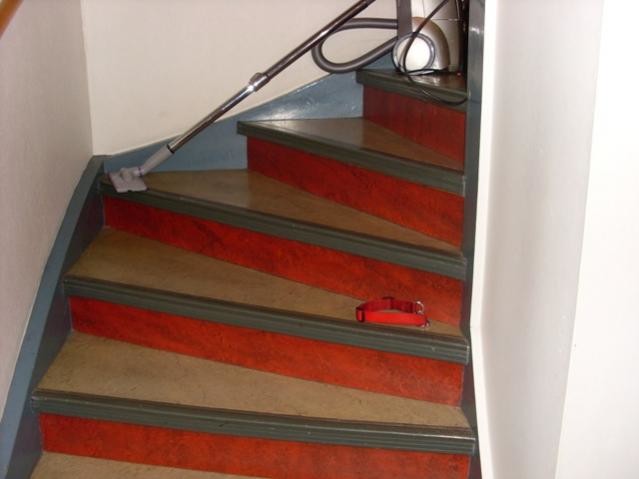
I'm checking out the stairs in our house because they are really dreadful. On the steps, there is some kind of gray patterned linoleum, and in between, there is some red stuff.
So what I've been thinking is to tear these off and then glue together pine floorboards to create units that I can cut out both the treads and the risers, so the stairs will be clad in pine, and then paint it. I've lifted the linoleum and checked, and there's nothing underneath that can be sanded down; it just seems to be junk wood, so that's why I came up with the idea to build on top with pine to get a good surface to paint on...
However, what I can't decide is what to paint with... you want it to be durable enough not to look like junk after a while... my partner wants to paint it completely white, but since it's intended to be pine floorboards, maybe we should whitewash it or something so you can still see the wood but not completely wooden... does such a finish hold up to foot traffic, or will it wear out quickly...
What I have planned to use for the stairs is this -> http://www.byggmax.com/se-sv/Prod/PID-08914117.aspx
What do you think of my idea? Am I completely off track, or could it work as I've thought?
In my mind, it looks really nice at least, but the question is whether it can be done like that.
And I have a picture of the stairs, so you can see how bad it is.
I'm checking out the stairs in our house because they are really dreadful. On the steps, there is some kind of gray patterned linoleum, and in between, there is some red stuff.
So what I've been thinking is to tear these off and then glue together pine floorboards to create units that I can cut out both the treads and the risers, so the stairs will be clad in pine, and then paint it. I've lifted the linoleum and checked, and there's nothing underneath that can be sanded down; it just seems to be junk wood, so that's why I came up with the idea to build on top with pine to get a good surface to paint on...
However, what I can't decide is what to paint with... you want it to be durable enough not to look like junk after a while... my partner wants to paint it completely white, but since it's intended to be pine floorboards, maybe we should whitewash it or something so you can still see the wood but not completely wooden... does such a finish hold up to foot traffic, or will it wear out quickly...
What I have planned to use for the stairs is this -> http://www.byggmax.com/se-sv/Prod/PID-08914117.aspx
What do you think of my idea? Am I completely off track, or could it work as I've thought?
In my mind, it looks really nice at least, but the question is whether it can be done like that.
And I have a picture of the stairs, so you can see how bad it is.

We had similar concerns but with a tightly glued carpet. The glue residues were quite stubborn. I used laminate flooring instead as it doesn't increase the height as much on the steps. I believe it's significantly easier to work with than pine planks. I glued the laminate flooring in place.
There are laminate options in all sorts of shapes and colors.
Don't forget the stair compass, it makes life much easier.
There are laminate options in all sorts of shapes and colors.
Don't forget the stair compass, it makes life much easier.
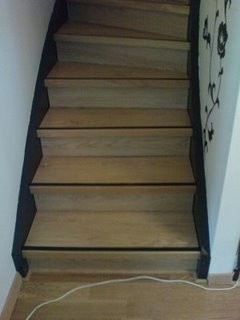
yes, they did look similar.. and damn stylish  the reason why I was considering pine planks was to make a sturdier staircase.. as mentioned, it seems to be built with crappy wood, so I thought it would feel a bit more robust if we covered it with that... and since both my partner and I are leaning towards painting it, parquet might not be so good then, as it takes away the whole point of it...
but where can one find a staircase compass?? I've read and seen that many people use it, but haven't found any links to where you can buy it... I was thinking of taking something like cardboard to make templates for each step and cut out... the stairs don't seem to have any strange angles that I can see, but they mostly look like straight angles everywhere... although maybe it's the eye being tricked...
and one more thing... do you have to have a stair nose? it's a bit protruding now, but I was planning to cut it off to make it easier to put the covering and then put a metal strip ( http://www.byggmax.com/se-sv/Prod/PID-140106.aspx ) on the edge... but if the stair nose has some function related to walking the stairs, maybe it needs to be there.
the reason why I was considering pine planks was to make a sturdier staircase.. as mentioned, it seems to be built with crappy wood, so I thought it would feel a bit more robust if we covered it with that... and since both my partner and I are leaning towards painting it, parquet might not be so good then, as it takes away the whole point of it...but where can one find a staircase compass?? I've read and seen that many people use it, but haven't found any links to where you can buy it... I was thinking of taking something like cardboard to make templates for each step and cut out... the stairs don't seem to have any strange angles that I can see, but they mostly look like straight angles everywhere... although maybe it's the eye being tricked...
and one more thing... do you have to have a stair nose? it's a bit protruding now, but I was planning to cut it off to make it easier to put the covering and then put a metal strip ( http://www.byggmax.com/se-sv/Prod/PID-140106.aspx ) on the edge... but if the stair nose has some function related to walking the stairs, maybe it needs to be there.
Last edited:
Quite simple actually. Now I might mix up the terms tread and riser... but here goes...Tiger79 said:
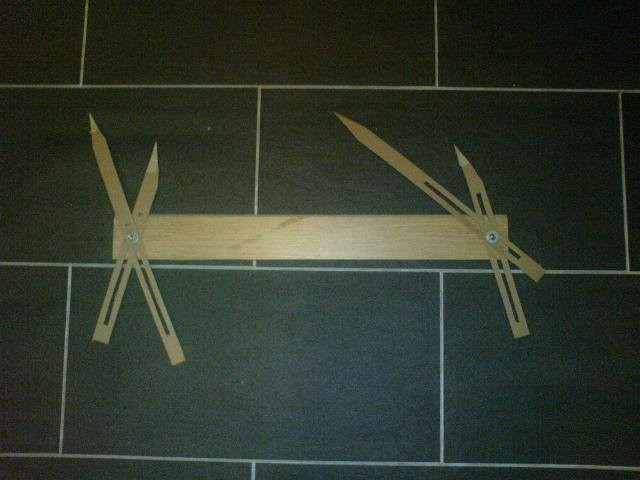
I made my own stair compass that I used to measure each tread after we tore off the carpet and sanded it a bit flat.
Once I had measured the tread, I stacked three laminate boards, measured the step with the compass, drew a line point to point and used a jigsaw to carefully cut out the step in the laminate boards. The risers(?) were quite easy and rectangular and were glued with PL600 first.
Then I glued tongue and groove on the laminate boards (also PL600) and also on the tread. Then gently placed the glued laminate boards on the step. In some cases, I had to fine-tune with a file.
Then add weight... books, photo albums, catalogs, anything you could find for a couple of hours.
Meanwhile, I made the stair nose from a tile edging in oak, whose width was about 5mm wider than the existing stair nose + laminate.
Once the laminate boards' glue dried, you had to sand down the short sides to make them plumb so you could nail on the new stair nose without a gap. However, I was a bit sloppy, and there were some gaps here and there which were covered with anti-slip tape.
Hope this little description was enough... Attached is a picture of the homemade stair compass.
A laminate board, two screws and nuts, and hard cardboard pieces as pointers.
My personal opinion is that metal stair noses don't look beautiful, but it's up to the eye of the beholder. Installation is certainly simple and smooth. Function... no idea?Frigge said:and one more thing... do you have to have a stair nose? it's a bit protruding now but I was thinking of cutting it off to make it easier to fit the cladding and then put a metal strip ( [link] ) on the edge... but if the stair nose has any function with walking on the stairs, then maybe it has to be there
But there must be some white laminate that looks according to your wishes? I absolutely don't advise against doing it with furuplank, but it spontaneously feels unnecessarily troublesome.
showed the pictures to my partner and now we have completely different ideas in the hallway where the stairs begin, we have similar laminate with a kind of anthracite tile imitation... so we found this at byggmax that would probably look great on the stairs (http://www.byggmax.com/se-sv/Prod/PID-13845.aspx). partly dog hair and dirt aren't as noticeable on this as on white, and it matches the hallway floor.
and with light sides and wainscoting, it could probably be really nice.
in the hallway where the stairs begin, we have similar laminate with a kind of anthracite tile imitation... so we found this at byggmax that would probably look great on the stairs (http://www.byggmax.com/se-sv/Prod/PID-13845.aspx). partly dog hair and dirt aren't as noticeable on this as on white, and it matches the hallway floor.and with light sides and wainscoting, it could probably be really nice.

I took 14 mm oak parquet.
There is a stair ruler available for purchase. You can rotate it in all directions.
For the stair nose, use oak trim 56 mm, that way you cover everything.
Scroll down a bit in my album here to see the result.
http://www.minhembio.com/speedomac/29955/
There is a stair ruler available for purchase. You can rotate it in all directions.
For the stair nose, use oak trim 56 mm, that way you cover everything.
Scroll down a bit in my album here to see the result.
http://www.minhembio.com/speedomac/29955/
I did the same and since we were going to paint, I kept the "skitvirket" and sanded off glue and linoleum residues. I got a reason to buy a new solid sander, but with that and 40-grit paper, it was less work than cutting pine/parquet/laminate which were the alternatives. Our staircase looked like yours in the picture and turned out very nice with gray paint, we think So if you change your mind again and decide to paint, I see no reason to cover it with pine.
So if you change your mind again and decide to paint, I see no reason to cover it with pine.
Click here to reply