
30,877 views ·
57 replies
31k views
57 replies
Soundproofing - double drywall hasn't helped

Yes, you got it right. Now it remains for you to continue this thread and document the build so everyone knows how much better it gets. 
Ps. If you want the ability to screw things on the wall without using molly plugs, or drywall plugs, you can put a layer of OSB first before putting on the drywall, so you have wood behind the drywall. Not crucial but might be worth considering at least. But of course, then you'll lose another 12.5 mm of the room.
Ps. If you want the ability to screw things on the wall without using molly plugs, or drywall plugs, you can put a layer of OSB first before putting on the drywall, so you have wood behind the drywall. Not crucial but might be worth considering at least. But of course, then you'll lose another 12.5 mm of the room.
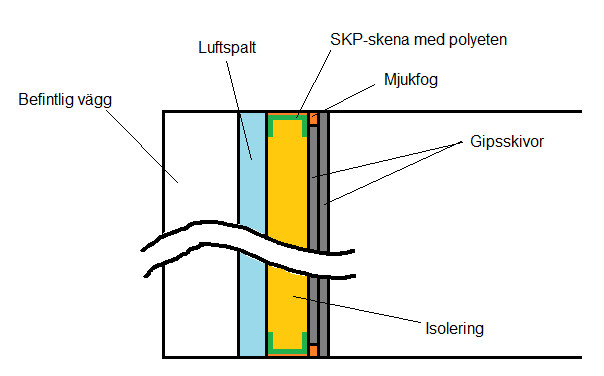
A cross-section of the proposed wall construction. Don't forget the soft sealant and to use the SKP profile with polyethylene as track and ceiling runner. And of course, you should have vertical studs at a cc600 or cc450 distance in the yellow section of the image.
Accuracy in all steps is key.
I'm going to start building this wall. I was thinking of a 50 mm air gap. The question is which insulation to use. I've received some different suggestions in the thread. Mineral wool or stone wool?
If I remember correctly, I used this one:4 4cyberspace said:
https://www.byggmax.se/isoleringsskiva-ljudskiva-piano-isover

In post 41, the image with the air gap, we have 30cm in our apartment. On each side, there's double plasterboard, then an air gap, one piece of plasterboard, an air gap of 30mm, insulation, and double plasterboard. The wall thickness between us and the neighbor, I guess, is 500-600mm. It's completely silent, nothing is heard between apartments. The question is if it's possible to build it thinner if structure-borne noise from the kitchen and daily clatter should stop on their respective sides. There are many new exciting materials today that didn't exist in 1982, when our apartment was built. Generally, it's about mass and different thicknesses of boards, not screwing too much into the studs, but gluing as much as possible. Then, sound is quite a tricky thing, frequencies that need to be blocked, all things have their own resonant frequencies, so good luck!
Personally, I'm tempted to pour sand in a place where we have sound traveling between rooms. I'm thinking double plasterboard, then sand 50-100mm, then double plasterboard. But when you drill into that wall, you get a surprise then
I've noticed that quite a bit of noise comes through one of the exhaust vents located on the side wall in the living room next to my current stud wall. The exhaust is non-existent, so I'd rather plug it up.
The exhaust vent probably leads close to or directly to the neighbor's bedroom because you can hear them clearly. A stud wall might also be needed to completely block off the neighbor as noise comes through both the vent and the wall.
How would you plug up a ventilation opening? I'm considering stuffing it with insulation material and placing a smaller gypsum board over the square hole.
The exhaust vent probably leads close to or directly to the neighbor's bedroom because you can hear them clearly. A stud wall might also be needed to completely block off the neighbor as noise comes through both the vent and the wall.
How would you plug up a ventilation opening? I'm considering stuffing it with insulation material and placing a smaller gypsum board over the square hole.

Okay, strange what the square hole on the wall is then? The house was built in the 1940s, so it was probably built differently then. Feels like it is some kind of ventilation or what else could it be?Jonatan79 said:
There is an old board in the hole covering about 80-90%, but it should still be extracting air if it were an exhaust ventilation. Or it is not working properly. In the bathroom, the exhaust ventilation extracts air well.
I’d rather plug up the hole if it serves no purpose and instead makes it more noisy.
Not building standard anymore. Make sure to plug and ensure you have intake vents in the wall near windows or window frame. Do you have a fan for bathroom ventilation?4 4cyberspace said:Okay, strange what that square hole on the wall is then? The house was built in the 1940s so it was probably constructed differently back then. Feels like it's some kind of ventilation or what else could it be?
There is an old board in the hole covering about 80-90% but it should still extract air if it was an exhaust vent. Or it might not be working well. In the bathroom, the exhaust ventilation extracts air well.
I would rather plug the hole if it doesn't serve any function and instead just makes it noisy.
I have an exhaust ventilation in the bathroom that draws out air well. It's a good extraction there. Yes, there is an air inlet vent in the living room near the window.
To plug it, I thought of filling the hole with insulation material. Then put a plasterboard in the hole and fill over it?. Then I will probably frame another wall in front of this.
So the two framed walls will stand perpendicular to each other.
To plug it, I thought of filling the hole with insulation material. Then put a plasterboard in the hole and fill over it?. Then I will probably frame another wall in front of this.
So the two framed walls will stand perpendicular to each other.
That sounds good. It will work.4 4cyberspace said:I have an exhaust ventilation in the bathroom that draws out air effectively. There is good extraction there. Yes, an intake vent is located in the living room near the window.
For plugging, I thought of filling the hole with insulation material. Then put a drywall in the hole and plaster over it? Then I'm probably going to build another wall in front of this.
So the two framed walls will be perpendicular to each other.
It's probably not a bad idea to check the density of the insulation board. But in reality, it's probably not that simple. You should never focus solely on one property. If you find a board that is classified as "soundproof" by the manufacturers, it's likely good.4 4cyberspace said:
A quick Google search found two variants as below
Stone Wool
Paroc Sonus:
https://www.paroc.se/produkter/byggisolering/universell-byggisolering/paroc-sonus
Glass Wool
Isover Piano:
https://www.isover.se/products/isover-pianor-ljudskiva-stal-c450
Last edited:
Click here to reply