I also soundproofed and came across Green glue which I thought would never work, but it seems to do the job. In the end, I chose a completely different product.
"ViscoLam 65" from a company called Chova. It's some special rubber that weighs more than lead while also being flexible. You place this between two layers of drywall. It comes in a self-adhesive mat. I also looked at special "clips" that are sound-absorbing, e.g., reducto clip, but decided against them since it was difficult to find the necessary studs in Sweden. Worth noting is that to make it completely soundproof, you also need to address the floor and ceiling since the sound will propagate through the entire structure.
Does this also apply to regular conversation, thuds, and screams that propagate through ceilings and floors? That's mostly the noise I'm dealing with. So no music or deep bass etc.
I believe the existing drywall is installed with studs against the interior wall. So the question is whether these should be taken down and if it is complicated? All the screw holes are already painted over. It's not good if the drywall remains from a sound perspective and they take up unnecessary space if that's the case.
I believe existing plasterboards are mounted with studs against the interior wall. So the question is whether these should be taken down and is it complicated? All screw holes are pre-painted. Because it's not good if the plasterboards stay in terms of sound, and they build out unnecessarily much in that case.
there was a lot of talk about 2 layers of plasterboard. It's a matter of 200kr and 1h of work to tear out. I would have torn everything out and started over and lived with the thought that you will probably hear the neighbor but hopefully less with a better wall. An alternative is always to move.
that was a lot of talk about 2 layers of drywall. It’s about 200kr and 1h of work to tear it out. I would have torn everything down and started over and lived with the idea that you'll probably hear the neighbor, but hopefully less with a better wall. An option is always to move.
Okay, yes, that’s what I meant about whether it is difficult and time-consuming to tear down the existing wall. But now I know. I don't care about the drywall as long as it turns out well.
So I should tear down the existing drywall and build a new wall that should have an air gap and not be directly against the old interior wall.
Does that also apply to regular talking, thuds, and screams that propagate through ceilings and floors? It's mostly that noise that's the issue. So no music or deep bass, etc.
Yes, all sound propagates, but it's much easier to get rid of "regular talking" than footstep noise. If you build a proper wall, it will result in a noticeable improvement. What I wrote that you need to soundproof the floor and ceiling to make it completely silent is also not true; if you really want complete silence, it's a room filled with vacuum that's needed since sound cannot travel in vacuum.
Addition to my tip about Norgips descriptions. Here, I found a video on how to install the Silent panel. The Silent panel is shorter and narrower than regular gypsum boards. Moreover, if you have never worked with metal studs, you can see some types of profiles that are used:
KnaufDanogips has a table for different constructions that might be of interest too:
Maybe a bit late, but keep in mind that if you have, for example, electrical outlets or similar on the wall, you will of course need to move them if you are building a new wall in front.
Maybe a bit late but keep in mind that if you have, for example, electrical outlets or similar on the wall, you'll need to move them out as well if you're building a new wall in front
It's worth considering that electrical outlets, junction boxes, spotlights, and the like let through quite a bit of sound. If you don't have a tight construction, it doesn't matter how much mass you add.
Is the construction that Fasting65 links to a few posts above better?
Yes, it is correct if you disregard that there should not be gypsum on both sides, just as I mentioned in my first post.
If the current wall is framed, you can either tear it down or cut the gypsum so you have at least 50% open surface evenly distributed.
Regarding the floor and ceiling, this needs to be mapped out with an insulation measurement (air and impact sound insulation). If the noise disturbance is troubling from residents above, you need to hang a heavy decoupled gypsum ceiling. You can expect the ceiling height to be at least 250 mm lower depending on the measurement results.
In a soundproof wall, you should aim for external electrical installations. If you want recessed electricity, spotlights, etc., you need to build dense gypsum boxes behind the sockets. I build sound studios where the requirements are extremely high, both regarding sound insulation and room acoustics, and we perform insulation measurements when the constructions are completed. No expensive special products are needed to build a soundproof partition wall; everything is available at the lumberyard. What is important is to choose the right construction solution and be meticulous so that it becomes completely airtight and that the two walls are not shorted. Regarding the choice of insulation, its function is to absorb the cavity resonance in the stud bays. Therefore, it is important that the insulation has the right flow resistivity. A heavy rock wool board has too much flow resistance to provide the right absorption.
I have found a blueprint of the apartments in my building, which is nice as you can see a bit of how it's constructed. I've received quite a few tips on soundproofing, but I thought it might still be interesting to see this blueprint to perhaps notice something.
The right apartment "2 rooms and kitchen" is my apartment. Imagine then that you move an exact copy and position of the left "3 rooms and kitchen with dining area" and place it wall to wall to the right of my apartment.
The apartment to the right of mine is what bothers me the most. However, I can also hear the neighbor to the left of my apartment when I'm in my bedroom. So it's noisy there too, but not as disturbing as from the neighbor's apartment to the right of mine. Note that I don't have any issues with noise from neighbors above or below.
Their living room is therefore wall to wall with my living room. Also note that a small part of their left bedroom is adjacent to my living room, which makes sense as I hear noise from that room too.
Note that there is a ventilation hatch with exhaust in the right corner of my living room near the neighbors' apartment. Could some of the noise be coming from there? This hatch is currently closed and painted over by the previous owner. I can also hear the neighbors in my kitchen from their left bedroom. Thanks to tiles and kitchen cabinets, etc., the noise is somewhat muffled but it's still noisy.
I can also mention that there is an electrical outlet on the plasterboard wall that is against the inner wall. The electrical outlet was previously on the inner wall.
Noise from thuds and the like is not prioritized at the moment, so soundproofing of walls and ceiling is probably not relevant. The main goal is to avoid hearing conversation and shouting between the inner walls.
Someone asked if it's noisy vertically in the building, but it isn't. It's mainly between the apartments that it's extremely noisy.
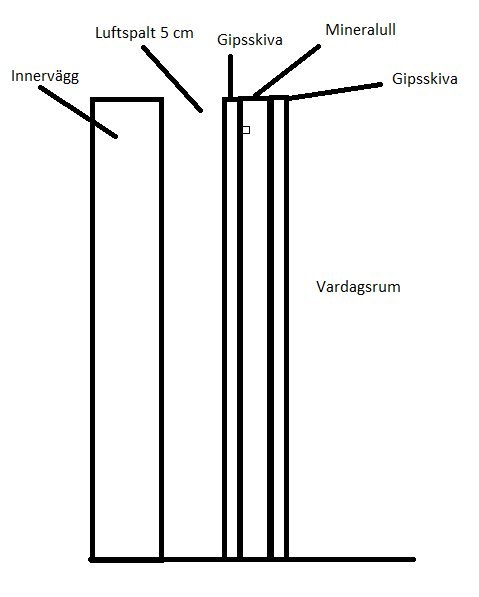
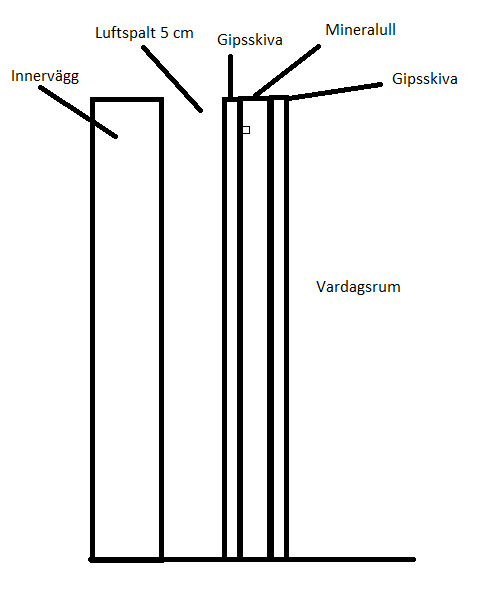
According to what I've read, a soundproof wall could look like the following. Does anyone see any mistakes or anything that could be improved in the construction below? The existing gypsum wall that exists today is attached to the inner wall. This small change of placing the new wall a bit away with an air gap in between would therefore make the soundproofing better?
According to what I've read, a soundproof wall could look like the one below. Does anyone see anything wrong or something that can be improved in the construction below? The existing gypsum wall that is currently in place is attached to the interior wall. This small change of placing the new wall a bit away with an air gap in between, would that make the soundproofing better?
[image]
The insulation should be in the air gap and one of the gypsum layers directly against the apartment wall.
@4cyberspace How were you planning to attach the inner drywall to your stud frame?
No, you should frame a structure a few cm from the existing wall. Fill the framework with insulation. Then you put two layers of drywall, with staggered joints (or soundproofing drywall as I have suggested before).
The wool should be in the air gap and one of the layers of gypsum directly against the apartment wall.
I have plasterboard mounted directly against the wall today and it hasn't helped much against the noise. According to the experts here on Bygga Hus, that's precisely how you shouldn't build, i.e., directly against the wall.
Apparently, it's important to have an air gap in between.
@4cyberspace How did you plan to fasten the inner drywall to your framed structure?
No, you should frame a structure a few cm from the existing wall. Fill the framework with insulation. Then you apply two layers of drywall with staggered seams (or soundproof drywall as I previously suggested).
You mean that in my picture the inner drywall should be removed? Okay, I get it, thanks for clarifying. Double drywall should only be on one side.
The construction will be as you say, that is:
Existing inner wall - Air gap - Framework filled with insulation - Double drywall
I can also add that there is a recessed electrical outlet on the current drywall/inner wall, which might be a reason why it hasn't improved. I should probably remove this outlet and have exposed wiring instead, as Björn Melander suggested.
Vi vill skicka notiser för ämnen du bevakar och händelser som berör dig.

Viktor.J said:
 as long as it turns out well.


Fasting65 said: