45x95 is the standard dimension for building large scaffolds in wood, so building with 45x195 feels a bit excessive.
I used 195s as beams to have a longer span; the longest span I had was almost 3 meters. I tied the 195s in the middle with a 95 to avoid a fun house sensation when walking on them.
I used 195r as a supporting layer to achieve a longer span, the longest I had was almost 3 m. I tied the 195r together in the middle with a 95:a to avoid a funhouse feeling when walking on them.
45x95 on wooden scaffolding is used only on vertical supports. All load-bearing horizontal beams are 45x145, with a maximum span/walkway width on the "bridge" of 120 cm.
In this construction with brackets, I feel some hesitation that the breakpoint between the diagonal brace and the horizontal load-bearing beam for the "walkway bridge" could become a buckling point that has to take all vertical loads outside. This means that additional rigidity/load-bearing capacity is needed on the horizontal load-bearing beams. I would never risk my life on 45x95, even if they were doubled. How much the load-bearing beams need to be reinforced with this construction naturally depends on whether my vague and diffuse load-bearing considerations are correct, but also then on the width of the walkway outside the intersection point (=>torque/buckling load).
45x95 on a scaffolding in wood is only used for vertical supports. All load-bearing horizontal beams are 45x145, with a maximum span/walking width on the "bridge" of 120 cm.
In this construction with brackets, I feel a certain doubt that the breaking point between the diagonal brace and the horizontal load-bearing beam for the "walking bridge" can become a weak point that takes all the vertical load outside. This means that additional stiffness/carrying capacity is needed on the horizontal load-bearing beams. I would never risk my life on 45x95, even if they were doubled.
How much the load-bearing beams need to be beefed up with this construction naturally depends on whether my vague and diffuse load-bearing considerations are correct, but also on the width of the walking bridge outside the intersection point (=> torque/buckling load).
thanks for the explanation!
Do you mean that the mounting to the diagonal brace becomes the weak point?
Really feels like it should be difficult to break two 45x95 that are 1m long, with my 80kg
Had a friend here who helped me look at the roof parts and it will be such that a company will get to redo part of the roof in the spring and then we'll arrange this.
If the length is 1 m, then perhaps the distance outside the crossbeam's intersection is only 20 cm or similar. Then the moment in the intersection/attachment point won't be as large, unless one leans against the railing, of course. Or loads a lot of bricks or similar heavy things on the outer edge.
The problem with weak 45x95 is that they are extremely sensitive to defects such as cracks and knots etc.
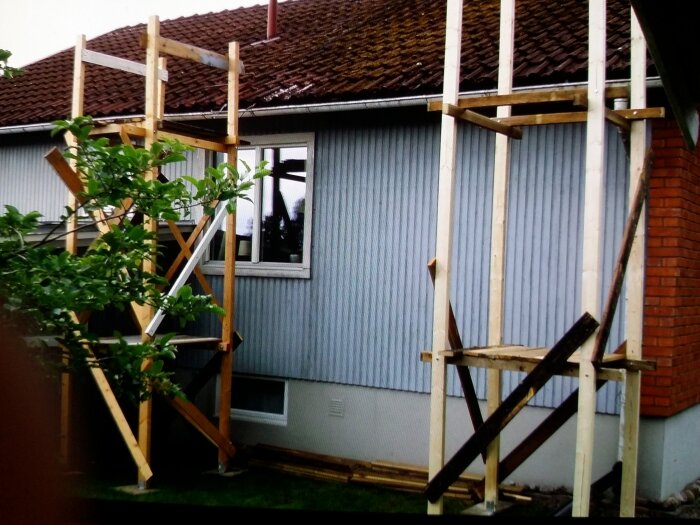
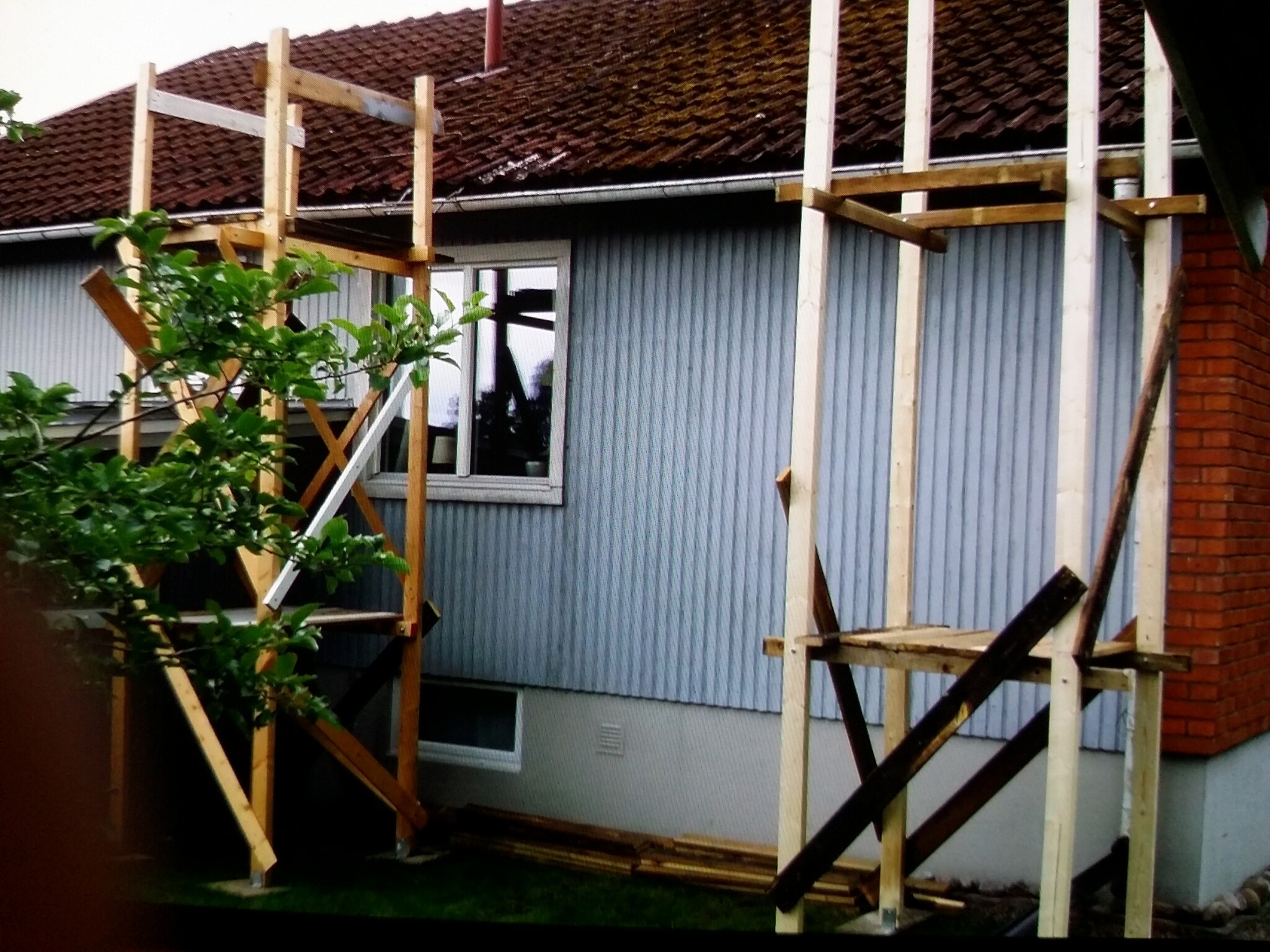
Jacks are certainly good, but I like my standalone "towers." They are fun both to build and take down. I have two up right now:
The one on the left is the same poles as in my first version I mentioned earlier in the thread (they are 3.90 long, not 3.60 as I wrote then). I have improved the construction since then by attaching the poles to concrete slabs and using carriage bolts for the platform joists. The lower platform is mainly to have something to stand on when I build the upper one. (The ladder is currently taken down because otherwise the neighbor's cat climbs up and sometimes jumps down onto the metal roof to the left, which makes a hell of a noise.)
The one on the right is under construction with new poles (which happened to be 4.20 long), and I have sacrificed aesthetics by reusing printed joists for the platforms and old decking as diagonal braces. A bridge is intended to be built between them later. Maybe a real staircase up instead of a ladder (from leftover wood from the demolition of a patio roof).
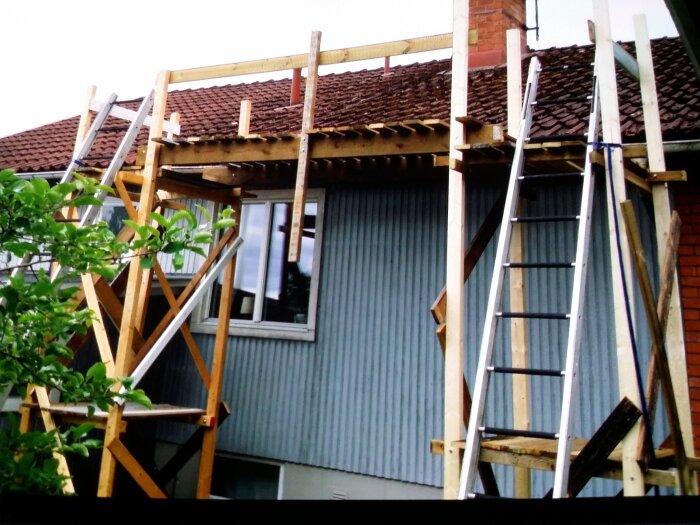
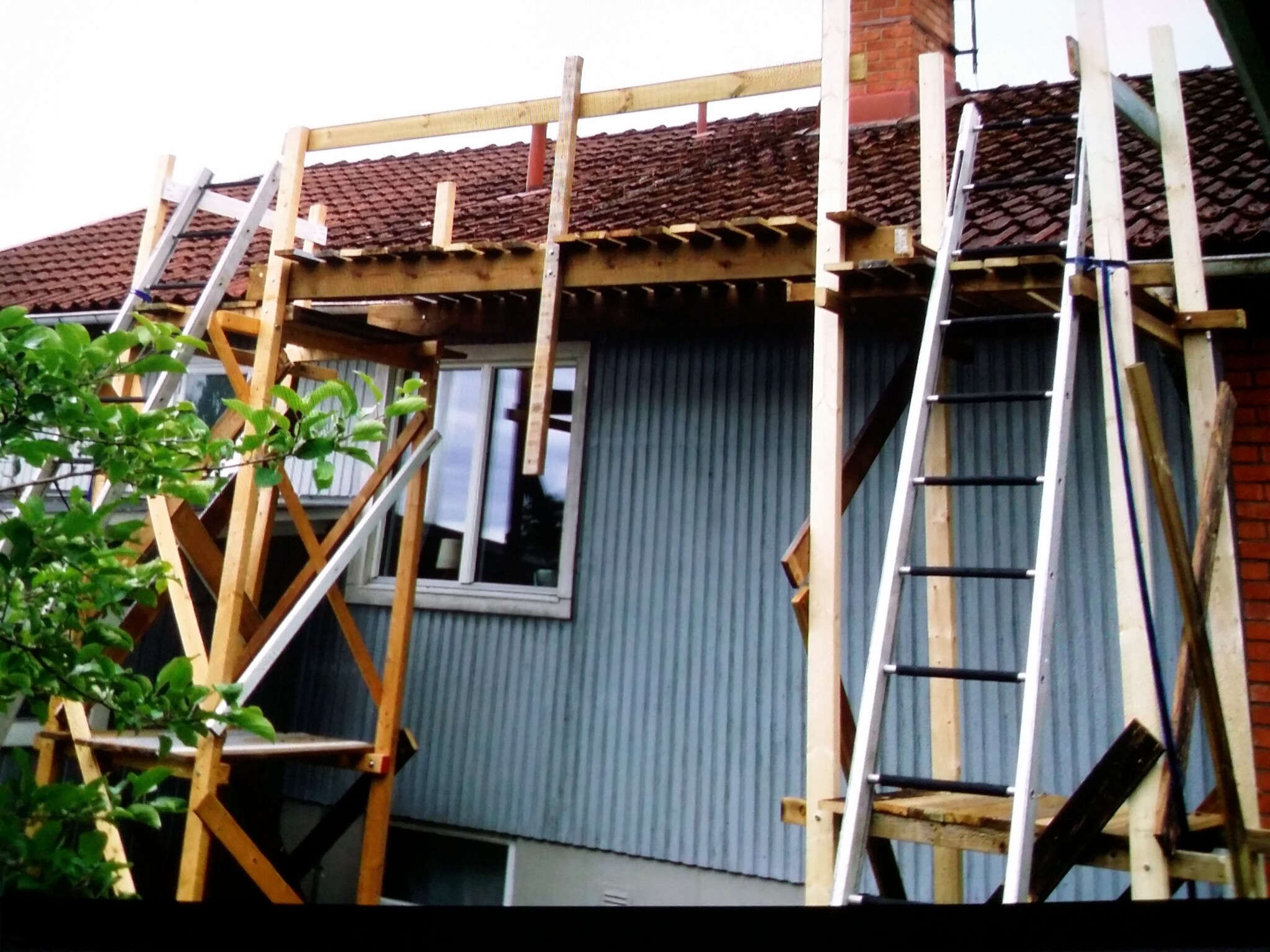
Here's how it turned out in its finished state at this location:
Unfortunately, the span of the "bridge" is only 2.7 m, and I used the used 170-timbers I had in roughly the right length, so there won't be a nice sway in the middle. I'll have to try another time with longer in a slimmer dimension.
Edit: Now I realize that I placed the post in the middle of the railing the wrong way.
Don't know if I managed to explain it understandably. Here is a simple sketch of how I built my brackets and how I prevented them from moving sideways. Then, of course, a deck should be screwed on top to hold the entire construction together. And don't forget to add a simple railing if you are at a high altitude!
[image]
Picking up an old thread, hope it's okay. Thanks for a great drawing! I want to try this. Do you remember the dimensions of the triangle? The horizontal, the one against the wall, and the diagonal. Grateful for an answer.
Reviving an old thread, hope that's okay. Thanks for a great drawing! I want to try this. Do you remember the dimensions of the triangle? The horizontal one, the one against the wall, and the diagonal one. Grateful for a response.
Unfortunately, I don't have exact measurements. The horizontal and vertical sides were probably around 1.5-2m long. The diagonal side turned out as it did. You can use Pythagoras to calculate it if you want. If you feel unsure, you could probably make the vertical side a little longer anyway.
Fun that I found this old thread. I'm going to replace fascia boards this summer and am now thinking about building some sort of brackets to get up there. It's probably no more than 5-6m to the ridge.
Has anyone done this in the last few years and can share some inspiring pictures? I have promised to build raised garden beds from something like 45x170c. 3 or 4 in width feels like it would make a decent platform.
Unfortunately, I don't have exact measurements. The horizontal and vertical sides were probably around 1.5-2m long. The diagonal side ended up as it did. You can use Pythagoras to calculate it if you like. If you're unsure, you could probably make the vertical side a bit longer anyway.
Oh, so it turns out to be quite a wide platform. Thank you very much!
Oh, so it's going to be quite a wide platform. Thank you very much!
I checked once more on the old pictures I posted earlier in this thread and I have to revise my answer. I would guess that the horizontal and vertical sides were around 1-1.2m long. If you make them much larger than that, they risk becoming heavy and difficult to set up on your own.
Funny that I found this old thread. I plan to replace the fascia boards this summer and am now thinking of building a temporary scaffold to get up there. It's probably no more than 5-6 meters to the ridge.
Has anyone done this in recent years and can share some inspiring pictures? I've promised to build planter boxes from something like 45x170c. 3 or 4 across feels like it would be a decent platform.
I used a smaller dimension for the timber than that. Keep in mind that it can be tricky to set them up if they become heavy. There are several pictures earlier in this thread.
I checked again on the old pictures I uploaded earlier in this thread and I have to revise my answer. I would guess that the horizontal and the vertical sides were probably around 1-1.2m long. If you make them much larger than that, they risk becoming heavy and difficult to set up on your own.
Oh, thank you for taking the time! I haven't started yet, so I have time.
Click here to reply
Vi vill skicka notiser för ämnen du bevakar och händelser som berör dig.

Oldboy said:
45x95 on a scaffolding in wood is only used for vertical supports. All load-bearing horizontal beams are 45x145, with a maximum span/walking width on the "bridge" of 120 cm.