I understand, but is it enough? To make it really stiff sideways, you should add a few diagonal braces. The risk of it moving sideways isn't that big, but if it does, it's not very successful.
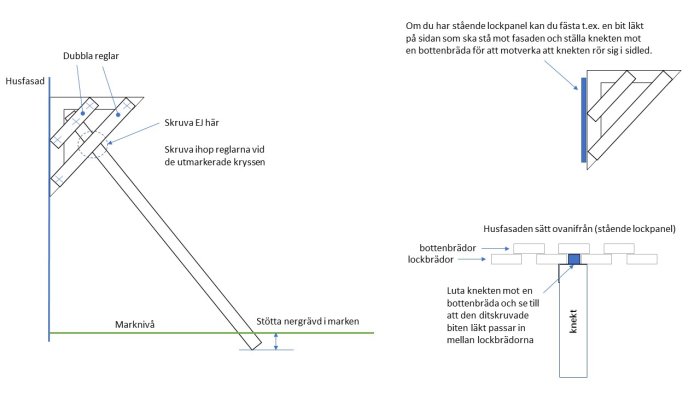
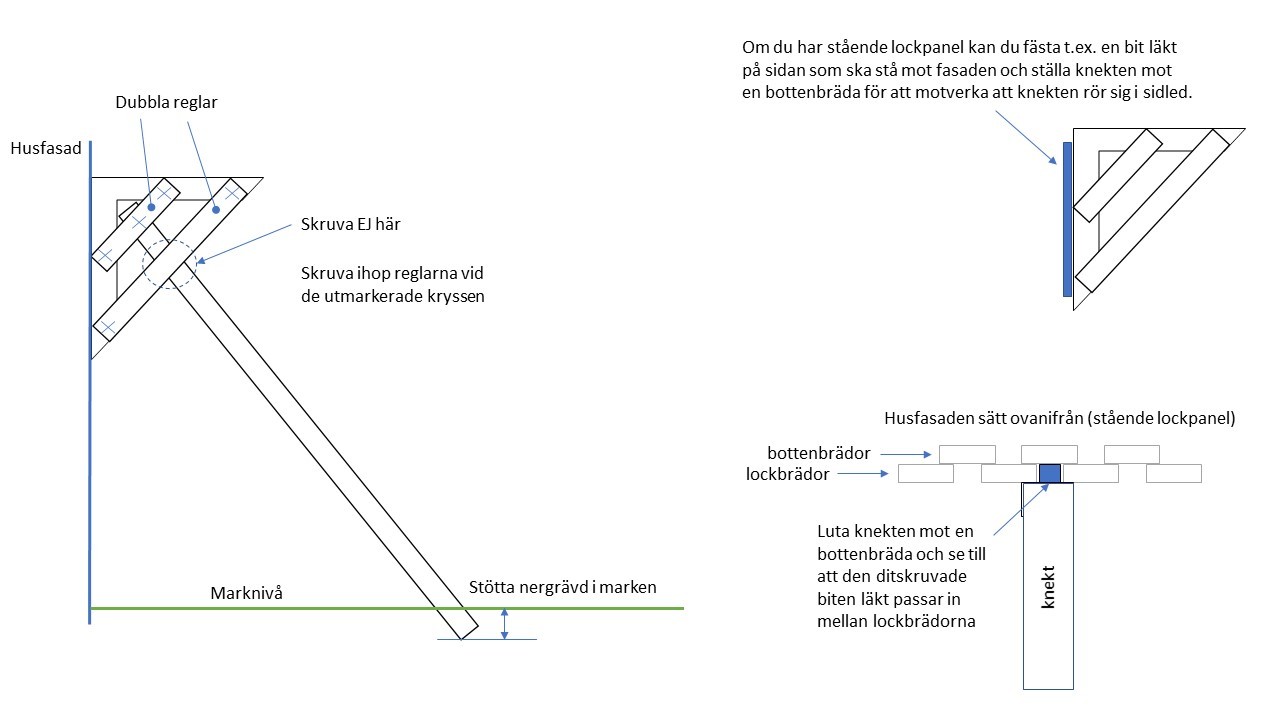
Certainly works. However, I forgot that I had another solution for this. I took advantage of the fact that I have vertical cladding. Each bracket was leaned against a bottom board, which meant there was an edge on each side that held it sideways.
I don't know if I managed to explain it clearly. Here's a simple sketch of how I built my supports and how I prevented them from moving sideways. Then, of course, decking should also be screwed on top to hold the entire construction together. And don't forget to add a simple railing if you are at a high height!
It probably works. However, I forgot that I had another solution for this. I took advantage of the fact that I have standing lock panel. Each bracket was leaning against a bottom board, which created an edge on each side that held it laterally.
Hmmm. It's not always possible to dig down the supports into the ground (like on an asphalt surface, for example), or - like josa100 - have the lower part of a facing house wall to support with. I first thought that you could "secure" each support using a clamp at the point where j-man says not to screw (see picture above). Alternatively, "secure" with a rope between the support and the lower part of the board that is against the house wall. But that doesn't seem like a good solution either - the whole support might still slide away if things go wrong. So the construction is indeed ingenious but requires the ability to dig down the supports, as I see it.
How do you set up a (tall) scaffold using knektar? Don't you need another scaffold to perform the assembly
Last fall, I built a small scaffold on four legs on my own, height to the top platform about 3 meters (3.60 poles), and then you could climb up as the construction progressed. Didn't even really need a ladder.
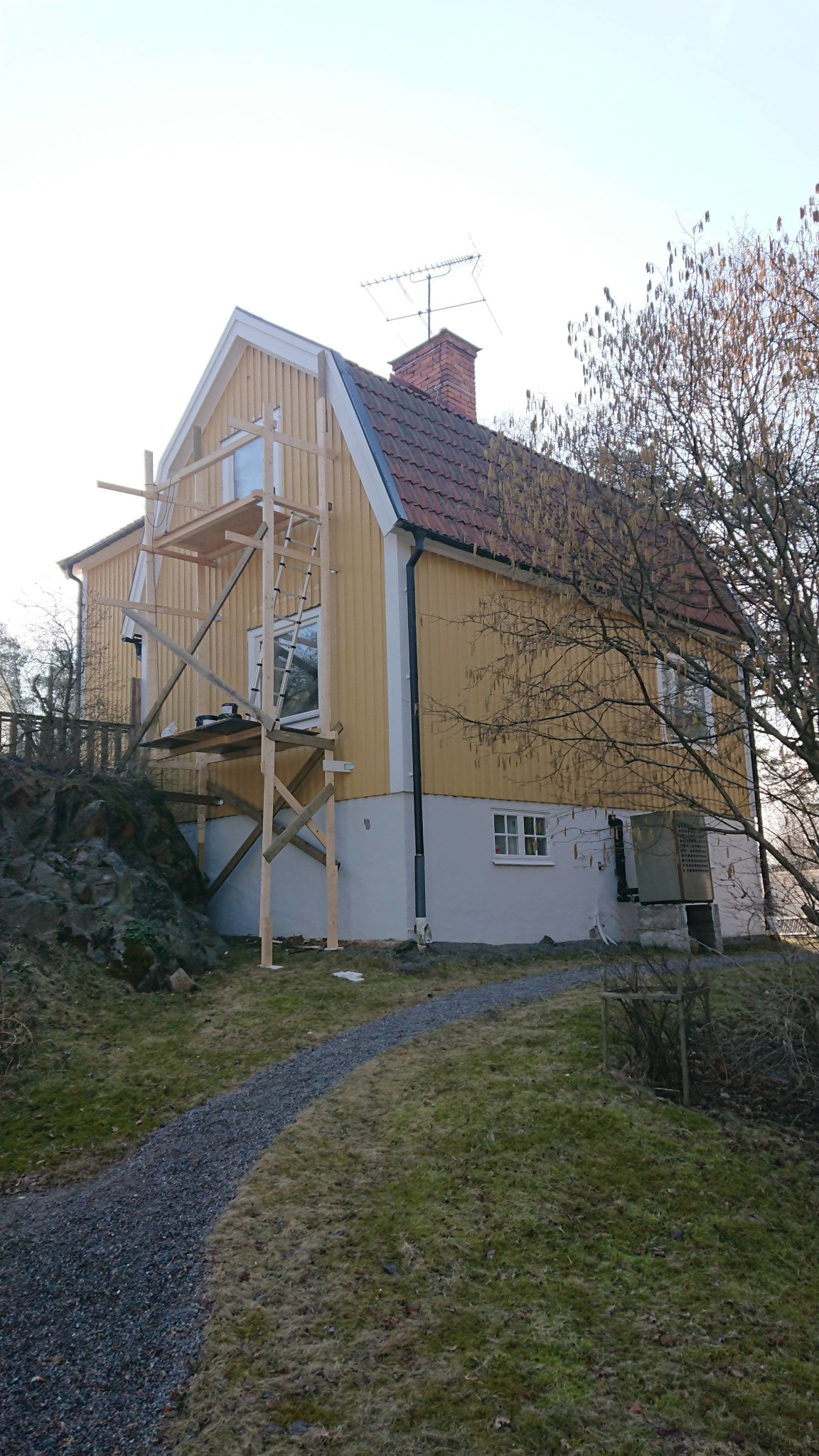
Nice, but the green studs/boards disrupt the visual impression. It also looks a bit risky with the "overhang" on the lower platform. Will the inner nail/screw hold if you jump at the very end?
Nice, although the green studs/boards disturb the visual impression. It also looks a bit risky with the "overhang" on the lower platform. Does the inner nail/screw hold if you jump at the far end?
Well, I didn't test jump it. There's also a lack of guardrails, but I built the structure solely for myself and I'm still alive. It was surprisingly easy and smooth to build, and it was dismantled and set up around the house as the window replacement progressed.
How do you set up a (high) scaffold of trestles? Don't you need another scaffold to perform the assembly?
Last fall, I built a small scaffold with four legs on my own, height to the top platform about 3 meters (3.60-posts), and I could climb up as the construction progressed. Didn't even really need a ladder.
I managed to set them up entirely on my own with the help of a ladder. On the high trestles (see the earlier picture I posted), I used whole beams that were probably 4.2 m long. I never measured how high I got, though.
Yes, 2 meters is not enough. I think I need about 3 meters to reasonably comfortably carry out my next planned job (replacing the gutter including brackets) and 4-5 meters to paint fascias and eaves on the gables.
How do you set up a (tall) scaffold using knektar? Don't you need another scaffold to perform the assembly
The support is "foldable" so you just stand on the ground and slide the knekt up along the wall. Then you just press the support into the ground, or secure it with a driven wedge.
Vi vill skicka notiser för ämnen du bevakar och händelser som berör dig.

janwide said:

Magnus E K said: