
125,027 views ·
73 replies
125k views
73 replies
Scaffolding in wood?
chris47 said:
I can really recommend building yourself. No rent costs and it's cheap to purchase. It's faster to assemble than you think and it'll be super stable if you attach it with iron towards the house. I built with 45x95 beams that I assembled with carriage bolts. If you want a different height when you move, or if a staircase is in the way, you just drill new holes.
I know the thread is old and I might have missed another thread but I'm taking a chance to ask since I'm new.
I'm planning to build a wooden scaffold with platforms at 2-meter intervals and the ridge is at 9m.
I've drawn up my idea and would be grateful if you could provide feedback on any craziness (of course without taking responsibility in any way)?
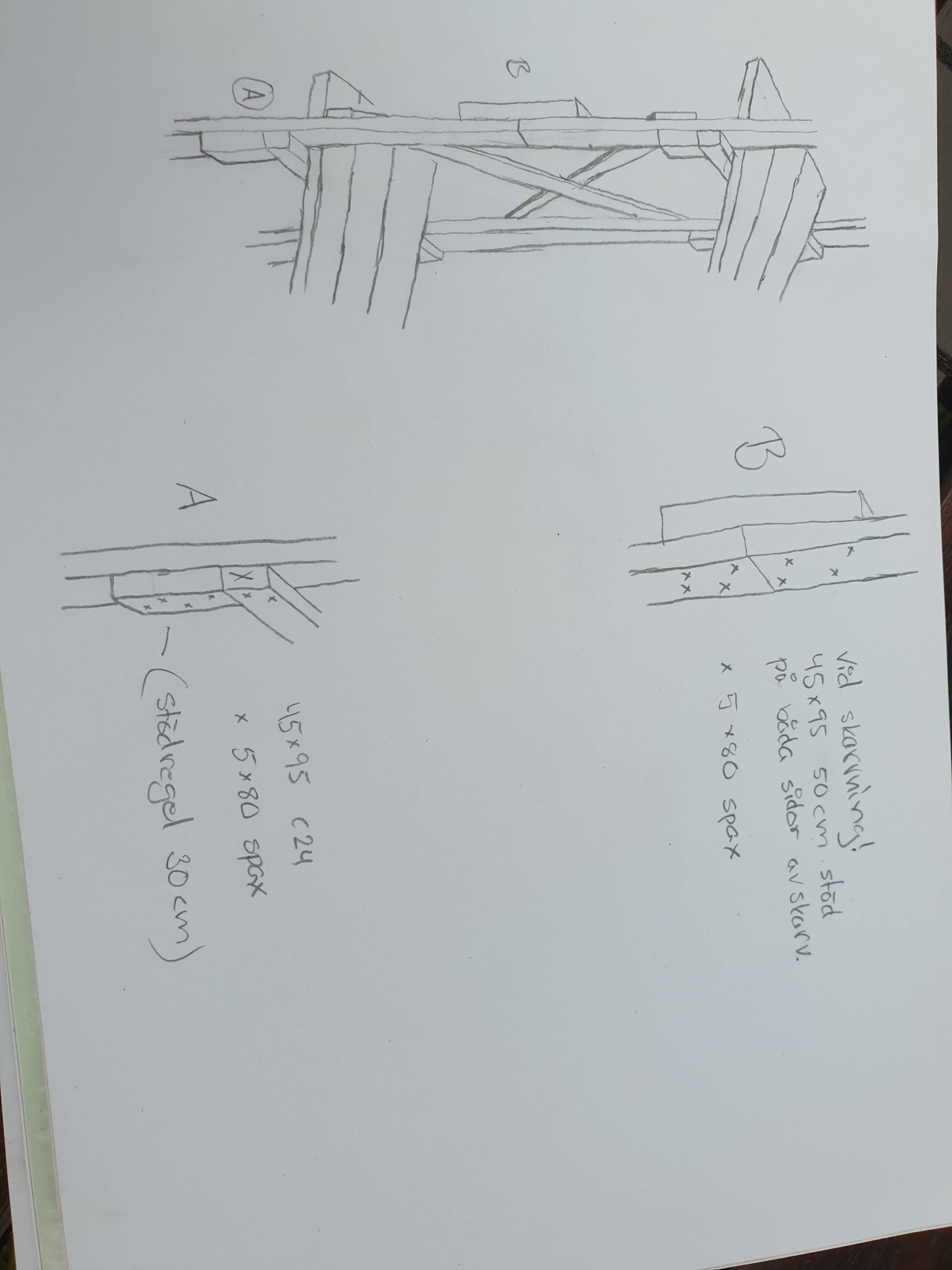
I built with four long 45x95. The first pair 30cm from the wall and the next pair 1m from the wall just like a metal stand. The crossbars can be attached with carriage bolts at any height on each short side, and these also support the beams you stand on. Cross braces on both the long and short sides for stability, as well as angle irons secured to the wall.
We were given a trial loan of a traditional steel scaffolding. It wasn't attached to the facade. If you had a picture of the scaffolding from above, it would look like a K - a straight part along the house and two parts that protrude diagonally backward (away from the house). Maybe it's possible to do something similar with a wooden scaffolding if you absolutely don't want to attach the scaffolding to the facade?
M
Marcussjogren
Member
· Västra Götaland
· 3 083 posts
Marcussjogren
Member
- Västra Götaland
- 3,083 posts
Hey!
I need to work on the fascia boards on the main building, about 7 meters up. However, there's an extension at the gable, so I either need to build a small platform on the roof ridge and place my Haki scaffolding on it with two legs and the other two on the ground. But the problem arises because there's a patio and basement stairs there.
I get bad vibes from that suggestion.
Then I saw this thread about brackets and thought that it should be possible to make brackets/wall consoles in 45x95 and then some horizontal ones that act as a railing.
I'm thinking of a bracket but without the last support piece and instead fastening the "back" of the bracket to the wall.
Imagine a wooden shelf on consoles in a gigantic format.
That should work pretty well, right?
I need to work on the fascia boards on the main building, about 7 meters up. However, there's an extension at the gable, so I either need to build a small platform on the roof ridge and place my Haki scaffolding on it with two legs and the other two on the ground. But the problem arises because there's a patio and basement stairs there.
I get bad vibes from that suggestion.
Then I saw this thread about brackets and thought that it should be possible to make brackets/wall consoles in 45x95 and then some horizontal ones that act as a railing.
I'm thinking of a bracket but without the last support piece and instead fastening the "back" of the bracket to the wall.
Imagine a wooden shelf on consoles in a gigantic format.
That should work pretty well, right?
Hi Marcus
Try building and at a lower height conduct a load test.
However, I would size up the construction timber of the console and consider the fastenings one more time.
Try building and at a lower height conduct a load test.
However, I would size up the construction timber of the console and consider the fastenings one more time.
M
Marcussjogren
Member
· Västra Götaland
· 3 083 posts
Marcussjogren
Member
- Västra Götaland
- 3,083 posts
thanks - I'll think about how to go about this. I suspect it's going to take a while to finish this, so renting a skylift every time I need to work doesn't seem feasible.T Tjorven2021 said:
but why would this construction be weaker than the knekt?
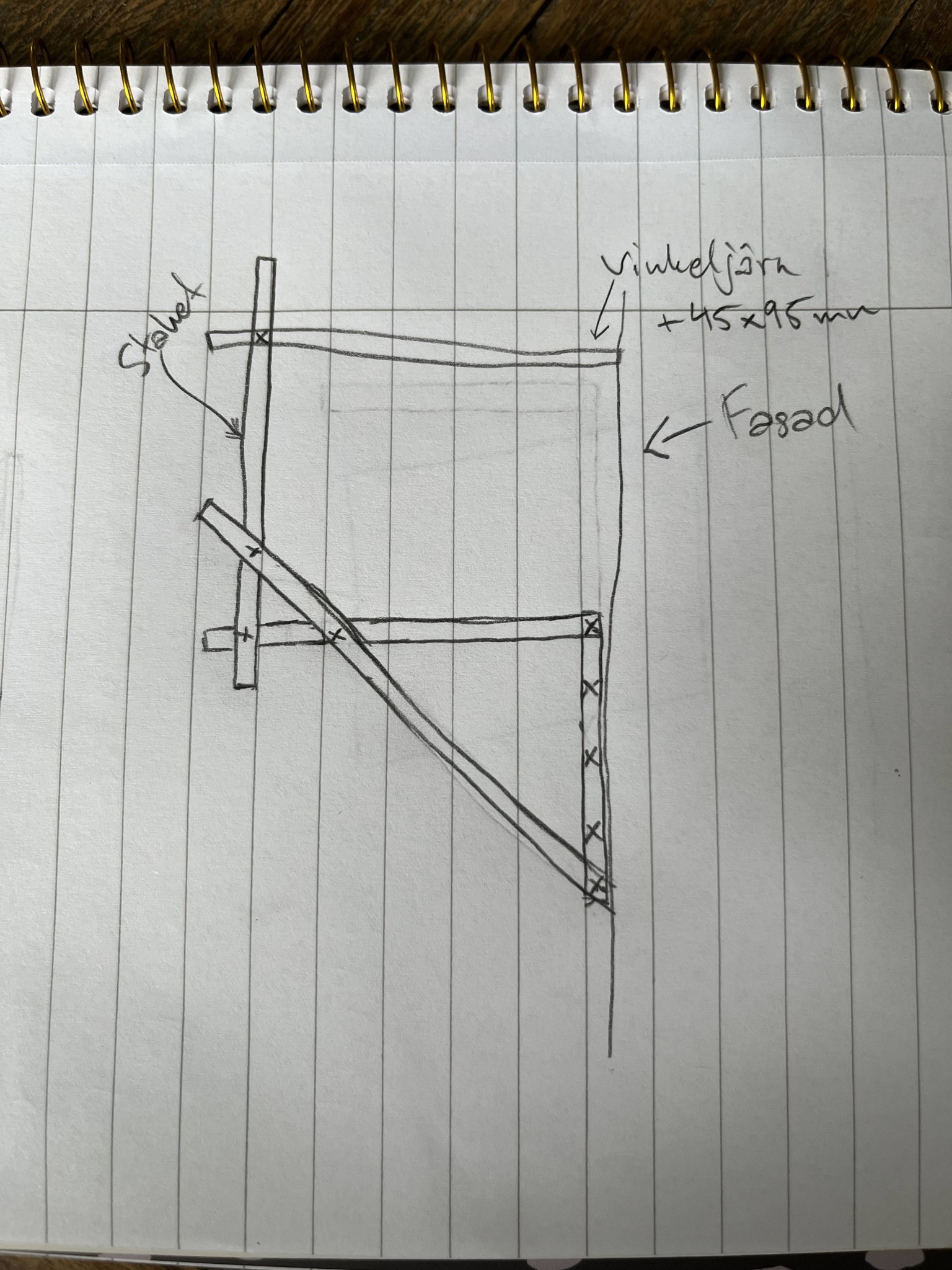
I'm not a constructor but the weight from the "shelf" goes through the support down into the ground, with your bracket the weight will end up on the facade.
Had a similar challenge at our summer house.
Used safety line and primed from above and planned to do the final layer from a lift in the fall.
Used safety line and primed from above and planned to do the final layer from a lift in the fall.
Quick googling shows that 45x95 weighs kg/m, and I guess the platform should be 45x195, which weighs 4kg/m. The weight for the platform will be about 80 kg, then you and the material should be added.M Marcussjogren said:
I would load test before.

How "wide" is the extension and how much scaffolding do you have?M Marcussjogren said:
I would build a scaffolding tower on each side and bridge over the extension - possibly with one or more feet on the extension's roof if it is wider than 3 meters.
M
Marcussjogren
Member
· Västra Götaland
· 3 083 posts
Marcussjogren
Member
- Västra Götaland
- 3,083 posts
45x95 is the standard dimension for building large wooden structures, so building with 45x195 might feel excessive.T Tjorven2021 said:
M
Marcussjogren
Member
· Västra Götaland
· 3 083 posts
Marcussjogren
Member
- Västra Götaland
- 3,083 posts
it's about 410cm "gutter-to-gutter", otherwise I would have built a Haki with 4m length beams over the extension.C cpalm said:
The problem is that I don't have much scaffolding, I only have two 3-meter Haki sections (3x6m) and maybe some extra parts to borrow from a neighbor, but not more than that

M
Marcussjogren
Member
· Västra Götaland
· 3 083 posts
Marcussjogren
Member
- Västra Götaland
- 3,083 posts
missed this, but yes, that's obviously how it will be. This is, by the way, a log house, so with sufficiently long screws, one should achieve support in that part.T Tjorven2021 said: