
10,079 views ·
6 replies
10k views
6 replies
Rotten "Skirt Board" outside the sill
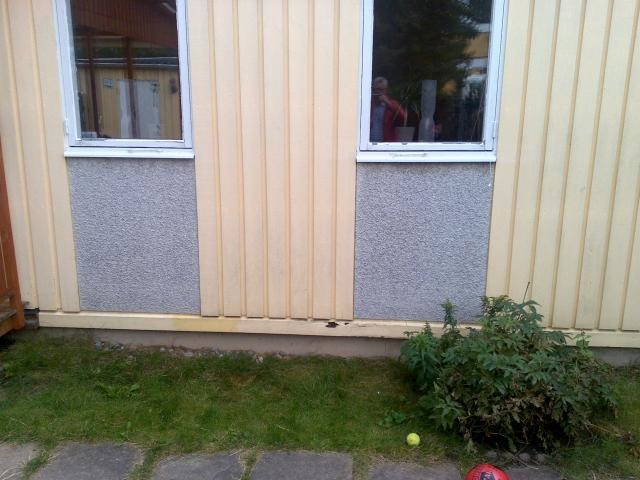
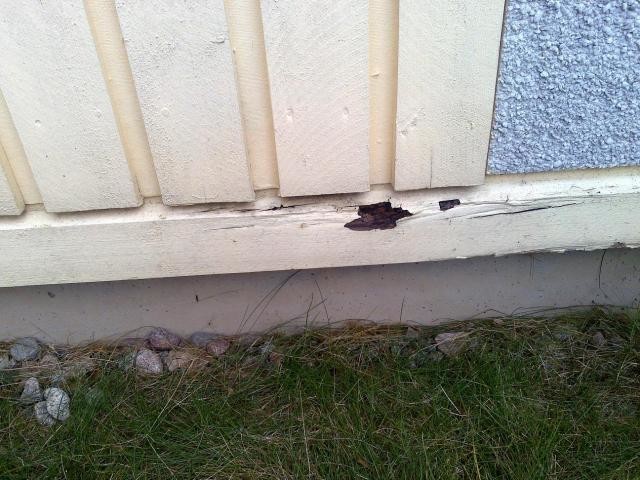
My daughter has a house with a so-called "offerbräda" (see the image) at the bottom where the panel ends. Inside it is a sill that goes up about 8 cm. The "offerbräda" has a piece of wood on the back that goes up under the panel and the masonite. The wall is probably prefab and the studs are located inside the "asfaboard", i.e., the panel is directly against the board. Now, the "offerbräda" is rotted in certain places on two sides of the house. I think it seems to be nailed from the front into the sill.
We are thinking of replacing these boards and have a few questions about this if anyone has experience with this type of walls:
1. What function does this kind of "offerstock" serve? Does it carry anything, or can it just be replaced?
2. If you pull out the nails from the front, can you just wiggle the board loose from the wall downwards, i.e., do you think the panel also needs to be loosened?
3. We are thinking of replacing the piece of wood on the back of the "offerbräda" with a metal flashing (drip edge) that will slide under the panel and the masonite and then cover the new "offerbräda". Does this sound like an okay solution that will work?
4. What should be put in place of the old "offerbräda"? Does it need to extend outside the panel? Can pressure-treated wood be used, and if so, when can it be painted?
Best regards,
Per-Åke
We are thinking of replacing these boards and have a few questions about this if anyone has experience with this type of walls:
1. What function does this kind of "offerstock" serve? Does it carry anything, or can it just be replaced?
2. If you pull out the nails from the front, can you just wiggle the board loose from the wall downwards, i.e., do you think the panel also needs to be loosened?
3. We are thinking of replacing the piece of wood on the back of the "offerbräda" with a metal flashing (drip edge) that will slide under the panel and the masonite and then cover the new "offerbräda". Does this sound like an okay solution that will work?
4. What should be put in place of the old "offerbräda"? Does it need to extend outside the panel? Can pressure-treated wood be used, and if so, when can it be painted?
Best regards,
Per-Åke
Now I can only speak for myself. We have a house from 1924 and we have just replaced the facade and restored it, put on a new one what you call offerbräda.
We did it as they did in -24 (we had the original facade left under the asbestos cement) and that board is put on first and nailed into the sill, at an angle from above with "svinlånga" nails. On top of that, you can nail a possible frame for insulation, above that nail battens then the facade boards and finally the covers.
In our case, it requires a large effort to replace it.
Function: By having such an offerbräda on a wooden facade where bottom boards and covers are beveled, you avoid end grain. If done carefully, the facade becomes completely tight at the bottom. Additionally, it acts as a "roof" for the basement windows, some protection for the foundation, etc.
On your house, I don't know at all what its function is other than possibly protecting the sill. Our entire facade is bevel-cut at 20 degrees.
We did it as they did in -24 (we had the original facade left under the asbestos cement) and that board is put on first and nailed into the sill, at an angle from above with "svinlånga" nails. On top of that, you can nail a possible frame for insulation, above that nail battens then the facade boards and finally the covers.
In our case, it requires a large effort to replace it.
Function: By having such an offerbräda on a wooden facade where bottom boards and covers are beveled, you avoid end grain. If done carefully, the facade becomes completely tight at the bottom. Additionally, it acts as a "roof" for the basement windows, some protection for the foundation, etc.
On your house, I don't know at all what its function is other than possibly protecting the sill. Our entire facade is bevel-cut at 20 degrees.

Member
· Västernorrland
· 97 posts
If you have the opportunity, buy the latest issue of Gör Det Själv. They have an article about sacrificial boards.
Thanks for the tips. We might do as in the Gör det själv magazine. It was quite easy to get rid of the old "offerbrädor". Just pull out the nails (long ones) and then pull the board downwards. We might plane the "offerbrädor" with an electric planer so that they become slanted. The panel is already bevel-sawed.
Do not use pressure-treated, it absorbs water that migrates further inward.
Now I understand that it should not be pressure-treated wood and not a sheet metal above. What I understand is that it's called "offerbräda" because it's the one that should be affected first so that you notice it before the sill gets damaged.
Thanks for all the help
Thanks for all the help
Eventually, we found a panel board that we think can replace the old sacrificial board well. It has a "flärp" at the top that goes under the panel and covers the sill well. Additionally, the part under the vertical panel is automatically "beveled," as that's how the panel is designed. This panel board is a bit thinner, but that's probably a good thing since the water runs off it instead of collecting on it. This is also a "sacrificial board" that should be monitored, i.e., if it starts rotting, it should be replaced quickly, as it is meant to protect the sill. The sacrificial board takes the hit instead of the sill. Therefore, the sacrificial board can't be of too high quality so that it lasts while the sill behind it rots. Here are a few questions:
1. Have I understood the function of the sacrificial board correctly?
2. Is there anything negative about the new sacrificial board not being as thick?
3. How far below the sill should the new sacrificial board go to offer good protection? This one goes about 1 cm below.
4. Should one take the opportunity to oil the visible part of the sill with primer oil?
5. Do you think a metal strip should be added to the underside of the sacrificial board that sticks out under it and prevents water from running towards the sill?
Thankful for answers
1. Have I understood the function of the sacrificial board correctly?
2. Is there anything negative about the new sacrificial board not being as thick?
3. How far below the sill should the new sacrificial board go to offer good protection? This one goes about 1 cm below.
4. Should one take the opportunity to oil the visible part of the sill with primer oil?
5. Do you think a metal strip should be added to the underside of the sacrificial board that sticks out under it and prevents water from running towards the sill?
Thankful for answers
Last edited:
Click here to reply