

I am going to replace the subfloor in our upstairs hallway. The reason for this is that I am going to install ventilation to the downstairs and I want to replace the 23mm subfloor that is there today as it creaks and pops today. Above the subfloor there will be oak parquet, the new subfloor is 21mm pine.
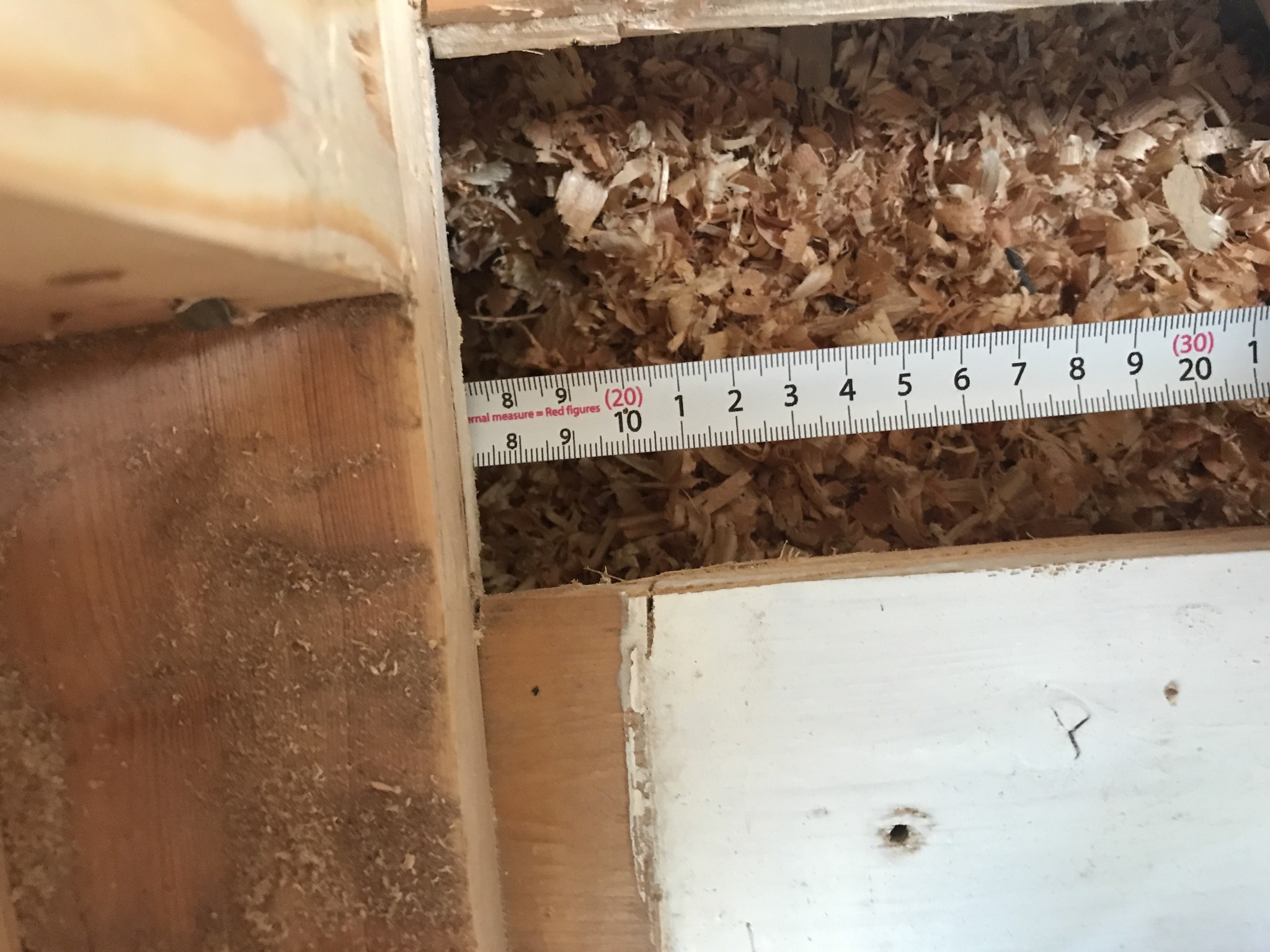
Now to my problem which I hope to get help with. When I sawed up some planks to examine how the joists are set, I discovered that the floor tiles extend 7-8 cm under the part I haven't sawed. My thought is to glue and screw a glued laminated timber post of 90/90 or alternatively 115/115 to the joist and then lay the new subfloor above the laminated timber post.
But if I choose 90/90, there is only 1 cm to fasten the new floor to. In the doorways, I get an additional 2-3 cm to lay the floor on. Which is about 2/3 of the length.
Would it work with a 90/90, or should I take a 115/115? The price of the glue-laminated timber doesn't matter.
Or am I off base and this will never work out?
Now to my problem which I hope to get help with. When I sawed up some planks to examine how the joists are set, I discovered that the floor tiles extend 7-8 cm under the part I haven't sawed. My thought is to glue and screw a glued laminated timber post of 90/90 or alternatively 115/115 to the joist and then lay the new subfloor above the laminated timber post.
But if I choose 90/90, there is only 1 cm to fasten the new floor to. In the doorways, I get an additional 2-3 cm to lay the floor on. Which is about 2/3 of the length.
Would it work with a 90/90, or should I take a 115/115? The price of the glue-laminated timber doesn't matter.
Or am I off base and this will never work out?
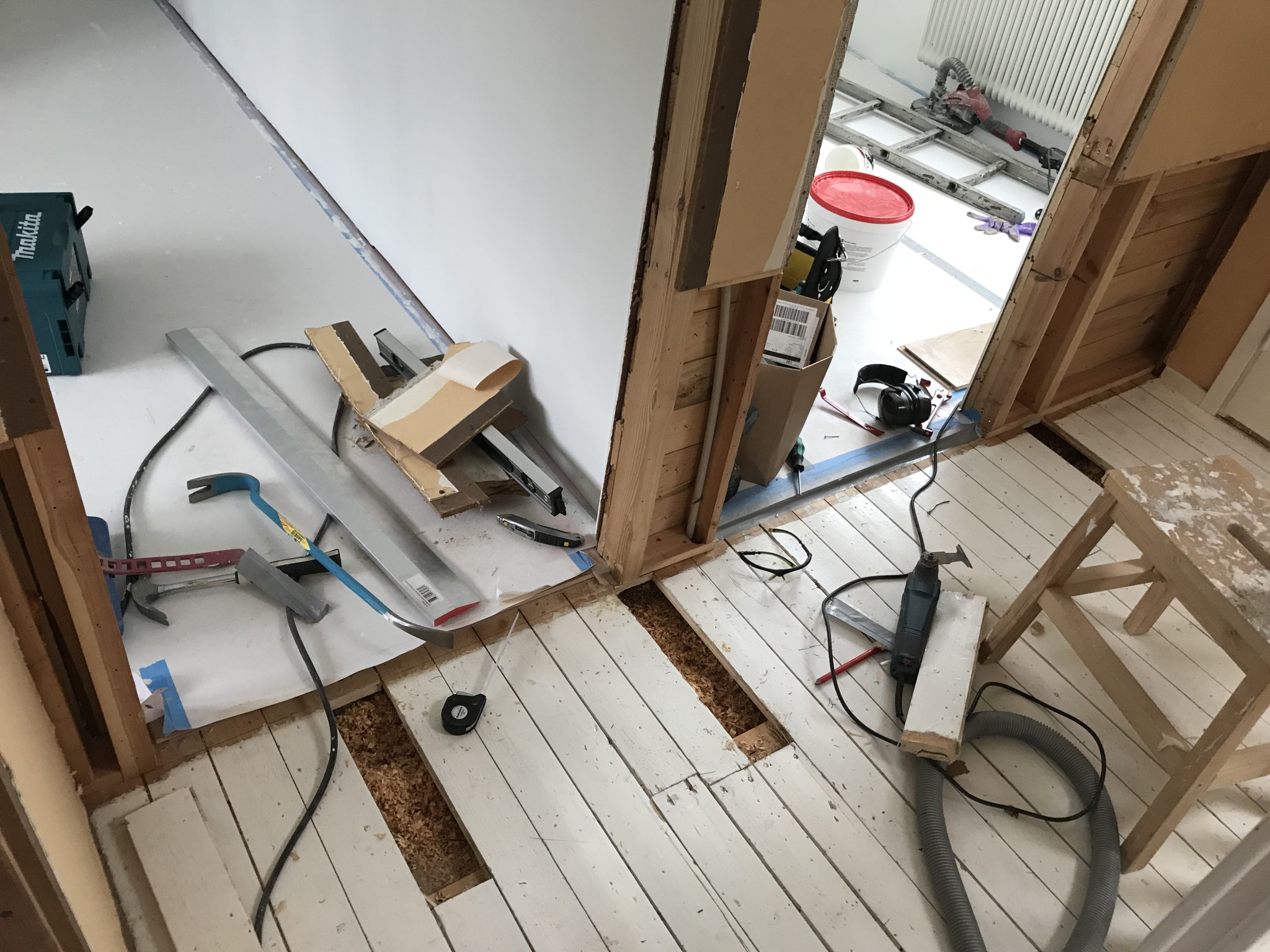

So you're thinking of attaching the post on top of the beam that the wall stands on? Wouldn't it be easier to install a new floor joist that attaches in the same way as the others?

The house is 1.5 stories, and unfortunately, I cannot access to attach new floor joists. The only solution I can think of is to screw-glue a laminated wooden post onto the existing floor joist.
Don't you think it will work?
Don't you think it will work?
If you are going to fasten something, I think it should have the same dimensions in height as the existing floor joists. Glulam posts become very difficult to handle. However, I cannot understand why it wouldn't be possible to insert an extra floor joist resting on the same interior walls on the ground floor as the existing ones. If you have a floor plan, post it.
If you can access to set your post, you should also be able to set a floor joist in the compartment too, right? If not, you could cross-brace between existing joists and hang the new one in the cross-braces.
It is the space on the upper floor labeled as a hall that I am working in. And the wall facing the bedrooms. In the slot, I need to run two 100mm ventilation ducts and a 20mm flex conduit. So it will be difficult to notch. The slot is 350mm wide, measured from where the wall ends. I might be able to place a stud at one end of the main wall, but I think it will be very difficult to get it in place. I don't want to remove the floor in the walk-in closet on the upper floor; apart from the door and frame, it is completely newly renovated.
Edit: found better images of the floor plan.
Edit: found better images of the floor plan.
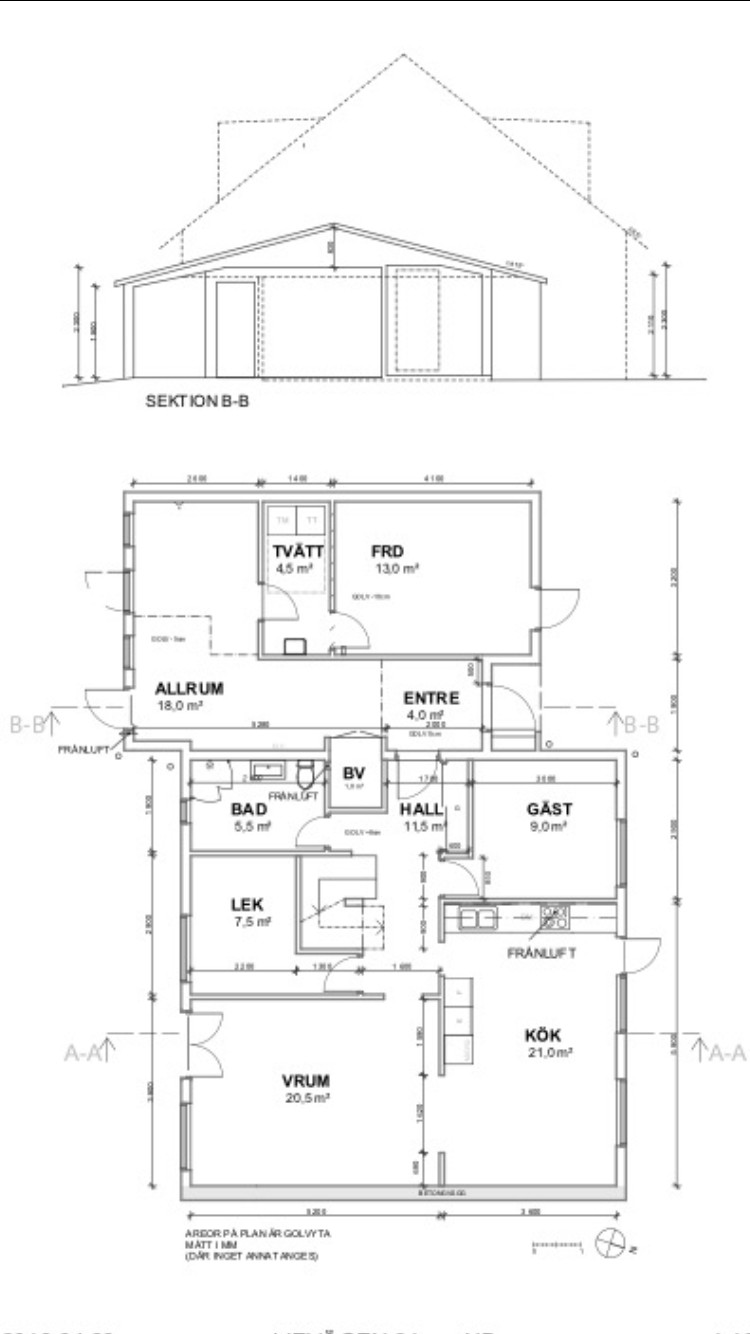
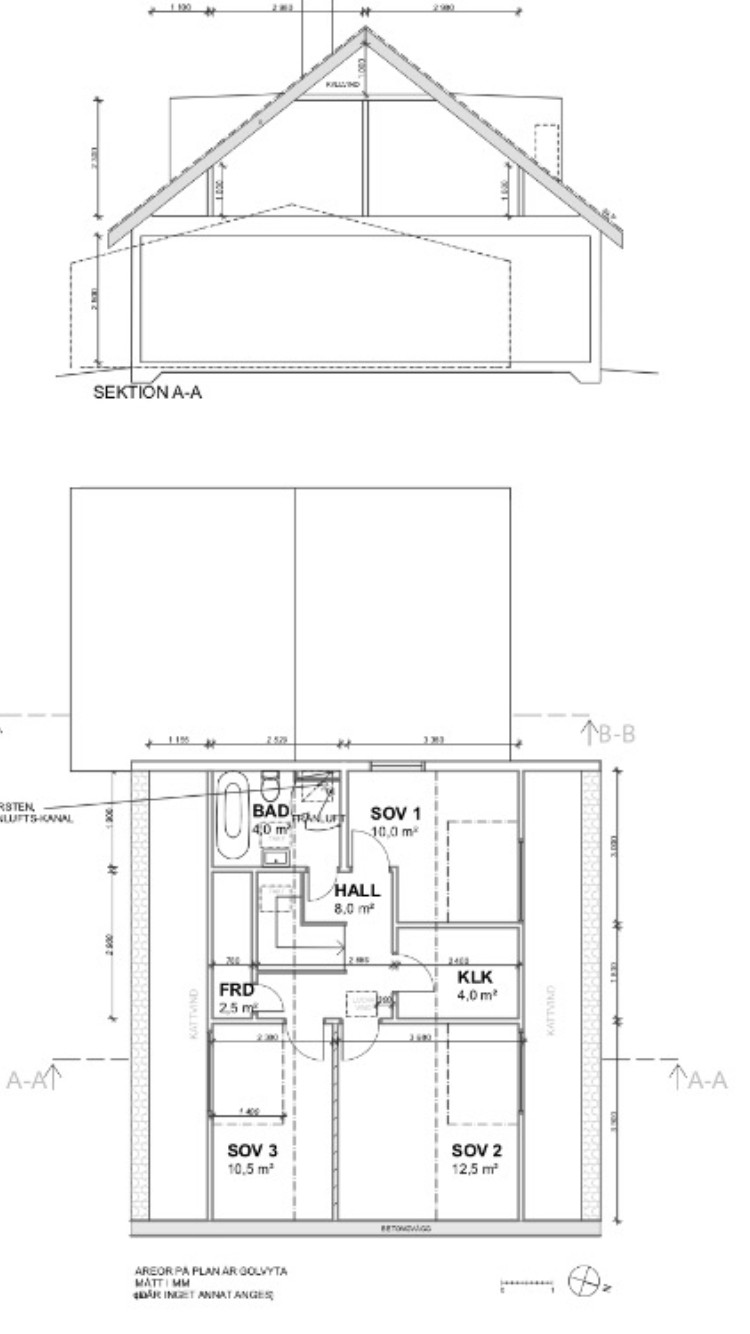
Last edited:
Without knowing all the conditions, your suggestion with the glulam post sounded a bit cumbersome, but it surely works. Tough to work with such "wide joists."
You mention a 10 mm support for the floor with a 90x90 post, which really feels on the low side, but in the picture, it looks more like closer to 20 mm, which I think feels more acceptable.
You mention a 10 mm support for the floor with a 90x90 post, which really feels on the low side, but in the picture, it looks more like closer to 20 mm, which I think feels more acceptable.
One solution could be to first attach spacer blocks to the sides of the hidden floor joist and then attach an additional floor joist to these. At the ends, this extra joist needs to be hung on noggings while in the middle it should rest on the load-bearing wall!?
I am very grateful for all the input, thank you!
The layout where there are no doorways varies between 1-2 cm. To the left, it is just over 1 cm, to the right it is 2 cm. The partition wall would end up at one end of the new floor joist. And there would be a long distance between the noggins due to the ventilation ducts.
My current thought is to place a 90*90 glulam post. And try to preserve the existing floor to the right in the image. There would be a small support if I tear up the floor. Since that floor only leads to an attic storage, we rarely go there. So it doesn't matter much if the floor creaks. In the doorways, I get about 4 cm support if I saw up the floor more in the doorways. If there is only 1 cm of support where the floor meets the bedroom wall, I will add an additional C24 stud right there.
I was thinking of using the following glue and screw for gluing/screwing?
The layout where there are no doorways varies between 1-2 cm. To the left, it is just over 1 cm, to the right it is 2 cm. The partition wall would end up at one end of the new floor joist. And there would be a long distance between the noggins due to the ventilation ducts.
My current thought is to place a 90*90 glulam post. And try to preserve the existing floor to the right in the image. There would be a small support if I tear up the floor. Since that floor only leads to an attic storage, we rarely go there. So it doesn't matter much if the floor creaks. In the doorways, I get about 4 cm support if I saw up the floor more in the doorways. If there is only 1 cm of support where the floor meets the bedroom wall, I will add an additional C24 stud right there.
I was thinking of using the following glue and screw for gluing/screwing?


Click here to reply