
Member
· Västernorrland
· 12 096 posts
must be easier to cut to wood and fill with and then apply drywall ....
Nah, I'm not sure if I agree... do you mean timber then plasterboard or timber then plaster?S Stefan1972 said:
Timber and plaster feel like a bad construction; the wood will shrink, etc.
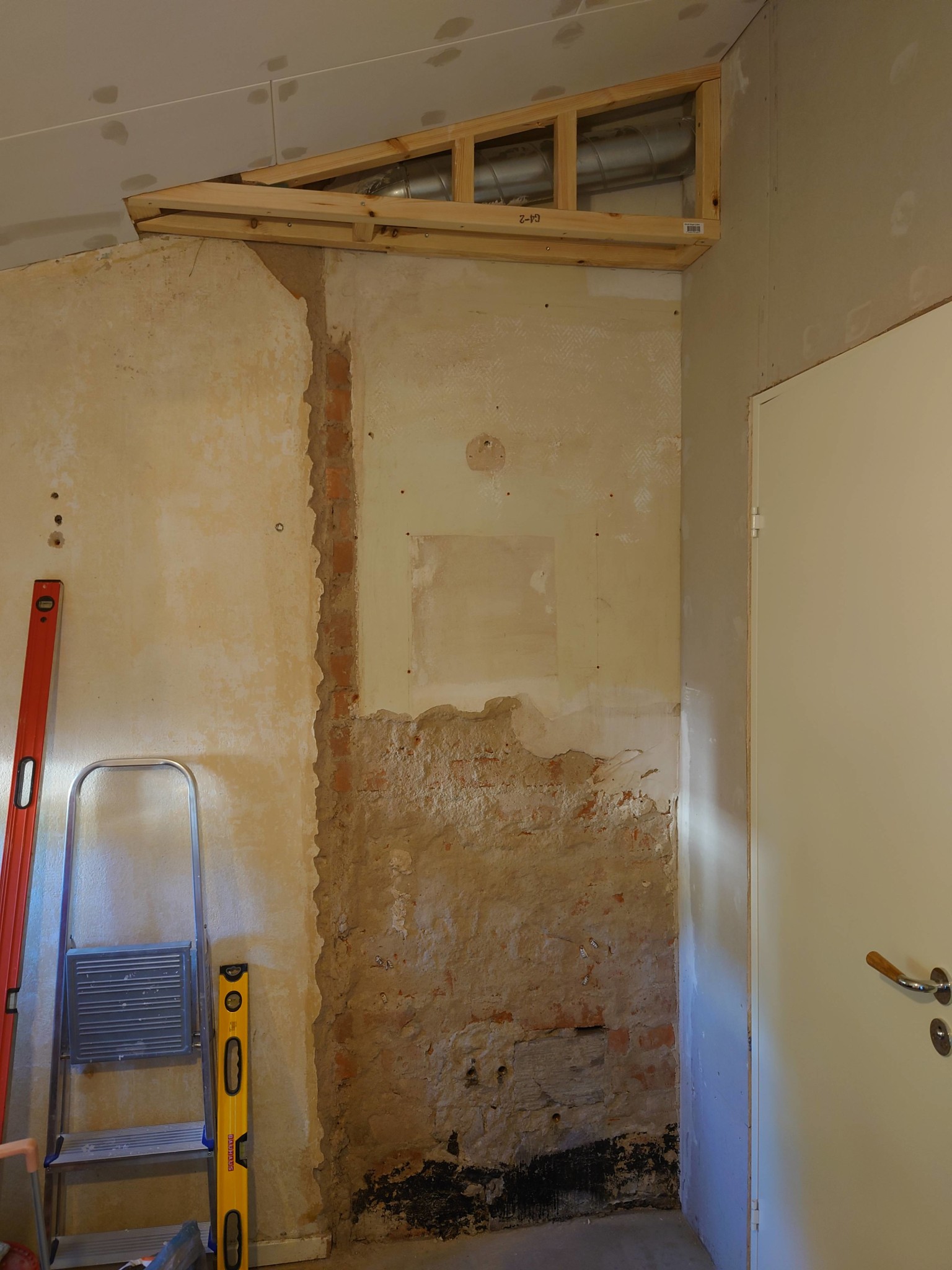
Timber and plasterboard would be quite tricky since the wall is very uneven, and would still need to finish with a solid layer of filler or plaster to blend it with the wall next to it.
Overall, it feels more appropriate to fill up with plaster/render to create a homogeneous surface between the old and new. If I mix in other materials in between, it seems doomed to crack at the joint over time.
Member
· Västernorrland
· 12 096 posts
I mean to cut the studs so that you align the wall with the one on the left and then put drywall over the entire wall afterwards.
It's just a matter of holding a stud across and then measuring how the wedges should be. Three should be enough.
It's just a matter of holding a stud across and then measuring how the wedges should be. Three should be enough.
As long as you follow advice on how thick an application you can make and adhere to the tolerances for the amount of water in relation to the plaster, it's not necessary. You should be able to apply the gypsum plaster and it should stay there without any tendency to run downwards. If you go by feel and accidentally add a little too much water, the mixture might show a tendency to move slightly downward, but as long as you have good adhesion, you can trim off any bulging with a putty knife when the plaster starts to set. A normally mixed plaster should otherwise hold up.
However, if you are going to fill in the entire area and the average depth is quite large, a lot of plaster will be needed... On larger areas with a large depth, it can be beneficial to fill up with blocks that take up volume. For example, if you have an area with a 5 cm depth, by glueing (with gypsum plaster) lightweight concrete blocks that are 3 cm thick, you can significantly ease the process and reduce the volume of plaster needed afterwards.
Not that you necessarily need it, but a plaster net facilitates the application. If your greatest thickness is at the floor, for example, you can place the plaster net there with some distance from the substrate, and at the top, attach it directly to the surface.
Gypsum, as previously mentioned, obviously has its advantages, but the disadvantage is definitely the risk of cracking between the two different materials on the wall over the seasons.
However, if you are going to fill in the entire area and the average depth is quite large, a lot of plaster will be needed... On larger areas with a large depth, it can be beneficial to fill up with blocks that take up volume. For example, if you have an area with a 5 cm depth, by glueing (with gypsum plaster) lightweight concrete blocks that are 3 cm thick, you can significantly ease the process and reduce the volume of plaster needed afterwards.
Not that you necessarily need it, but a plaster net facilitates the application. If your greatest thickness is at the floor, for example, you can place the plaster net there with some distance from the substrate, and at the top, attach it directly to the surface.
Gypsum, as previously mentioned, obviously has its advantages, but the disadvantage is definitely the risk of cracking between the two different materials on the wall over the seasons.
Click here to reply