The OSB boards reduce sound insulation, use only fibergips.
OSB reduces sound insulation compared to if the board had instead been made of plaster. Naturally, OSB increases sound insulation if placed behind an otherwise solitary plasterboard
Doesn't it improve to stuff twice as much mineral wool into the wall? That is, compressing 90mm mineral wool to 45mm thickness.
I looked a long time ago at a material that was developed solely to dampen sound as much as possible. It resembled mineral wool but packed at least 10 times as densely.
Doesn't it improve to stuff twice as much stone wool into the wall?
Good question. The reason why it's not done in an outer wall is understandable since you want a certain amount of air for thermal insulation, if I understand it correctly. But in this case, when it's an interior wall, it's not thermal insulation we're after, just soundproofing.
Maybe Björn can run his cool program again if it's possible to input that type of data?
Dense material dampens low-frequency sounds.
Less dense material dampens high-frequency sounds.
When we were trying to dampen engine noise in a garage, fire insulation (densely packed mineral wool) was not sufficient, so we had to use one with lower density instead.
Dense material dampens low-frequency sounds.
Less dense material dampens high-frequency sounds.
When we were supposed to dampen engine noise in a garage, fire insulation (densely packed mineral wool) wasn't sufficient, so we had to use one with lower density instead.
Well, I think you might have simplified things a bit too much.
Also, when you write "supposed to dampen engine noise in a garage," I wonder if you mean transmission dampening or absorption. Or maybe just diffusion ...
In other words, was it the sound in adjacent spaces that should be reduced, or in the garage itself.
A soundproofing construction is never better than its weakest link. Good thing the discussion about flanking sound and floor structures came up. FG's nice images explain this well.
Acoustics is a fairly complex subject. It's not easy to explain on a forum without having to omit small but very important details.
The partition wall that TS is going to build is based on the principle MASS - AIR - MASS. The higher the mass in the panel material and the larger the air gap we use, the better the sound reduction (Rw). If we then decouple the masses from each other (broken floor structure), the soundproofing is further improved.
The insulation in the air gap has the function of absorbing the standing wave/resonance that forms in the air gap. Nothing else.
The insulation's ability to absorb sound depends on its flow resistivity. This varies between different materials but also at different depths in constructions. This is why you should never compress the insulation in a sound wall.
Sometimes different layers are mixed to obtain the right absorption for a given construction.
Follow-up question, what happens when building sliding door frames? There is a hole in the wall when the sliding door is closed. Can it be insulated in a smart way, or does it perhaps not matter?
It depends on how much sound reduction is needed.
In general, it can be said that it is both difficult and costly to build. The biggest problem is the sealing around (brush seals and compression of sealing strips). A sliding door can never be as sealed as a hinged door.
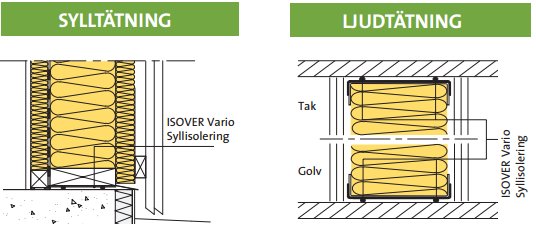
I was told by a builder that you can put some kind of rubber insulation between sills and wall/ceiling/floor. I guess it's one of these then: http://www.isover.se/produkter/produktvisning?id=20745 Meaning sill insulation. Looking at the PDF brochure, they call it "sill sealing" when you have wooden studs (which I plan to have) while in the example for "soundproofing" they use metal studs. If I'm interpreting the images correctly. But it should provide good sound insulation even with wooden studs. Does anyone have experience with this type of sill insulation?
Sill and top plate should always be sealed with a flexible sealant in a soundproof construction, regardless of whether it is a metal or wood framing construction. It must be completely airtight.
If spacers are used, there are those with ready-made sill seals. If the subfloor is even, these work fine. Those for sound walls have rubber strips. There are also spacers that have sill sealing made of foam plastic with an open cell structure, but these do not seal as well in these contexts.
Do you mean you should use soft sealant (silicone) together with the sill sealing?
And what do you mean by 'utlägg'?
/Curious...
Yes, the gap between the floor and the sill must be sealed. This is done with a soft sealant that remains elastic over time, e.g., Sikacryl or similar. Utlägg (plåtregelsyll) comes with ready sill sealing. If you are building a simple sound wall at home, the one with round rubber strips is preferable over the one with foam.
Hmm, now I almost understand...
What do you mean by "the one with round rubber seals"? Is it like the jam seal I linked to earlier?
And do you mean in that case that you use Sikacryl in combination with the rubber seal?
I thought that maybe either some latex/silicone solution or rubber seal would suffice.
You learn a lot here...
Click here to reply
Vi vill skicka notiser för ämnen du bevakar och händelser som berör dig.